Baptism of Blood

The Sixth North Carolina at 1st Manassas 
 

Researched and written by Historian Frederick Walton

Copyright © 2001, 2023 By Frederick Walton

Confederate troops boarding the train at Piedmont Station en route to Manassas

It was not too many years ago that any schoolboy or girl could have told you the story of the battle of 1st Manassas. Even a child could see the irony of the southern citizen soldiers  who gathered on the plains of Manassas with their faces toward an invading northern army and their backs to the  homes and hearths that they vowed to protect. This is a classic David and Goliath story, right against might, a story of how stout-hearted Confederates, against overwhelming odds were able to turn the tables on an over-confident enemy and send them running back to Washington, D.C. in a panic stricken and confused  rout.

But, there is another story to be told within the context of this larger tale. The story of the only North Carolina Regiment in the fight that day. The story of  brothers fighting with brothers against a common enemy. The story of how fate took these North Carolinians from their post in the Shenandoah Valley to the left of the beleaguered Confederate line at just the right moment to save Stonewall’s legendary counter charge from certain destruction under the unseen guns of a lone Federal Battery waiting on their flank.

Many of the young men from North Carolina never returned home from this moment of glory, and history has overlooked their critical contribution to the pivotal event of the battle. This is a story to commemorate the sacrifices of those brave North Carolinians so long ago.       

 Levi Festerman awoke with a start as the laboring steam engine lurched around a bend. His fitful sleep was disturbed once again as he clung to the roof of the rattling car until his fingers tingled with numbness. Last night's excitement, when finally boarding the train for the battlefront, was now a distant, weary memory. The exhausted soldiers inside the train began to feel crushed and claustrophobic as the hot, muggy air seemed to press in on their crowded compartment. On top of the train, windblown soldiers held on for dear life as the rickety train hurtled through the darkness into the unknown. In the ensuing silence, as even the more boisterous fell silent, terror began to invade the thoughts of the citizen soldiers. They recalled tales they had heard about loyal unionists who had been known to put obstructions on the rails that could send the precariously perched soldiers to their deaths. 

 Sparks from the locomotive streaked brightly through the darkness, masking imagined bushwhackers around every bend. The night sounds were lost to the clicking of the rails and the roar of the engine. The crowded roof constantly shifted as the train bucked and lurched. Hot embers from the engine stung as they flew into Levi's face, burning little holes in his new uniform. The early morning wind was surprisingly cool.  

The men had eagerly boarded the train about 7 p.m. on the 20th of July 1861, excited about the prospect of going to Manassas junction and being part of the big fight commencing there. After an exhausting forced march left them worn out and hungry, they had been waiting all day to board the cars. In her diary, Ida Powell Delaney recorded the scene at Piedmont Station: 

"The many soldiers scattered about in groups, sleeping, cooking, eating and talking, waiting for the cars to take them to meet the enemy, seemed like sheep gathered for the slaughter, and my heart ached to look at them." 

But the men, although tired and hungry, shared no such thoughts. They felt more like caged animals worried about their prospects of getting to Manassas before the battle was over and the South won the "war" without them.  
 
For the Sixth North Carolina State Troops, a train derailment that afternoon was a blessing in disguise. The Colonel, Charles F. Fisher, was the president of the North Carolina railroad, and many of his men were former railroad workers he had recruited when he formed the regiment. He volunteered the know-how of these railroad men to set the train back on the track. It’s not known if he made their immediate passage a part of the bargain, but  their hard labor was rewarded by jumping ahead of the other troops waiting and getting on the very cars they righted.  Some of the tired men including Levi Festerman of company G, climbed on top of the cars while others pushed into the stuffy, crowded interior.  An air of excitement and jubilation prevailed as the young men were finally off to war…and glory. 

Early the next morning Levi focused his weary eyes on the eastern horizon. The light from the rising sun streaked across the gray dawn sky. Without even thinking about it, a lifetime of farming permitted him to read the weather and told him this would be another hot day. 
 
Miles away, on the Northern side of the Bull Run, Federal troops, who had been awakened at 2:00 a.m., wearily marched into position as they approached the Confederate picket lines. They were store clerks and salesmen who had responded to Lincoln's call to suppress the rebellion. Their commander, General Irwin McDowell, was not yet confident of their abilities and only sent them toward the Confederates upon the urging of the President, Abraham Lincoln. When McDowell complained that his troops were inexperienced and needed more time for training, his superior, General Scott, responded by reminding him: 
"You are green, it is true, but they are green also; you are all green alike." 
 General Winfield Scott Circa 1862
(LOC LOT 14043-2, no. 914 [P&P])

McDowell’s plan was simple. Send a diversionary force to demonstrate near the Stone Bridge, the logical approach to Manassas from his stronghold at Centerville, while sending his main body far to the right around the Confederate flank, crossing the Bull Run upstream at the unprotected Sudley ford. 

At 6:00 a.m. a monstrous thirty-pounder Parrot rifle of Federal General Tyler’s Brigade belched forth three missiles from a protected place half a mile away from the Stone Bridge, on the Warrenton turnpike, indicating the beginning of the battle. One of these shells, aimed at a signal station, knocked down the tent of young E. Porter Alexander. Perched high in the air on his makeshift tower, he trained his glass toward the Stone Bridge to observe the activity there. As they continued firing, the Federals were frustrated by the fact that the Confederates neither ran off in terror nor betrayed their position on the opposite bank of the Bull Run. Around 8:30 a.m., Alexander's well trained eyes noticed a momentary flash in the distance. It was the early morning sunlight flashing off a polished brass cannon barrel. Later recalling it as "indescribably quick", it drew his attention to Sudley ford, some eight miles distant from the signal station, where he noticed "the glitter of bayonets all along a road crossing the valley". He realized McDowell's plan and quickly signaled Colonel Evans, at the left end of the Confederate line to "look out for your left, you are flanked", spoiling the Federal's element of surprise. Evans moved a portion of his force to meet the Yankee threat on the flank and was soon engaged in a battle on Matthew's hill that would last all morning, drawing Confederate manpower away from General P. T. G. Beauregard's carefully placed defenses. Beauregard had spent the last month meticulously planning this battle and it was already off to a disastrous start.  

General Joseph E. Johnston

The Sixth North Carolina was still many miles distant as the battle commenced. Between the violent lurching of the train and the frequent stops for fuel, water and maintenance it seemed like they would never arrive. As they drew near the junction at Manassas they could hear the booming rumble of artillery and the muffled, far off crackling of musketry fire. On the horizon, great clouds of smoke and dust boiled over the treetops marking the fierce battle being fought below. 

Their journey really began several weeks before when they left the training grounds in Richmond, where President Davis himself had come out to review them. They boarded cars north to Manassas Junction and then Piedmont station, marching the final 18 miles to Winchester.  They were joining General Joseph E. Johnston's army of the Shenandoah and were brigaded under General Bernard Bee. Lt. Willie P. Mangum of company B recalled: 
"We all suffered much from fatigue and want of food and the bad weather. But soldiers must become accustomed to privations." 
This would be the beginning of four years of privations for many of the men. Others would not live beyond this battle.
 
General Pierre Gustave Toutant-Beauregard

On the evening of July 18th General Joseph E. Johnston had personally spoken to the regiment, telling them they were going to Manassas to help General Beauregard, who was under attack by the Yankees.  The enthusiastic and untested  young men responded with a loud and lusty cheer. They were soon on the march, retracing their steps of a few days before, back to Piedmont station. Amanda Virginia Edwards watched the dusty columns passing by Belle Grove near Paris, Virginia.

 "Our dear, worn, fatigued soldiers. O! What is it that we wouldn't do for them. Regiment after Regiment pass by... "Dixie" is the national and favorite air. Many are singing, laughing and chatting in perfectly good spirits, just ready and willing for a fight. You never suppose that an idea of getting killed ever entered their heads. Poor creatures-- how many will march to their graves. Some are dear little boys between fifteen and sixteen years old and others are grey headed." 

Now that they had finally arrived, their help was desperately needed. It was about sunrise when they finally got off the trains. They marched four miles, toward the Lewis house and the sounds of the battle already under way. Captain York wrote to the North Carolina Standard after the battle that the terrible cannonading "nerved every arm, brightened every eye and quickened every step." The regiment had been without food and had little sleep for over thirty hours. When a spring was reached the companies were filed left and allowed to fill their canteens. Twenty three year old Levi and many of his tired comrades sunk down in the cool  shadows of the surrounding grove and promptly fell asleep while their pards replenished their canteens. One account indicates that they were halted and "drilled in the manual" for an hour,  before continuing their march to the battlefield. Most accounts place their time of arrival on the battlefield at about 2:00 P.M. Colonel Fisher pushed on ahead going to the Lewis house to meet General Johnston and receive his orders. The tired men of the Sixth were ordered to "load" and then fell out under cover of a hill behind the line of Confederate guns near the Lewis house, "Portici", being used by Johnston as his headquarters. Many of them promptly fell asleep on their loaded arms, even with the sound of the battle exploding all around  them. Missiles whizzed through the trees above their heads, sending limbs and leaves fluttering into their midst. Deprived of sleep for three days, the men barely moved. 

The Lewis House Portici (LOC LC-DIG-ppmsca-20479.jpg)

Suddenly a "slug" from a rifled cannon came tumbling into the ranks parting Captain Craig's  G company. Another struck Colonel Fisher's Horse, slightly injuring  it. Wounded Confederates began appearing from the battlefield, staggering toward the rear. The eager young lads of the Sixth regiment were seeing the bloody result of the fighting, their first glimpse of war, real war. This was no longer a fanciful, storybook daydream. They were no longer chivalrous knights in long plumed hats. Men were dying this day.  Lieutenant (later Captain) Ray, from Company D, recalled seeing wounded men coming through the ranks and wrote 
"some of our men were so unsoldierly as to envy those who had escaped with only such slight wounds as would give them a furlough" 


Colonel Fisher

Colonel Fisher ordered the gawking boys into line, knowing he might lose control  of his frightened green troops if he didn't act quickly. What happened next, while not precisely clear, was reported on by dozens of eyewitnesses in letters, newspapers and memoirs.  
Lieutenant (later Captain) B. F. White, of company F,  recalled  
"Lieutenant-Colonel  Lightfoot requested Major R. F. Webb to ask, for him, the privilege of putting the regiment in line of battle, as Colonel Fisher had not drilled the regiment and was incompetent to do it, and further that Colonel Fisher and himself were not on good terms" 
 Colonel Fisher refused this request and ordered the regiment forward, hurrying toward the threatened left of the Confederate line.  
After a mid-day  lull in the battle, McDowell had ordered  Rickett's battery to the top of Henry hill where they quickly became engaged in an "exceedingly hot" dual with the Washington Artillery and other Confederate batteries, firmly planted on the opposite crest.  General Thomas J. Jackson, about to earn his nickname, "Stonewall", was calmly moving fresh troops of infantry into position behind the booming artillery.

 On the left of the Federal line, Griffin's Battery limbered up its two howitzers and galloped furiously behind Rickett's guns to "a less exposed" position. Reaching the Sudley road  he turned left , went down the road a short distance and then abruptly turned left again, reentering the field looking down the flank of the Confederate Guns. 

Griffin's Battery at Manassas Battlefield (Photo by Frederick Walton)

Nearby, the 33rd Virginia watched in amazement as the Federal gunners unlimbered and boldly set about their deadly business, seemingly unconcerned that the blue clad Confederates were massing nearby. Mistaking the Virginians for their artillery support, the gunners allowed them to advance to within 40 yards before the battery fell victim to a devastating volley. 

The 14th Brooklyn, known as the red-legged devils because of the baggy red Zouave pants they wore, rushed forward through the retreating artillerymen and unleashed a volley into the 33rd Virginia, crumbling their line and retaking Griffin's Battery. Supported by Minnesota troops, the Zouaves continued their advance pouring volleys into the crippled flank of the Confederate left. This put the Confederate line in a precarious position.


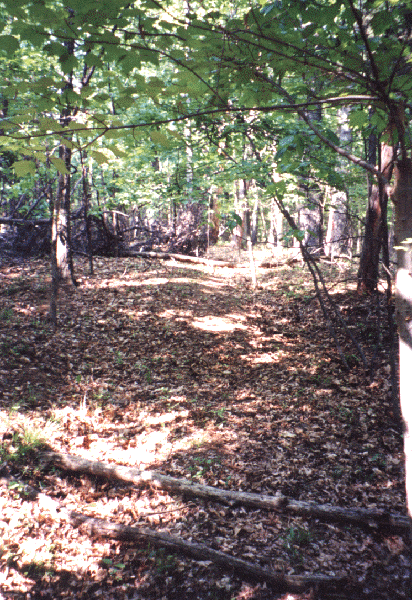
The Sixth North Carolina was close by, still moving toward the left. They had gone down a hill,  passing through some woods, before emerging into an old sedge field. They crossed a small stream, halting for a short time.  Heading toward a point to the rear of where Colonel Bartow fell earlier. A  mounted Confederate warned Fisher not to go in that direction to avoid being cut up by Yankee Cavalry. Fisher turned the Regiment abruptly left, crossed an old worm fence and passed through a thick Pine wood in the rear of the fourth Alabama, 2nd Mississippi & 2 companies of the 11th Miss. An old farm road  could be seen disappearing into the woods. Fisher turned right, again heading toward the left of the Confederate line. Following the road, keeping a thick copse of wood  to his  left, they emerged from the pines beyond the Mississippi troops. 

Remains of the Old farm Road at Manassas Battlefield Park (Photo by Frederick Walton)

When the right of the 6th North Carolina State Troops got opposite the left of the Mississippi Regiment , Captain White recalled
 "I heard distinctly one of our field officers call to Colonel Fisher, "Colonel, turn the head of your regiment this way" To this Colonel Fisher paid no attention whatever, but passed on into an angle formed by the Yankees in the Sudley road and the New York Zouaves marching to turn our left flank." 

When the left of the third company, company F, commanded by 1st Lt. Robert N. Carter came opposite of the Mississippi Regiment, one of the field officers yelled halt. Carter repeated the commanded and added "Right Face". Colonel Fisher was a short distance away and "called out sharply, "Who in the hell gave that command? I am the Colonel of this Regiment; follow me."" Carter corrected the command by saying "left face, Forward, March". Since no other company had halted, Co. F followed the two lead companies. "Lightfoot Remarked, "did any body ever see the like."  

With a sickening thud an unsuspecting soldier was thrown violently backward into his filemates before falling to the ground, shot in the head.  The sound of a volley  from an angle to their left echoed away,  passing  mostly  harmlessly over the heads of the surprised men. Before they could react a second and third volley came in lower and found their marks.  Captain York reported many of his injured men as being shot in the thigh. Lt. Colonel  Lightfoot was slightly wounded and according to Captain White,  
"headed toward the rear calling out "Boys, take care of yourselves"".  
Nearby, Captain Issac E. Avery's Company E had been halted directly in front of what they all believed to be Sherman's battery, only sixty  yards away. Staring down the twin dark throats of shiny brass howitzers, Captain Avery had  no time to wait for orders. Taking control of his company, he ordered his men to fire. His anxious men and others near them fired suddenly into the battery. A Thunderous volley killed most of the cannoneers as well as their horses. 
A Federal officer, thinking they were a Federal battery support, galloped up, waving his hat and calling "For Gods sake stop; you are firing on your friends". Discovering his almost fatal mistake too late, he attempted to ride off but reeled and fell as he passed the left of the adjacent Mississippi Regiment and was captured. He was Colonel Orlando B. Willcox, 1st Michigan who afterwards became a Major-General. General Clingman from North Carolina recalled that Colonel Liddell of the 11th Miss. got his horse  "and rode him for many a day". 

Another section of the Sixth had focused their fire on  the unseen riflemen to their left that were firing into their flank. Witnesses latter speculated that this may have been the 4th Alabama. As the smoke of  the unordered volley drifted over the carnage around the battery, seven of Fisher's companies ran forward firing at will. Three other companies who were not clear of the woods didn't get into the fight, although their ranks were raked with small arms fire. Witnessing this desperate charge, General Clingman later recalled that 

"The men ran down upon them and finished the survivors with their muskets and bowie knifes." 

The wide battle line became a confused mob as the flank companies focused on the battery in the center and  began a pursuit of the retreating Yankees. The momentum of the charge carried the line beyond the disabled battery toward the Sudley Road , Where it  was subjected to a heavy fire from Yankees stationed in the road and New York Zouaves, in bright red trousers, on the left. 

In the confusing melee, the Sixth was taking fire from all directions, Officers were desperately shouting for the men to stop "firing on your friends". Men fell dead and wounded across the crest of the hill. Exposed to a  raking crossfire Fisher had no other choice but to order his men to retreat, which Captain York recalled was done "with some disorder". 


 On the far right of the line, in a grove of trees, Lt. Mangum was leading his men forward when he fell stunned. A bullet had hit the bible in his breast pocket that his sister had presented him when he departed. Saving him from instant death, the bullet glanced off  "inflicting a severe, but not dangerous flesh wound". Poor medical treatment caused complications and several weeks later he died as the result of his wounds.  

(Today a marker commemorates where he fell). 

Lt. William Preston Mangum, 6th North Carolina State Troops

Marker on Manassas Battlefield (Photo By Frederick Walton)

Captain Avery recalled seeing Colonel Fisher fall  as he was rallying his men according to a report by General Clingman:

"Captain Issac Avery stated to me that while he was sitting for a moment on one of the captured pieces, he saw Colonel Fisher, who had moved forward to reconnoitre seemingly, but was waving his rifle above his head triumphantly. "

"having passed over the battery, [Fisher] received a ball in the brain and fell dead about thirty yards in the rear of the battery they had taken."

A witness reported his last words to be "fire on the battery".  He fell, shot through the head by a single bullet. After the battle there was much controversy over where the projectile originated. In the confusion of the charge, some believe it may have come from Confederates. Avery believed it came from a Massachusetts regiment wearing gray that was posted near the Sudley road. Fishers death was lamented throughout the south as that of a brave and noble patriot. The young Rowan county farm boy, Levi Festerman,  wrote to his family: 
"We had a hard time here last Sunday... Our Colonel was too brave and rushed in too strong. The Colonel hollowed hurrah Rowan boys and kept rallying them up. It is a wonder we wasn't all killed  the way we was led into it. The Colonel must have been excited the way he went on, but the poor fellow lost his life by the operation." 
Making their way to the relatively safe fringe of pine, where they launched their original attack, the surviving officers of the 6th North Carolina State Troops attempted to restore order to the tangled and confused  knot of soldiers. As a fragile line formed, Captain Avery looked across the hillside scattered with dead and wounded comrades and noticed old glory still floating over the disabled battery. Determined to claim the battery, he ordered another charge and his men went forward into the whirlwind of bullets surrounding the guns. Moving quickly, his men drove off the remaining defenders and once again took the disputed  battery. Perhaps not realizing the success of this charge, and hidden by the   smoke of the battlefield, an eyewitness reported the Sixth North Carolina being fired on by Mississippi and South Carolina Brigades as well as the Federals in their front. 

Pressured to once again leave this murderous position, The gallant Sixth was compelled to abandon the hard won guns. Guns that could have devastated the fragile Confederate line. Guns that were never fired again that day as a result of the North Carolinian's charge.  

It can not be disputed that this charge was a turning point in the battle. Had Griffin's battery gotten established in this position, it would have enfiladed the Confederate line, forcing them off Henry hill as they had been pushed off of Mathews hill during the morning battle. 

"Stonewall" Jackson may have never earner his moniker if the 6th North Carolina State Troops had not stopped Griffin's Battery from Flanking him and his Virginians.

Captain Ricketts, who was captured, told Colonel Waightsill Avery  (Captain I. E. Avery's brother) That "the position of Fisher's Regiment was such that he supposed them to be a support for his battery". He recalled that all his men were killed or wounded by the Sixth and had he a minutes time longer he might have swept the whole head of the column down. 
As Fishers men blunted the effects of Griffin's  Battery, the entire Confederate line began moving forward, pushing the remaining Federals off of Henry hill and turning what might have been a disaster for the young Confederate cause into a rout. Fishers men had done their duty well, but as they reorganized their lines in the shadows of the pines, other southern troops had moved forward, and again "captured" the disabled battery, littered with the bodies of Yankee cannoneers, North Carolinians of the Sixth regiment  and dead horses still in their harnesses, holding the caissons fast to that position. 

Members of the 6th North Carolina State Troops reenactors at  
the 140th anniversary of the battle of 1st Manassas in 2001

The Surviving members of the Sixth North Carolina State Troops moved forward in the wake of the attacking Confederate line, driving the demoralized Yankees before them, down the sloops of Henry hill, through the fields bordering the Bull Run and finally across the stone bridge toward Centerville. As the shadows grew longer, the exhausted men gave up the chase and spent the night sleeping on the vast battlefield. Hopelessly  mixed up with other Confederate troops that only hours before may have been inadvertently firing on them as they surrounded the captured battery. 

Captain B. F. White

Captain White recalled that when the Sixth finally halted for the night and roll call was taken only 125 men were present. The fast moving battle had scattered the rest. They drifted back to camp from advanced positions on the battlefield removing the concern that the regiment had been wiped out. In the end 25 men from the Sixth were killed and double that number were wounded. Private Festerman survived the battle only to be slightly wounded a week later when a gun accidentally discharged in camp. (Levi would fight with the Sixth for two more years before being wounded at Gettysburg and captured on South Mountain.) 

Colonel Charles Frederick  Fisher, a gallant leader with a  promising future, was cut down by a single minie ball.  Many of the field officers, including Avery and Lightfoot were also wounded. The Sixth North Carolina had fought valiantly in their first battle. 

Colonel Fisher Fell about where the Flag pole stands at the Manassas Battlefield Visitor Center
(photo by Frederick Walton)

The following week as newspapers across the south celebrated the great victory, a dispute arose about "who captured Sherman's battery" the accomplished and feared 'regular army' cannoneers. Various regiments claimed the honor as their own. Much newsprint was dedicated to the debate. General Clingman implored General  Johnston to set the record straight, but Johnston slyly avoided the controversy by claiming he could only share what was submitted to him by his subordinates. At this time he was more concerned with his own place in history as he struggled to publicize his leadership role which both General Beauregard and President Davis were anxious to claim as well. 

Regrettably Colonel Fisher did not live to write the account of the glorious charge and claim for the Sixth North Carolina the credit they deserved. Lt. Colonel Lightfoot, for reasons not recorded for historians, refused to submit a report. General Clingman, trying to defend North Carolina's honor many years later wrote: 

"Lt. Colonel Lightfoot "with the two rear companies, was by some means separated from the balance of the regiment ." The officers stated that while under his immediate command, as the regiment was marching forward into battle, they were separated from the other eight companies. Lightfoot, in their presence, for it was a general conversation,  complained very much of Colonel Fisher because he carried the regiment into action by the flank"  He refused  to submit a report, not having  been in the battle himself."  

 Lightfoot was an unpopular officer and was not appointed to colonel of the Sixth Regiment after Fisher's death. 

Quartermaster, Lieutenant Nathaniel E. Scales, recalled in his memoirs :

"The lieutenant colonel, Charles E. Lightfoot, would naturally have been made colonel, but although a most excellent drill officer, very popular, after the battle made many unkind remarks about Colonel Fisher, laying all the blame upon him for the loss of his own life and the men on the right.

We officers resented this and some 12 or 15 of us met one evening in my tent to talk it over. We wrote to the governor of North Carolina [Governor Henry Toole Clark], who made the appointments in the state troop regiments, and asked him to give us a North Carolina man for colonel."

Colonel Pender, A North Carolinian and already the Colonel of the 13th North Carolina Regiment was appointed as the new Colonel of the Sixth North Carolina State Troops. Lightfoot was a strict disciplinarian and in the days after the battle, the men of the Sixth struggled with a new enemy- sickness and disease, shortages of food and clothing, poor living conditions and low moral.  Lightfoot ignored the hardships being faced instead renewing his military school notions on the men who were increasingly losing their respect for the drill master. 

Colonel Pender despaired over the sickness and low moral writing:

"I never saw such long faces as when I came here. Together with sickness and misdirected discipline one never heard a good laugh of an attempt at song"

 Realizing the hatred Lightfoot was breeding, Colonel Pender reprimanded him for his pompous attitude, further alienating his second in command.

Less than a year later Lieutenant Colonel Lightfoot transferred to the 22nd North Carolina Infantry Regiment Volunteers to become its colonel.

Captain Robert F. Webb

On July 22,1861 Captain Robert F. Webb, commanding the Flat River Guards, company B wrote to Hon. W. P. Magnum, Lt. Magnum's father, informing him of his sons wounding. his closing lines clarified what the his son and the 6th regiment had accomplished:

"I can testify to his gallantry, he was one of the few who charged Sherman's battery, and took it. He was standing by me when he was shot...the guns captured by our men are not certain to be Shermans [latter shown to be Griffin's] but we took the guns!"

The North Carolina Standard had the final say in a  short editorial comment several weeks after the battle. "Who took Sherman's Battery?" read the headline.  Their claim was short and to the point. "Well we know who took Rickett's battery, Colonel Fishers North Carolinians!  Any comments?" 
  

Sources:
Clark, Walter, Histories of the several Regiments and Battalions from North Carolina in the great War 1861-'65, Wilmington, N.C.: Broadfoot PublishingCo., 1991

Davis, William C., Battle at Bull Run, Garden City, New York: Doubleday & Company, 1977

Davis, William C. and the Editors of Time-Life Books, First Blood: Fort Sumpter to Bull Run, Alexandria, Va.: Time Life Books, 1983

Hanson, Joseph Mills, Bull Run Remembers..., Chelsea, MI: BookCrafters, 1951 & 1991

Hennessy, John, The First Battle Of Manassas: An End to Innocence, July 18-21, 1861, Lynchburg, Va.: H.E. Howard, Inc., 1989

Iobst, Richard W., The Bloody Sixth: The Sixth Carolina Regiment Confederate States of America, Raleigh, N.C.: North Carolina Division of Archives and History, 1965

Jordon, Weymouth T. (editor), North Carolina Troops, 1861-65, Raleigh, N.C.: NC Dept. Of Archives and History, 1981 

McDonald, JoAnna M., "We Shall Meet Again":The First Battle of Manassas (Bull Run) July 18-21, 1861, Shippensburg, Pa.: White Mane Books, 1999 


Shanks, Thomas Henry (ed.), "The papers of Willie Person Magnum", Durham , N. C.:Christian Printing Co. (for State (N. C.) Dept of History and Archives), 1956

Warder, T. B. & Catlett, Jas. M., Battle of Youngs Branch or Manassas Plain: Fought July 21, 1861, Richmond: Enquirer Book and Job Press, 1862 (Prince William County Historical Society Reprint)

Wheeler, Richard, A Rising Thunder: From Lincoln's Election to the Battle of Bull Run: An Eyewitness History, New York: HarpersCollins Publishers Inc., 1994 


News papers and Documents


North Carolina Standard July 27; July 31; August 3; August 7; August 10, 1861 

The North Carolina Weekly State Journal, Raleigh, NC September 4, 1861 


Greensboro Daily News December 28,1921

Manassas National Battlfield Park Archives: Letter from Levi A. Festerman to parents on 7/24/61

Living History: The 158th Anniversary of the Fall of Fort Anderson

 Copyright (C) 2023 by Frederick Walton Historian and Reenactor


I climbed out of a warm, cozy bed on Saturday morning February 18, 2023 to find bright sunshine streaming in the bedroom window. Outside the temperature was a cool 40 something degrees, not nearly as warm as the 70's of the past several days. My wife chucked. It never seems to fail that on  days of a reenactment, regardless of how beautiful the preceding weather is, it would be worse that day  then any other day. No matter, The date is set and the activities are planned. I looked forward to going to my first reenactment in two years. 

I had to go bowling that morning, the last game of the season and I couldn't miss it so I was planning to travel to Fort Anderson in the afternoon. Maybe the temperature would be warmer by then.

The invitation to members of the Sixth North Carolina State Troops read "Plunging Shot and Screaming Shell: A Nighttime Bombardment" with the above  picture of an air burst and troops scrambling up the interior walls of the fort to defend it from attack. 

"As we commemorate the 158th anniversary of the fall of Fort Anderson, the night sky will come alive with a realistic reenactment of the bombardment and evacuation of the Fort. This event will be a rare opportunity to witness a heavy artillery duel."

That looked like something I wanted to do, especially since it was almost literally in my back yard. My last reenactment was January 17-19, 2020 at Fort Fisher. Then Covid and political correctness managed to shut pretty much everything off. 

Rick at Fort Fisher in January 2020

I wasn't really even sure where my reenactment gear was at this point. I spent the week before the Fort Anderson event gathering together my stuff. It was scattered in the garage, the attic, the guest bedroom closet and who knows where else. If nothing else this was a good excuse to inventory my collection and get it centralized in one place. Next was my rifle. It was looking a little shabby so I spent one afternoon stripping it down and giving it a thorough cleaning. I might even have went a little too far. It looked brand new! I hope the other reenactors wouldn't mistake me for a fresh fish.

Next I pulled out my uniform and couters. It was in the 70s that day and I was wearing shorts and sweating from moving boxes in the hot attic. Would I need the flannel long underwear? Wool gloves? Scarf? Greatcoat? It is February after all. I figured I'd throw them in the car just in case.

At some point my bayonet and cap box got removed from my belt and that took me the better part of an hour to get them put back on correctly. When was the last time you put your bayonet scabbard on your belt? The first three attempts are ALWAYS wrong. It ends up facing backwards or on the wrong side. And do you think I could remember which was the right side? Or find a picture with the bayonet facing the right direction? When I finally finished this exercise I needed to take a break!

Next I checked out my uniform. Any missing buttons or holes I meant to fix two years ago? That all looked good so I laid it out on the guest room bed. Rifle ...check, uniform...check, Canteen, haversack, couters...Check. It looked like I had everything ready, and still had two days to go! good job! Hmm I had this nagging feeling I was still missing something. Cartridges! They mentioned I would be doing a lot of firing. I remember having a bunch left over from Fort Fisher, but who knows where they ended up, so I decided to roll some more and spent that night rolling cartridges in front of the TV.

Where  is Fort Anderson

 Fort Anderson was built  on top of the ruins of  an abandoned colonial village and port called Brunswick town. In 1861 the Confederate States of America took advantage of the high bluffs overlooking the river halfway between Wilmington and Southport by building a large fort at the site as part of the river defense of Wilmington. The Cape Fear was an essential route for supplies moving by rail from Wilmington to Petersburg and Richmond for General Lee's army. By 1865 it was the last remaining Confederate port.

The Fort Contained  There were two batteries, each with five cannons overlooking the shipping channel and providing protection to blockade runners. The forts sand mounds provided a strong defense to the batteries. 

In February 1865, a month after the fall of Fort Fisher at the mouth of the river, Union forces repositioned to attack Fort Anderson. Federals attacked from the land and river. After three days of bombardment, the Confederates evacuated the fort at night. Union gunboats started firing at first light, unaware Federal soldiers were scaling the walls of the fort. The infantry frantically waved sheets and blankets to stop the deadly fire from their own forces. Union Admiral David Porter came ashore to accept the surrender of Fort Anderson from Union General Jacob Cox. The Federals occupied Wilmington on George Washington's birthday, February 22, 1865.

The Re-enactment

By Saturday afternoon it had warmed up to a balmy 49 degrees! But it felt fine as I left the house all dressed in Confederate Gray wool. My gear had been in the car for two days, waiting for this moment, so off I went. I arrived at the Fort an hour later. The parking lot was full and cars lined both  sides of the road leading to the parking lot. But why were streams of people LEAVING? It turns out that free activities showing what life was like for soldiers and civilians during the American Civil War were scheduled for 10 a.m.-3 p.m. Visitors were able to see infantry demonstrations, medical and embalming interpretations, and Artillary presentations throughout the day. You needed a ticket to see the nighttime scenario, which I has especially come to participate in and that didn't start until 6:00. It was not quite 3:00 when I got there so I was too late for drill...oh darn!

I wandered into camp and found a cluster of large tents. Looking further I failed to see the dog tents of my comrades in the Sixth North Carolina State Troops. Seeing some familiar faces in the 26th NCT,  I made my way over to their campfire where I  was warmly greeted and welcomed. They pointed me to a lone figure reclining against a tree on a rubber blanket representing the 6th North Carolina State Troops. As I approached, I recognized my old friend Jeff Morton and we exchanged greetings, glad to see each other. 

Rick and Jeff at Fort Anderson

Jeff explained that the usually reliable members of our regiment each had other conflicts and couldn't make it for various reasons. I was disappointed  that I would not be able to renew my acquaintance with some of the finest men I know after an absence of two years.  I was very happy to sit down with Jeff and catch up, soon to be joined by another old friend, Don Scott, who joined our little circle. As good as the wool felt, the temperature started dropping as the sun began it's westward descent. I was glad I had my greatcoat in the car, and excused myself to retrieve it. I was surprised to see the parking lot was now half empty and my car was sitting by its lonely self way down on the side of the approach road, so I moved it to the parking lot. I returned to camp in greatcoat, scarf, and gloves, starting to feel toasty again. Thank goodness there was little or no wind coming off the nearby Cape Fear River.

When I got back to Camp there was a general movement toward the parking lot because the food truck had arrived and it was supper time. I discovered that my participation had earned me a free meal ticket, so I got in line and came away with a delicious hamburger.

Finishing my meal I perceived a general restlessness in the camp and realized the men were coutering up in preparation for first call, so I disposed of my paper dinner plate and joined them. "First Call" shouted someone, but the ranks were already closely formed and I inserted myself into the rear rank, causing mass confusion to those around me who wondered who the new guy was and if I even belonged in their midst. 

We counted off, came to attention and marched off to get ready for the evening program. We were all long time veterans, so this was all being done on autopilot. Since this was one of the first events of the season for most and for many, perhaps, the first event in two years, we were a little rusty. Needless to say, the term "parade ground precision" was on nobody's lips, but it didn't matter, there were no spectators watching us anyway.

In years past this would have been considered a "small" event and would have only attracted a small contingent of troops. Small, in those, days meaning a couple of hundred reenactors.  As I looked around at our small company, I'll bet there weren't more than 30 in total for the entire event. Sadly (and I mean no disrespect to any of my fine, fellow reenactors, most of whom have been reenacting for 25 or 30 years) the blush of youth has faded from our white whiskered cheeks. Where are the young guys following in our footsteps? 

A few of us were discussing this and sadly, this hobby is dying out because our older members are getting too old, and in some cases they have passed from this earth . Unfortunately few in the younger generation have taken up the banner to carry it forward to educate future generations about their Confederate heritage.


The proposed scenarios described the attacking Federals  "bombing" the fort from the river,  simulated with fireworks representing cannon air bursts, ground charges representing cannon hits and piles of wood set on fire. The scene would be one of mass confusion as troops run to the walls to defend, other troops run around in the chaos. Couriers would be running around and officers shouting orders, eventually abandoning the fort. As we started moving around the fort to begin the program, I was amused... All that was planned occurred...except the running.  Our running days are pretty much long gone!


Our company marched to the walls as twilight was turning to darkness. We hobbled up the steep, slippery trails and positioned ourselves in skirmish order and began firing over the wall at the approaching Yankees. To be as authentic as possible I knelt down, then laid prone to make myself less of a target to the enemy. It all came back to me as I rolled over on my back to reload, again and again. One time, in my hurry, I missed the muzzle, positioned on my chest, and got a mouthful of black powder, but that's all part of the fun. 

The next order was to extend the line. Not a problem when you are 20 years old and limber, but a little difficult when you are 65.  Let me just say there was a lot of grunting as I made my way back to my feet and eventually shifted my position. I decided that since no one was actually shooting at me, it might be better to be less authentic and stay standing, especially since it was now so dark I could barely see the end of my musket to load it.

Officers did a great job shouting orders and counter-orders as information came in by courier of the attacking yankees. Cannons blasted nearby brightened the sky and shook the ground. Eventually we were ordered to abandon the fort. We had prearranged a dramatic exit as some of us grabbed bales, boxes and bundles and carried them to safety through the crowd of spectators creating a stir of excitement amongst some of the children watching us.

Once behind the spectators, at the edge of our dark camp, we quickly changed our uniforms and became the attacking Yankees. Our plan was to circle around and reenter the fort, through the spectators, to make them feel like they were part of the scene. Even as cannons blasted away in the background, the spectators began leaving, thinking it was over when we abandoned the fort. We tried to fight our way back into the fort as attacking Yankees, but the eager spectators were more successful than the Confederate troops 158 years ago in keeping us "Yankees" from accomplishing our mission. Like a hole punched into the bottom of a bucket, the spectators flowed out quickly and unstoppable before disappearing into the night. The Cannons died out to be replaced by crickets and silence. "Plunging Shot and Screaming Shell" was history. 

Stumbling around it the dark I made my way back to camp as fellow reenactors began feeding fuel into campfires to provide some light and warmth. The temperatures had dropped to the mid 40's making my greatcoat feel very comfortable. We said our farewells and I turned toward the parking lot. My first reenactment in two years was quickly over. I had shot enough rounds to make my barrel too hot to hold. I had seem some good friends for the first time in two years. I was glad to be wearing the wool again. I was glad I came. Unlike my comrades in the 26th NCT who had traveled here from across the state, I was a local. I was glad to be heading home... I was glad to be sleeping, on this winter night, in my own warm bed. 


The North Carolina Grays- Will their flag ever fly again?

 Copyright (c) 2015, 2016, 2023 By Frederick Walton, 6th North Carolina State Troops Historian

With the recent announcement of the achievement of their Conservation fund raising goal, let's take another look at the history of this interesting flag.

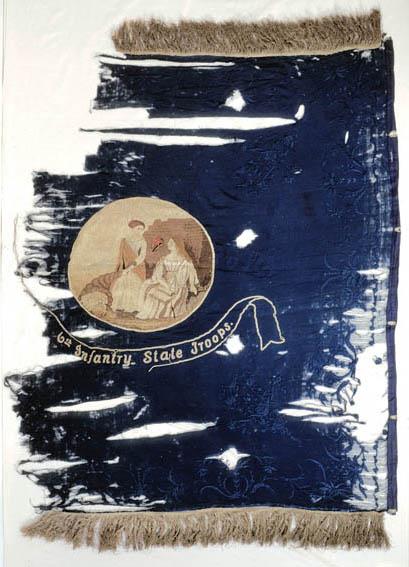
North Carolina Company Flag , (State Seal Canton) artifact 19xx-330-174c,
North Carolina Museum of History, Raleigh, N. C.

Deep in the bowels of the North Carolina Museum of History, in a dark storage drawer, lies the once proud flag of the North Carolina Grays. Lovingly hand stitched out of fine silk by the young ladies of the Cedar Fork community in Wake County, North Carolina, the State Seal hand painted by accomplished artist, Sophia Partridge, the flag was presented with pride to the brothers, fathers, uncles and husbands about to go to war. Today the flag is not only forgotten, it is falling to pieces.

Sofia Partridge of Raleigh, North Carolina (1817-1881)

When the threat of war swept through North Carolina, a young school master named Richard York suspended classes at the Cedar Fork Academy in western Wake County and drilled his pupils, forming one of the earliest militia companies in North Carolina. Both the young boys and girls enthusiastically practiced drilling, but ultimately it was the young men that would march off to fight. The young ladies, wanting to contribute, formed the Cedar Fork Soldiers Relief Society to help their young men survive the ordeal with some of the comforts of home. A period newspaper article quoted their spokeswoman:

“We wish to do something in the defense of our country, that our desire is to render the burdens of those whose duty it is to take a more active part in the defense of the same, as light as possible.”


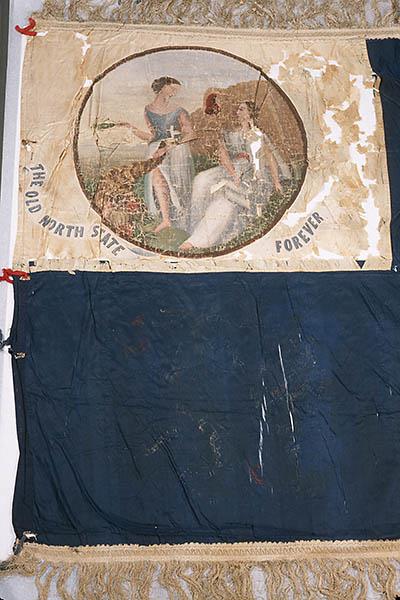
North Carolina Company Flag , (N. C. Grays Canton) artifact 19xx-330-174b,
North Carolina Museum of History, Raleigh, N. C.

Presenting the boy soldiers with “a handsome flag” to remind them that the folks at home were thinking of them was a primary stated objective of the society. On one side of the Blue silk banner is a single gold star in the white canton framed with their company name “THE NORTH CAROLINA GRAYS” and the reminder “PRESENTED BY THE LADIES OF CEDAR FORK”. On the front of the flag, beneath the Canton’s hand painted State seal, was emblazoned the motto “THE OLD NORTH STATE FOREVER” to remind the boys to do their duty, even when far away from home.

It was presented to the young soldiers during a day long celebration on June 1, 1861 in Morrisville, N. C. attended by throngs of citizens wishing to show their support. The day started with Captain York smartly drilling his men “to the satisfaction of the expectant crowd”. Fifteen year old Miss Fanny Lyon, sister of one of the recruits, stepped forward to give a passionate speech charging them to “aid in the defense of our rights” and presenting to “the brave sons of this vicinity, this beautiful ensign.” 

Newly appointed Lieutenant, Malcus Williamson Page accepted the flag and in an equally passionate speech remarked that the sight of the flag would give them cheer and refresh their spirits. He pledged to keep the flag safe through the trials ahead. A number of other prominent local gentlemen took this opportunity to address the crowd before being dismissed to a spurious repast prepared by the ladies of the neighborhood, that was enjoyed by all attending. The closing event was a sermon and presentation of bibles before the soldiers marched off to war under the silken banner floating in the breeze above their heads.

North Carolina Governor John B. Ellis

The North Carolina Grays, now Company I of the Sixth North Carolina State Troops, joined their new comrades at Camp Alamance, in Company Shops, N. C. (present day Burlington) for training. Stopping in Raleigh, on their way to the seat of war in Virginia, they were called on to escort the body of recently deceased N. C. Governor John B. Ellis where the Company flag was used, possibly the only time it flew in an official capacity. Once they joined the Sixth Regiment, a regimental flag would have been flown, rather than their company flag. 

Captain York recalled that many of the men took trunks, to carry some of the comforts of home to the battlefield. Finding them cumbersome and unwieldy during campaigning, the trunks were put into storage sometime in the fall of 1861. The flag and York’s dress uniform had been packed in his wife's borrowed Saratoga trunk. This was the last the men ever saw of the flag. At a later date, A Federal cavalry detachment chasing some Confederate “bushwhackers” came upon a cabin containing the trunks, where they has been stored by the North Carolinians when leaving their winter quarter in the spring of 1862. Upon searching the trunks, The Federal’s found and confiscated the contents including spare Confederate uniforms, underwear, linens and the barely used company flag of the “North Carolina Grays”.

During the following war years, Company I and their comrades earned their nickname, “The Bloody Sixth” by becoming experienced combat veterans of nearly every campaign fought by the Army of Northern Virginia. Their precious flag was the last thing on their minds.

a Soldier's Saratoga Trunk, used to store unused Linens, Uniforms and a Flag while campaigning


After the war, the men heard their trunks had fallen into the hands of the Yankees, some blaming it on the treachery of the man left in charge of their belongings. As the soldiers got on with their lives and the battles became distant memories, the men defended their honor by reminding any who questioned them that their flag was stolen, not captured in battle. It had become such a foggy memory that some of the post war descriptions of the flags details were now being “mis-remembered”. York described the flag in 1892 as “On one side the arms of North Carolina and on the other a pine tree in a coiled rattlesnake”. He was only half right. The pine tree motif was more commonly seen on the regiments buttons.

North Carolina officers button with the phrase "Noli me tangere" meaning "Don't tread on me" 


By the 1890’s the old soldiers were beginning to reconcile their differences. On the morning of January 30, 1892, veterans of the North Carolina Grays must have been surprised to read a letter from a Yankee in their local newspaper, addressed to them. “I am writing you this letter” wrote Major Thomas W Higgins, of the 73rd regiment of Ohio Infantry, “I now propose to return the flag to the survivors of the “North Carolina Greys" (sic). Higgins explained how he was in charge of the expedition that captured the flag and has had it in his possession, adding that it is “in a tolerably good state of preservation”. He had previously offered it to former N. C. governor Holden at the end of the war, on the condition that “a company be raised to sustain the Union” but in the spirit of reconciliation was now offering it without any conditions.


Newspaper Headline from the 
The State Chronicle (Raleigh, North Carolina) · Sat, Jan 30, 1892 · Page 1

He received a volley of letters from veterans each directing him how to return the flag, but it was’t until the Chatham Record newspaper suggested in an editorial that the flag return be part of a veterans reunion that Richard York, now known as Major York, organized a committee to plan a gala reunion and accept the flag. The Governor was invited, and on October 7, 1892 over 3,000 showed up in Morrisville, N. C. to see the North Carolina Gray’s get their flag back, at the same place it was originally presented to them. Among the attendees was Mrs. Fannie Lyon Lowe, who presented the flag 31 years earlier. Over 200 local veterans were in attendance. Of the 152 men serving in the company throughout the war, only 67 were left. When reading Company I’s roll, 31 members were present to answer “here”.

Miss Fanny Lyon Lowe

The primary event was Major Higgin’s presentation of the Flag to Major York, who in turn presented it to the Governors representative who proudly accepted it, remarking that it would be “tenderly placed in the State Library at Raleigh, to remain an everlasting reminder of the bravery and devotion”.


Ironically, through this much publicized event the flag became better known and viewed than when it was originally presented in 1861. The tattered relic became a symbol of the lost cause. Besides being on display at the North Carolina State Library, it was present at the dedication of the N. C. Confederate Veterans memorial on May 20, 1895 and flew over more veterans parades than it ever flew over Virginia battlefields. And yet it is a reminder of North Carolina’s heritage. Lovingly made by the daughters of the old North State to demonstrate their devotion, it was presented to the brave young men of their community who answered the call of their state government, many, never to return. This silken banner is a tangible reminder of the devotion of North Carolinians who lived and died a century and a half ago, but whose blood still runs in the veins of their descendants.


Sadly, this flag, like many artifacts from this time period are now in danger. All artifacts can decay over time when not properly conserved due to the adverse effects of light, temperature, humidity and pollutants in the air. Professional conservation can preserve this flag for future generations, but it will be costly. This fragile flag, in the collection of the North Carolina museum of History (19xx-330-174), will cost an estimated $15,000 to conserve before it can be put on display. We are concerned that this particular artifact may perish without our help. Many institutions have limited funding to conserve their collections, which is why The Cedar Fork Rifles Preservation Society, Inc. has begun a fund raising campaign in partnership with the museum. North Carolina has been a diligent stewart of this flag for over a century, but now is the time for us to act. The veterans who gave this flag to the state wanted it to be preserved and seen as a reminder of the sacrifices of her citizens. So do we.

In February 2015 (when this article was originally written), the reenactors and living historians of the Sixth NCST voted to undertake a fundraising campaign to conserve the silk flag of the North Carolina Grays.  At the time, it seemed like an overwhelming, nearly impossible task, due to an estimated cost of  $14,000-$15,000.  With funds left over from completed Sixth North Carolina State Troops Saylor's Creek battle flag conservation project, We were able to kick off this new fund. Various efforts, including personal contributions by members, resulted in a total of $6,000 by late 2018. Close to the half-way point, we were running out of ideas to reach our goal. In 2019, the members of the 26th North Carolina Regiment announced that they would take the N.C. Grays flag as their next preservation effort and joined with us in fund raising. 

We are thrilled to announce that the North Carolina Museum of History, holding these funds on our behalf, informed us that we have now raised the $13,742, the amount needed to conserve this flag.

The membership of the Sixth NCST would like to thank everyone who donated to the effort and would especially like to thank the 26th NCT for their help and assistance these past 4 years to reach the goal of conserving this beautiful flag.

Over one hundred and fifty years ago the Cedar Fork community recognized how important is was for each individual to contribute to the cause in their own way. Now it's our turn.

1861 Civil War silk flag, North Carolina Grays Waiting for conservation

On Saturday September 7, 2024, The conserved flag of the North Carolina Grays was dedicated before the public at the North Carolina Museum of History. The Museum, currently being renovated, plans to display this flag when it reopens.

Author, Rick Walton, with the Conserved Flag.


Private Isaiah Presley Markham


The following photographs and information are original members of the "Bloody Sixth". I am honored to include their stories and images here. If you would like to share a story or photo about your 6th NCST ancestor, please leave a comment and I will be in touch.


Private Isaiah Presley Markham
Company C (Orange Grays)
Sixth North Carolina State Troops


Isaiah Markham
North Carolina Museum of History Record ID: N.88.12.8


Prior Occupation: Farmer 

Enlisted: May 1, 1861, for the war.

Age at Enlistment: 27

Where: Company Shops, Orange County (by Captain Freeland)

Discharged: October 24, 1861 Due to Surgeons Certificate of Disability

Appears on N. C. Roll of Honor in recognition of his service in the 6th NCST

Enlisted: in Wake County, N. C.  in the 56th North Carolina Troops, Co. E on July 17, 1862


11/1/1862- Detailed as Ambulance Driver


11/1/1863- Detailed as teamster


5/20/1864- Killed in action at Ware Bottom church


Appears on N. C. Roll of Honor in recognition of his service in the 56th NCT

Isaiah Presley Markham.  Markham Memorial Gardens, Durham, N. C. 

The family story that has been handed down is as follows: (shared by Ancestor Edgar M. Malpass)

Henry Stovall Markham, Isaiah Presley and John Henry's father, after hearing of Isaiah's battlefield death in Virginia in May 1864, managed to make it to Chesterfield County, Va. to retrieve his son's body. He then buried it on the family property in Durham. Twenty years ago (early 2000's) the old Markham family house and the family cemetery plot was still intact. It was there I placed a Confederate States headstone for Isaiah Presley within the family cemetery plot as it was unmarked. Unfortunately, sometime in the early 2000's a developer had bought the entire property and bulldozed the cemetery and house for a new housing community. I was told that the all remains were moved to Markham Memorial Gardens located close by but I have my doubts as I have seen no evidence of their new location. John Henry Markham, Isaiah's brother was KIA at the battle of Chancellorsville in  May 1863. We assumed he was possibly buried in that same family plot but we don't know for sure. We don't even know for sure if his body was ever recovered by the family. 

Another story concerning Isaiah Presley Markham was that before the Battle of Ware Bottom Church took place the battle lines were drawn close together and in the evenings soldiers from both sides would sneak across their lines and meet in the middle in the evening to trade items, like tobacco and drink and play cards. 


Private John Henry Markham
Company C
Sixth North Carolina State Troops
Brother of Isaiah P. Markham

No known Photo Available

Resided in Orange County, N. C. where he enlisted in the Orange Grays which became Company C (Captain Freehand) of the 6th North Carolina State Troops at age 25, May 1, 1861, for the war. 

Killed at 2nd battle of Fredericksburg (Chancellorsville), Virginia, May 4, 1863.

Index to Sixth North Carolina State Troops Flags within the Collection at the North Carolina Museum of History

First Sgt. Rick Walton with the Reproduction Fisher Flag in 2011
Source: 20110625 Morrisville Living History-35.JPG

One day, way back in 2009, I was searching the North Carolina Museum of History Collections for something related to the Sixth North Carolina State Troops that  I was researching at the time. After visiting the museum and seeing an object related to the Sixth North Carolina State Troops, I was very excited to learn there was an online database that would tell me more about the object. 

Imagine my surprise and amazement when I discovered there were other Sixth North Carolina State Troops  items in the collection that were NOT on display. What a cool "secret" treasure trove of artifact descriptions and photos I had stumbled into.

From that day on I spent very free moment searching the collection. At first it was thrilling to find random items, but I soon started stumbling over myself and re-finding the same things again and again, so I organized my searches and recorded my results. 

Eventually my fishing expeditions started to come up dry, nothing new to find. I was as disappointed as an eight year old opening the last present on Christmas morning. The excitement was gone. But what about all the items I discovered? This was still a treasure trove of information. It was not necessarily meaningful at the time, but eventually many of these items were helpful to me in research projects and presentations.

This collection represents a massive research project that took me years to fully discover. I eventually collected all the results and created a webpage for the Sixth North Carolina State Troops website. 

To make sure this effort is preserved for the future, I have reviewed, updated and present it here. The following tables contain descriptions and links to all the currently known (by me) objects in the collection of the North Carolina Museum Of History relating to the 6th North Carolina State troops. Some of them have photographs and some have only descriptions

Want to search for something specific , try their search page below:

SEARCH the North Carolina Museum's Collections

OR browse through all the FLAGS I have found related to the 6th North Carolina State Troops below:

Instructions

Click on the Highlighted Title in each description box to go to the related page in the museum's database which contains more details and photographs (when available). Click on the photos to the right of the description to see an enlarged view. Please report any missing or broken llnks to me so I can reconnect them.

Flags related the the 6th N.C.S.T.

H.1915.4.5
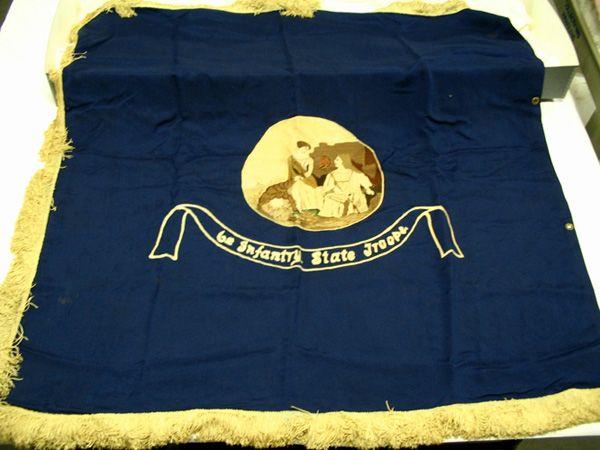
REGIMENTAL FLAG (Fisher Flag)
BLUE SILK BROCADE SHAWL, OBVERSE IS EMBROIDERED IN WHITE "MAY 20TH 1775/ NORTH  CAROLINA/ DEEDS NOT WORDS/ MAY 20TH, 1861" REVERSE HAS EMBROIDERED NC STATE SEAL
Fisher Flag at NCMOH
H.19XX.330.174

North Carolina Grays COMPANY FLAG

Important Note: This Flag is the subject of the 2016-2023 Fund Raising Campaign that raised $14,000 to conserve  this flag for future generations. 

CO. I, BLUE FIELD W/ WHITE CANTON PAINTED NC STATE SEAL & "THE OLD NORTH STATE  FOREVER"; REVERSE READS "NORTH CAROLINA GRAYS, PRESENTED BY LADIES OF CEDAR  FORK"


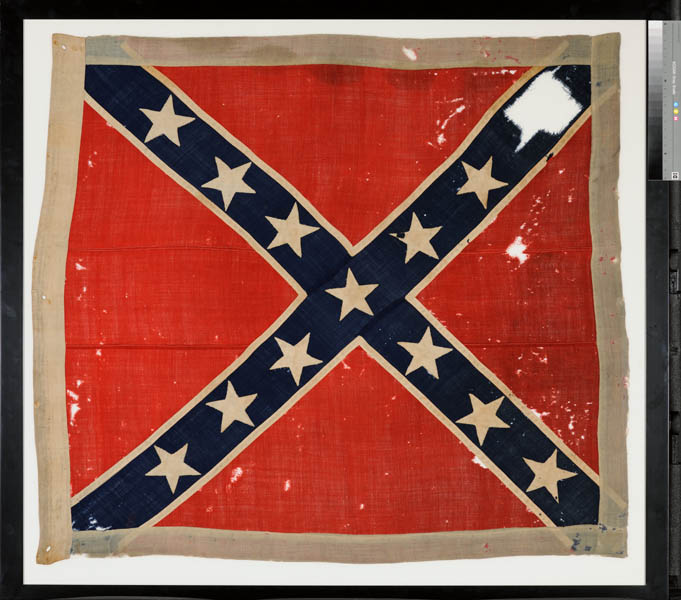
H.1914.252.18 6th North Carolina State Troops REGIMENTAL BATTLE FLAG

Important Note: This is the Flag we raised $6458 to conserve

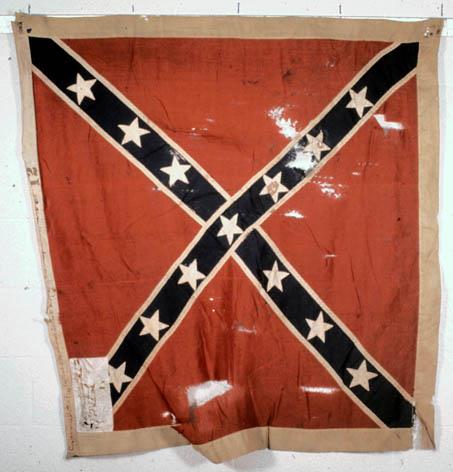
CSA BATTLE FLAG, W/O HONORS, CAPTURE NO. 357 STENCILED UPPER EDGE, MACHINE-SEWN, SEVERAL HOLES THROUGHOUT, STAR CUT OUT LOWER FLY, HOLES IN BORDER. CAPTURED AT SAILORS CREEK.

6th North Carolina State Troops Battle Flag
H.1914.252.34 REGIMENTAL BATTLE FLAG

CSA BATTLE FLAG, CAPTURE NO. "12" STAMPED ON REVERSE UPPER STAFF EDGE & FLY CORNER, HANDWRITTEN HISTORY ON STAFF EDGE, HAND-SEWN, SEVERAL HOLES THROUGHOUT

Note: Recent scholarship suggests that this flag may have been mis-identified. The 6th NCST battle flag Captured at Rappahannock Station is most likely a flag currently owned by Stratford Hall and on display in Gettysburg

mislabeled battle flag
H.1967.57.1 CENTENNIAL REPRODUCTION FLAG

REPRODUCTION CIVIL WAR FLAG OF THE N.C. SIXTH REGIMENT; USED BY THE REACTIVATED SIXTH in the 1960's.

Reproduction Fisher Flag

Faces of the Sixth- Private Christopher McDaniel-Company C


The following photographs and information are original members of the "Bloody Sixth". I am honored to include their stories and images here. If you would like to share a story or photo about your 6th NCST ancestor, please leave a comment and I will be in touch.


Private Christopher McDaniel 
Company C
 Sixth North Carolina State Troops


Christopher McDaniel  in the 1920s 

________________________________________________________________________________

Prior Occupation: Farmer 
Enlisted: September 22, 1862 for the war 
Where: Burke County 
Age at enlistment: 25 
Wounded: Gettysburg July 1,1863 
Captured: in field hospital at Gettysburg and confined to DeCamp General Hospital, Davids Island, New York Harbor 
Paroled: September 16, 1863 exchanged at City Point, Va. 
Furloughed: August 30, 1863  
Carried as Absent wounded on the rolls through December 1864


Christopher McDaniel enlisted on September 22, 1862 at age 25 with his three brothers Jesse, age 27, John, age 33 and William, age 23. Christopher was nicknamed "Kiddy" by his friends.


Christopher was wounded in the right foot on the first day of Gettysburg.He didn't receive medical attention for three days. When he finally did get a surgeon, his wound caused amputation of most of his right foot. He was captured by Union soldiers on July 5th. He was then sent to the prison camp at David's Island New York, where he received more medical attention at DeCamp General Hospital.  He was exchanged at City Point VA and was determined unfit for duty because of the loss of his foot.  He walked from there to his home in Burke County using only his rifle as a crutch. 


We don't know when he died, but some family members remember hearing stories from their fathers and mothers which said that he lived past the turn of the century and was alive as late as the 1920's. 


All three brothers died in defense of their homeland. William was also wounded and captured at Gettysburg and died at DeCamp hospital on July 28, 1863. John died in Plymouth of  wounds April 18, 1864. Jesse died of typhoid fever in a Richmond hospital on November 15, 1862


Source: Photo & Bio Courtesy of his Descendant Marty Christopher McDaniel


Additional information or photos would be welcomed to complete
the record of this honorable soldier. 

Regimental Commanders of the "Bloody Sixth"

  1st: Colonel Charles F. Fisher May 16, 1861-July 21, 1861 Killed in action at the Battle of First Manassas 2nd: Colonel William Dorsey Pen...