Showing posts with label Flags. Show all posts

The North Carolina Grays- Will their flag ever fly again?

 Copyright (c) 2015, 2016, 2023 By Frederick Walton, 6th North Carolina State Troops Historian

With the recent announcement of the achievement of their Conservation fund raising goal, let's take another look at the history of this interesting flag.

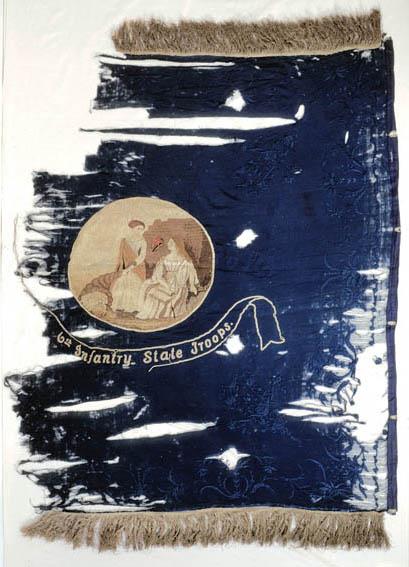
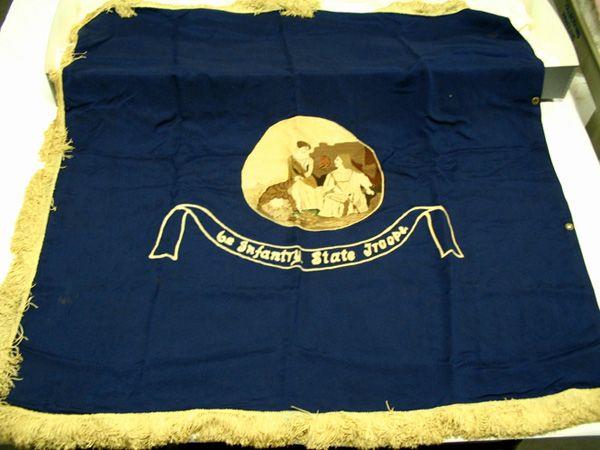
North Carolina Company Flag , (State Seal Canton) artifact 19xx-330-174c,
North Carolina Museum of History, Raleigh, N. C.

Deep in the bowels of the North Carolina Museum of History, in a dark storage drawer, lies the once proud flag of the North Carolina Grays. Lovingly hand stitched out of fine silk by the young ladies of the Cedar Fork community in Wake County, North Carolina, the State Seal hand painted by accomplished artist, Sophia Partridge, the flag was presented with pride to the brothers, fathers, uncles and husbands about to go to war. Today the flag is not only forgotten, it is falling to pieces.

Sofia Partridge of Raleigh, North Carolina (1817-1881)

When the threat of war swept through North Carolina, a young school master named Richard York suspended classes at the Cedar Fork Academy in western Wake County and drilled his pupils, forming one of the earliest militia companies in North Carolina. Both the young boys and girls enthusiastically practiced drilling, but ultimately it was the young men that would march off to fight. The young ladies, wanting to contribute, formed the Cedar Fork Soldiers Relief Society to help their young men survive the ordeal with some of the comforts of home. A period newspaper article quoted their spokeswoman:

“We wish to do something in the defense of our country, that our desire is to render the burdens of those whose duty it is to take a more active part in the defense of the same, as light as possible.”


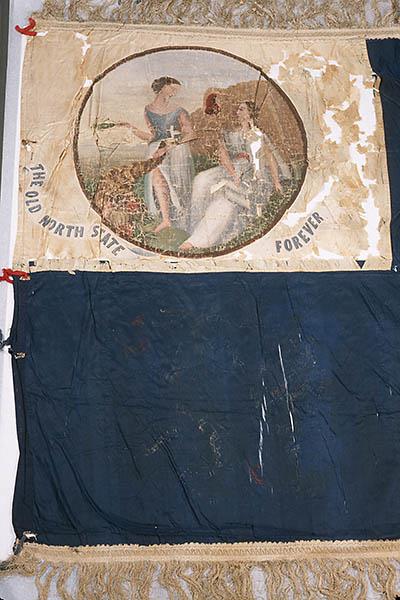
North Carolina Company Flag , (N. C. Grays Canton) artifact 19xx-330-174b,
North Carolina Museum of History, Raleigh, N. C.

Presenting the boy soldiers with “a handsome flag” to remind them that the folks at home were thinking of them was a primary stated objective of the society. On one side of the Blue silk banner is a single gold star in the white canton framed with their company name “THE NORTH CAROLINA GRAYS” and the reminder “PRESENTED BY THE LADIES OF CEDAR FORK”. On the front of the flag, beneath the Canton’s hand painted State seal, was emblazoned the motto “THE OLD NORTH STATE FOREVER” to remind the boys to do their duty, even when far away from home.

It was presented to the young soldiers during a day long celebration on June 1, 1861 in Morrisville, N. C. attended by throngs of citizens wishing to show their support. The day started with Captain York smartly drilling his men “to the satisfaction of the expectant crowd”. Fifteen year old Miss Fanny Lyon, sister of one of the recruits, stepped forward to give a passionate speech charging them to “aid in the defense of our rights” and presenting to “the brave sons of this vicinity, this beautiful ensign.” 

Newly appointed Lieutenant, Malcus Williamson Page accepted the flag and in an equally passionate speech remarked that the sight of the flag would give them cheer and refresh their spirits. He pledged to keep the flag safe through the trials ahead. A number of other prominent local gentlemen took this opportunity to address the crowd before being dismissed to a spurious repast prepared by the ladies of the neighborhood, that was enjoyed by all attending. The closing event was a sermon and presentation of bibles before the soldiers marched off to war under the silken banner floating in the breeze above their heads.

North Carolina Governor John B. Ellis

The North Carolina Grays, now Company I of the Sixth North Carolina State Troops, joined their new comrades at Camp Alamance, in Company Shops, N. C. (present day Burlington) for training. Stopping in Raleigh, on their way to the seat of war in Virginia, they were called on to escort the body of recently deceased N. C. Governor John B. Ellis where the Company flag was used, possibly the only time it flew in an official capacity. Once they joined the Sixth Regiment, a regimental flag would have been flown, rather than their company flag. 

Captain York recalled that many of the men took trunks, to carry some of the comforts of home to the battlefield. Finding them cumbersome and unwieldy during campaigning, the trunks were put into storage sometime in the fall of 1861. The flag and York’s dress uniform had been packed in his wife's borrowed Saratoga trunk. This was the last the men ever saw of the flag. At a later date, A Federal cavalry detachment chasing some Confederate “bushwhackers” came upon a cabin containing the trunks, where they has been stored by the North Carolinians when leaving their winter quarter in the spring of 1862. Upon searching the trunks, The Federal’s found and confiscated the contents including spare Confederate uniforms, underwear, linens and the barely used company flag of the “North Carolina Grays”.

During the following war years, Company I and their comrades earned their nickname, “The Bloody Sixth” by becoming experienced combat veterans of nearly every campaign fought by the Army of Northern Virginia. Their precious flag was the last thing on their minds.

a Soldier's Saratoga Trunk, used to store unused Linens, Uniforms and a Flag while campaigning


After the war, the men heard their trunks had fallen into the hands of the Yankees, some blaming it on the treachery of the man left in charge of their belongings. As the soldiers got on with their lives and the battles became distant memories, the men defended their honor by reminding any who questioned them that their flag was stolen, not captured in battle. It had become such a foggy memory that some of the post war descriptions of the flags details were now being “mis-remembered”. York described the flag in 1892 as “On one side the arms of North Carolina and on the other a pine tree in a coiled rattlesnake”. He was only half right. The pine tree motif was more commonly seen on the regiments buttons.

North Carolina officers button with the phrase "Noli me tangere" meaning "Don't tread on me" 


By the 1890’s the old soldiers were beginning to reconcile their differences. On the morning of January 30, 1892, veterans of the North Carolina Grays must have been surprised to read a letter from a Yankee in their local newspaper, addressed to them. “I am writing you this letter” wrote Major Thomas W Higgins, of the 73rd regiment of Ohio Infantry, “I now propose to return the flag to the survivors of the “North Carolina Greys" (sic). Higgins explained how he was in charge of the expedition that captured the flag and has had it in his possession, adding that it is “in a tolerably good state of preservation”. He had previously offered it to former N. C. governor Holden at the end of the war, on the condition that “a company be raised to sustain the Union” but in the spirit of reconciliation was now offering it without any conditions.


Newspaper Headline from the 
The State Chronicle (Raleigh, North Carolina) · Sat, Jan 30, 1892 · Page 1

He received a volley of letters from veterans each directing him how to return the flag, but it was’t until the Chatham Record newspaper suggested in an editorial that the flag return be part of a veterans reunion that Richard York, now known as Major York, organized a committee to plan a gala reunion and accept the flag. The Governor was invited, and on October 7, 1892 over 3,000 showed up in Morrisville, N. C. to see the North Carolina Gray’s get their flag back, at the same place it was originally presented to them. Among the attendees was Mrs. Fannie Lyon Lowe, who presented the flag 31 years earlier. Over 200 local veterans were in attendance. Of the 152 men serving in the company throughout the war, only 67 were left. When reading Company I’s roll, 31 members were present to answer “here”.

Miss Fanny Lyon Lowe

The primary event was Major Higgin’s presentation of the Flag to Major York, who in turn presented it to the Governors representative who proudly accepted it, remarking that it would be “tenderly placed in the State Library at Raleigh, to remain an everlasting reminder of the bravery and devotion”.


Ironically, through this much publicized event the flag became better known and viewed than when it was originally presented in 1861. The tattered relic became a symbol of the lost cause. Besides being on display at the North Carolina State Library, it was present at the dedication of the N. C. Confederate Veterans memorial on May 20, 1895 and flew over more veterans parades than it ever flew over Virginia battlefields. And yet it is a reminder of North Carolina’s heritage. Lovingly made by the daughters of the old North State to demonstrate their devotion, it was presented to the brave young men of their community who answered the call of their state government, many, never to return. This silken banner is a tangible reminder of the devotion of North Carolinians who lived and died a century and a half ago, but whose blood still runs in the veins of their descendants.


Sadly, this flag, like many artifacts from this time period are now in danger. All artifacts can decay over time when not properly conserved due to the adverse effects of light, temperature, humidity and pollutants in the air. Professional conservation can preserve this flag for future generations, but it will be costly. This fragile flag, in the collection of the North Carolina museum of History (19xx-330-174), will cost an estimated $15,000 to conserve before it can be put on display. We are concerned that this particular artifact may perish without our help. Many institutions have limited funding to conserve their collections, which is why The Cedar Fork Rifles Preservation Society, Inc. has begun a fund raising campaign in partnership with the museum. North Carolina has been a diligent stewart of this flag for over a century, but now is the time for us to act. The veterans who gave this flag to the state wanted it to be preserved and seen as a reminder of the sacrifices of her citizens. So do we.

In February 2015 (when this article was originally written), the reenactors and living historians of the Sixth NCST voted to undertake a fundraising campaign to conserve the silk flag of the North Carolina Grays.  At the time, it seemed like an overwhelming, nearly impossible task, due to an estimated cost of  $14,000-$15,000.  With funds left over from completed Sixth North Carolina State Troops Saylor's Creek battle flag conservation project, We were able to kick off this new fund. Various efforts, including personal contributions by members, resulted in a total of $6,000 by late 2018. Close to the half-way point, we were running out of ideas to reach our goal. In 2019, the members of the 26th North Carolina Regiment announced that they would take the N.C. Grays flag as their next preservation effort and joined with us in fund raising. 

We are thrilled to announce that the North Carolina Museum of History, holding these funds on our behalf, informed us that we have now raised the $13,742, the amount needed to conserve this flag.

The membership of the Sixth NCST would like to thank everyone who donated to the effort and would especially like to thank the 26th NCT for their help and assistance these past 4 years to reach the goal of conserving this beautiful flag.

Over one hundred and fifty years ago the Cedar Fork community recognized how important is was for each individual to contribute to the cause in their own way. Now it's our turn.

1861 Civil War silk flag, North Carolina Grays Waiting for conservation

On Saturday September 7, 2024, The conserved flag of the North Carolina Grays was dedicated before the public at the North Carolina Museum of History. The Museum, currently being renovated, plans to display this flag when it reopens.

Author, Rick Walton, with the Conserved Flag.


Index to Sixth North Carolina State Troops Flags within the Collection at the North Carolina Museum of History

First Sgt. Rick Walton with the Reproduction Fisher Flag in 2011
Source: 20110625 Morrisville Living History-35.JPG

One day, way back in 2009, I was searching the North Carolina Museum of History Collections for something related to the Sixth North Carolina State Troops that  I was researching at the time. After visiting the museum and seeing an object related to the Sixth North Carolina State Troops, I was very excited to learn there was an online database that would tell me more about the object. 

Imagine my surprise and amazement when I discovered there were other Sixth North Carolina State Troops  items in the collection that were NOT on display. What a cool "secret" treasure trove of artifact descriptions and photos I had stumbled into.

From that day on I spent very free moment searching the collection. At first it was thrilling to find random items, but I soon started stumbling over myself and re-finding the same things again and again, so I organized my searches and recorded my results. 

Eventually my fishing expeditions started to come up dry, nothing new to find. I was as disappointed as an eight year old opening the last present on Christmas morning. The excitement was gone. But what about all the items I discovered? This was still a treasure trove of information. It was not necessarily meaningful at the time, but eventually many of these items were helpful to me in research projects and presentations.

This collection represents a massive research project that took me years to fully discover. I eventually collected all the results and created a webpage for the Sixth North Carolina State Troops website. 

To make sure this effort is preserved for the future, I have reviewed, updated and present it here. The following tables contain descriptions and links to all the currently known (by me) objects in the collection of the North Carolina Museum Of History relating to the 6th North Carolina State troops. Some of them have photographs and some have only descriptions

Want to search for something specific , try their search page below:

SEARCH the North Carolina Museum's Collections

OR browse through all the FLAGS I have found related to the 6th North Carolina State Troops below:

Instructions

Click on the Highlighted Title in each description box to go to the related page in the museum's database which contains more details and photographs (when available). Click on the photos to the right of the description to see an enlarged view. Please report any missing or broken llnks to me so I can reconnect them.

Flags related the the 6th N.C.S.T.

H.1915.4.5
REGIMENTAL FLAG (Fisher Flag)
BLUE SILK BROCADE SHAWL, OBVERSE IS EMBROIDERED IN WHITE "MAY 20TH 1775/ NORTH  CAROLINA/ DEEDS NOT WORDS/ MAY 20TH, 1861" REVERSE HAS EMBROIDERED NC STATE SEAL
Fisher Flag at NCMOH
H.19XX.330.174

North Carolina Grays COMPANY FLAG

Important Note: This Flag is the subject of the 2016-2023 Fund Raising Campaign that raised $14,000 to conserve  this flag for future generations. 

CO. I, BLUE FIELD W/ WHITE CANTON PAINTED NC STATE SEAL & "THE OLD NORTH STATE  FOREVER"; REVERSE READS "NORTH CAROLINA GRAYS, PRESENTED BY LADIES OF CEDAR  FORK"


H.1914.252.18 6th North Carolina State Troops REGIMENTAL BATTLE FLAG

Important Note: This is the Flag we raised $6458 to conserve

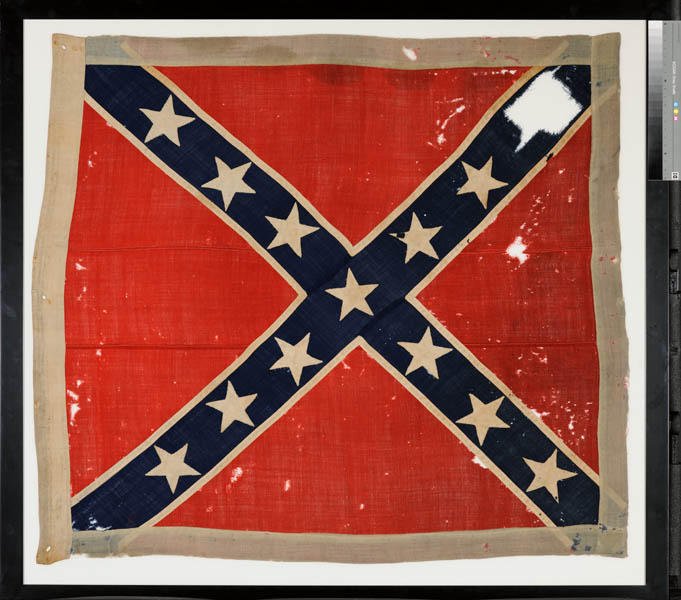
CSA BATTLE FLAG, W/O HONORS, CAPTURE NO. 357 STENCILED UPPER EDGE, MACHINE-SEWN, SEVERAL HOLES THROUGHOUT, STAR CUT OUT LOWER FLY, HOLES IN BORDER. CAPTURED AT SAILORS CREEK.

6th North Carolina State Troops Battle Flag
H.1914.252.34 REGIMENTAL BATTLE FLAG

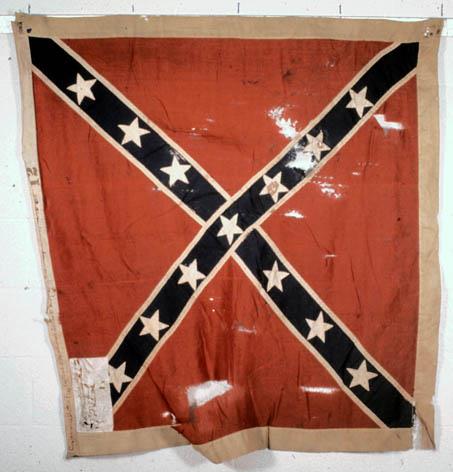
CSA BATTLE FLAG, CAPTURE NO. "12" STAMPED ON REVERSE UPPER STAFF EDGE & FLY CORNER, HANDWRITTEN HISTORY ON STAFF EDGE, HAND-SEWN, SEVERAL HOLES THROUGHOUT

Note: Recent scholarship suggests that this flag may have been mis-identified. The 6th NCST battle flag Captured at Rappahannock Station is most likely a flag currently owned by Stratford Hall and on display in Gettysburg

mislabeled battle flag
H.1967.57.1 CENTENNIAL REPRODUCTION FLAG

REPRODUCTION CIVIL WAR FLAG OF THE N.C. SIXTH REGIMENT; USED BY THE REACTIVATED SIXTH in the 1960's.

Reproduction Fisher Flag

Time line of the North Carolina Grays Company Flag


(C) 2015-2024 Documented by Frederick Walton, Historian


The flag of the “North Carolina Grays”  was designed and hand made by the girls and ladies of Cedar Fork to be  presented to their loved ones who were departing for war as company I of the newly formed Sixth Regiment of North Carolina State troops. It is an  Infantry company flag.

The silk flag has a blue field with a white canton containing a hand painted NC state seal. Beneath the state seal, on a painted flowing white ribbon, are the words "THE OLD NORTH STATE FOREVER”.


The reverse white canton reads "NORTH CAROLINA GRAYS” on a white arc above a centrally located small, single, gold five pointed star, with the words “PRESENTED BY LADIES OF CEDAR FORK” on a white arc below the Star.

This flag was carried with them to the seat of war in Virginia,  but packed in a trunk and unused while the regiment fought in many a bloody battle. The storage trunks were discovered during a Federal raid and the contents taken. Many years later the flag was returned and put on display.

Today the flag resides, in climate controlled storage, at the North Carolina Museum of History in Raleigh, N. C. Overall the paint is badly cracked and the silk fractured. No conservation has been performed upon this flag due to the brittle and shattered silk. It cannot be viewed or studied until conservation has been undertaken because even moving it causes deterioration.

Following is the concise, but detailed timeline of the flag from its inception to it delicate current state. It is now up to us to preserve both its memory and the physical reminder of this historic relic.

The Conception

1859- Cedar Fork Academy formed with Richard W. York as Principle and Hiram Weatherspoon as president of the board of trustees. Source: The Weekly Standard, 14 Dec 1859, Wed, Page 1

“The school is located immediately on the North Carolina Railroad, sixteen miles N. W. of Raleigh and four [miles] North of Morrisville, and students can get off the mail train at the academy. [I. e. School is located near the tracks] source: New Bern Daily Progress, 28 March 1860, Page 2.

Map Showing Location of Cedar Forks Academy near present day Morrisville, N. C.


January 7, 1860- York calls a military meeting at Cedar Fork and organizes the “Wake Riflemen” with Weatherspoon as Captain and York as 3rd Lt. Source: Weekly Raleigh Register, 18 Jan 1860, Wed, Page 1

April 29, 1861- A “Soldiers Relief Association” is organized by the Ladies of Cedar Fork with a stated objective of presenting Professor R. W. York’s volunteers with a “handsome flag” as well as supplying the volunteers with the material comforts of home and offering moral support. Source: Semi-Weekly Standard, 8 May 1861, Wed, Page 3; Semi-Weekly Standard, 18 May 1861, Sat, Page 2

May 11, 1861- “Prof York, of Wake, has suspended his school and raised a company [The North Carolina Grays], of which he has been elected captain. He expects to have 100 men or more.” Source: Semi-Weekly Standard (Raleigh, North Carolina)11 May 1861, Sat • Page 3 & Semi-Weekly Standard, 18 May 1861, Sat • Page 3


The Flag is Made

May 1861- Blue Silk Flag, with white hand painted Cantons, edged with heavy Gilt fringe was made by Miss Sophia Partridge of Raleigh who was conducting a female school in Raleigh and was a prize winning seamstress and artist.  source: The State Chronicle, 7 Feb 1892, Sun, Page 1

Sophia Partridge

May 16,1861 6th Regiment organized and went into camp of instruction at Company Shops, near present day Burlington, N. C. source: Jordon, “NC Troops”, Vol 1, pg 258


May 21, 1861- Letter from C. F. Fisher [Charles Frederick Fisher, president of the North Carolina Railroad  and organizer of the 6th Regiment] to Capt. York apologizing for being unable to meet due to other business but urging him to decide whether to join the regiment he was then forming. “I am called upon to present the names of Captains & Officers- for appointments- I believe no more short term volunteers will be received- so the governor says- until the State Troops are filled up. So your question would be as between myself & some other chief.”… “If you are yet determined- send me your names of officers by morning train to report for appointment at once or wait to see me- as you please”  Source: North Carolina State Archives, PC.498,  Charles F. Fisher Paper, 1 Item copied by Frederick Walton 8/13/2005


May 28, 1861- Company I [The North Carolina Grays] was organized and assigned to the 6th North Carolina State Troops with 120 members on the roll. source: Durham Globe (Durham, North Carolina) · Sat, Oct 15, 1892 · Page 1 


The Flag is Presented

June 1, 1861- Meeting of the North Carolina Grays at Cedar Fork to include speeches, sermon, flag and bible presentation, military drills and food. source: Semi-Weekly Standard, 18 May 1861, Sat, Page 3; The Weekly Standard, 12 Jun 1861, Wed, Page 2 (note: see this article for text of speech presenting and receiving the flag.)

July 9, 1861- 6th Regiment of North Carolina State Troops acts as Military Guard and escort for remains of deceased Governor John W. Ellis. source: The Raleigh Register. Raleigh, North Carolina, Saturday, July 13, 1861 - Page 3    Note: The North Carolina Grays Company Flag was carried at Ellis Funeral: “Co. I assigned to escort the body of Governor Ellis flying their company flag.” Source: The State Chronicle, 29 Sep 1892, Thu, Page 4

North Crolina Governor John W. Ellis (1820-1861)

July 11 1861- the 6th North Carolina State Troops,  957 strong, enters Confederate Service and left for Virginia. Source: Semi-Weekly Standard, 13 Jul 1861, Sat, Page 3

July 21, 1861- Battle of Manassas- North Carolina Grays are now Co. I of the 6th North Carolina State Troops and are participants in the first great battle of the war. Colonel Fisher Is Killed Leading his troops into battle.

August 1, 1861- Official statement of the killed and wounded in Col. Fisher's regiment at the battle of Manassas - Company I, Capt. York, commanding.--Sergeant Hiram Sears, Sergeant John W. Wilson and Private Joseph T. Morris, mortally wounded; Private James H. Moring, severely wounded, and Joseph D. Ausley, slightly wounded. Source: The Richmond Daily Dispatch: August 1, 1861

APRIL 12, 1861- General Lee Surrenders at Appomattox Court House. The war is over . 181 members of the 6th North Carolina State Troops Surrender and receive their paroles, including 26 members of Co. I (“North Carolina Grays”). None of those surrendering were officers. They returned without the (probably long forgotten) company flag.


The Flag is Lost

October- December 1861- In an 1892 interview, York recalled setting forth to “die for his country with his wife’s Saratoga packed full of clean linen and other articles deemed by them necessary for his comfort and well being.” Saratoga trunks were the premium trunks of the period containing myriad compartments, trays, and heavy duty hardware. Finding them cumbersome and inconvenient for active field operation York and about 60 of the men in his company left their trunks in charge of a man living near their camp, in a house on the Potomac adjoining Mount Vernon. The North Carolina Grays company flag, no longer used, was stored in Captain York’s trunk along with his other valuables.  Source: The State Chronicle, 7 Feb 1892, Sun, Page 1
Example of a "Saratoga Trunk". Less practical than a knapsack when on the march!

“Sometime in 1863”- the 73rd Ohio Regiment, guarding Washington, D.C., is sent on a special expedition to scout the area in their front and discovers Company I’s cache of Confederate trunks which were “captured”. The North Carolina Gray’s “handsome silk flag” was given to Major Thos. W. Higgins by the Brigade Commander as a souvenir. Source: The State Chronicle, 30 Jan 1892, Sat, Page 1    

Note: York Writes in “BRIEF SKETCHES NORTH CAROLINA STATE TROOPS IN THE WAR BETWEEN THE STATES. “COLLECTED AND COMPILED By JAMES C. BIRDSONG, ex-State Librarian. APPENDIX A. FLAG OF THE "NORTH CAROLINA GRAYS.:

“During the fall of 1862, while in camp on the Potomac river, the company was sent on an expedition against a force of Federal troops, and while on this duty the house wherein was stored the company's baggage, etc., was captured by the 73d Ohio Regiment under command of Major T. W. Higgins, and thus the flag fell into the hands of the enemy. Major Higgins sent the flag to his home in Ohio where it was preserved as a trophy of war.”


May 7, 1879- York, working on writing a regimental history solicits material from former comrades. Source:  The Observer, 8 May 1879, Thu, Page 2

June 22,1888- Major York writes to Chatam Record and explains that the North Carolina Grays Flag was “lost” when the trunk it was stored in was taken in a raid, not “captured in battle “and in fact was “never in any engagement”. Source: The Chatham Record, 28 Jun 1888, Thu, Page 3

The Flag is Found

Jan 22, 1892-  U. S. Federal Army Major Thos. W. Higgins writes to the Raleigh State Chronicle relating the story of how he came to process the North Carolina Gray’s Company flag and offers to return it to veterans of that unit in the spirit of reconciliation. Source: Major Thos. W. Higgins in The State Chronicle, 30 Jan 1892, Sat, Page 1

Feb 4, 1892- The Chatam Record prints an article about the offer to return the flag and suggests  organizing a veterans reunion and inviting Higgins to present the flag to the veterans. Source: The Chatham Record (Pittsboro, North Carolina) · Thu, Feb 4, 1892 · Page 3 


February 5, 1892- Major York request the flag be returned and offer to forward to the state Library where is can be displayed as an “historical relic”. Source: Durham Globe, 5 Feb 1892, Fri, Page 1

June 7, 1892- Major York announces reunion Planning meeting to be held at Cedar Fork on July 2, 1892. Source: Durham Globe, 7 Jun 1892, Tue, Page 1  Note: See Durham Globe, 18 Jul 1892, Mon, Page 2 for particulars decided on at the meeting.

Aug. 22, 1892- Announcement of Confederate Veterans reunion at Cedar Fork on October 7, 1892 featuring the return of the North Carolina Grays Company Flag, speeches, picnic dinner, etc. Source: Durham Globe, 22 Aug 1892, Mon, Page 4; Durham Globe, 6 Sep 1892, Tue, Page 1;Durham Globe, 4 Oct 1892, Tue, Page 1;The State Chronicle, 29 Sep 1892, Thu, Page 4

October 1, 1892: Major York invites N. C. Governor Holt to Reunion to receive the flag. Holt appoints a delegate and pledges to carefully preserve the flag in the memory of those who so courageously followed it. Source: The State Chronicle, 2 Oct 1892, Sun, Page 1


The Flag is Returned

October 7, 1892: The Last Reunion held at the Cedar Fork [Baptist] Church, The North Carolina Gray’s Flag is finally returned to North Carolina by Colonel Higgins and presented to Mrs. Fannie Lyon Lowe, who originally presented them to the company in 1861. She in turn presented them to Lieut. D. C. Gunter Major  R. W. York gave a historical sketch of the company, Sgt C. L Williams read the roll call of 120 original members and many were answered “dead” by friends, but 31 were present to answer the roll. Recruits during the war pushed the final roll to 252 men of who 67 were still living. A picnic and intermission followed the roll call. After dinner the people reassembled to watch Major York thank Col Higgins and present the colors to the state to be displayed in the state library. ( the State library was located on Capitol Square in the Supreme Court and Library Building which it occupied from 1888-1914) The Governor, unable to attend Appointed Col. E. G. Harrell , QMG to accept the flag on his behalf. A large crowd of over 3,000 people attended, Several speeches and music by the Durham band entertained visitors. Details reported in several newspapers:  Durham Globe, 8 Oct 1892, Sat, Page 1; The State Chronicle, 8 Oct 1892, Sat, Page 4 (includes Harrell’s speech);Durham Globe, 15 Oct 1892, Sat, Page 1 (Birdsong’s Speech)

Mrs. Fannie Lyon Lowe


Note:  The Blue Silk “Fisher” Regimental Flag was also present at the reunion. Source: The State Chronicle, 8 Sep 1892, Thu, Page 3


May 20, 1895- 25 men of “the Cedar Fork Veterans, Co. I, [Sixth] N. C. Regiment” carried the recently returned company flag in the parade to dedicate the Confederate memorial on the lawn of the Capitol in Raleigh. The Flag was borrowed from its display at the state library.
Source: News and Observer (Raleigh, North Carolina) · 21 May 1895, Tue · Page 5


December 5, 1902 Hall of History Created- Fred G. Olds Opens a “hall of History” in the State Museum (forerunner of the museum of Natural Sciences), in The Capitol City of Raleigh.  Olds's private collection and the State Museum's collection were merged and opened to the public as the Hall of History. This 100 x 40 foot room is equipped with the latest in environmentally secure, triple locked display cases. The intention is to show the rich history of North Carolina from Prehistoric Indian relics through the latest conflict of the war with Spain. Of special interest are relics, uniforms, arms and flags of the war between the states, including the  Company flag of the “North Carolina Grays”  previously displayed in the state library. Source: The Morning Post, Raleigh, North Carolina, 03 Dec 1902, Wed  •  Page 5

North Carolina Hall of History (taken between 1914 and 1930)
[North Carolina Museum of History Accession #: H.19XX.188.1].


December 1914- The North Carolina Historical Commission took over the Hall of History and assigned it a twofold purpose: to teach the history of North Carolina and to preserve historical material. The hall moved into its second home in the State Administration Building, now known as the Ruffin Building, at the intersection of Morgan and Fayetteville streets. These new quarters occupied two large halls on the second floor. Collector Fred Olds spent a great deal of effort to acquire Confederate flags for all the North Carolina regiments. It is not clear if the North Carolina Grays flag became part of the collection in 1902 or 1914. Source: NCMOH website

1926: A description of the Flag is found in the in the 1926 book “North Carolina Women Of the Confederacy, Written and Published by MRS. JOHN HUSKE (LUCY LONDON) ANDERSON,  Fayetteville, N . C. Historian, North Carolina Division, United Daughters of the Confederacy:

“In her sketch of Company I, 6th N. C. Regiment, Mrs. A. J. Ellis, the beloved historian of the Raleigh "Daughters," tells of the presentation of a beautiful flag to these boys of the Morrisville and Cedar Fork communities of Wake County. She says, "A beautiful banner of blue silk, trimmed with white silk fringe, the N. C. coat Of arms painted in one corner, and the inscription. "To the Morrisville Grays by the Ladies of Cedar Fork," in the center had been made by Misses Morris, Page and Lyon. This was presented to the company by Miss Jennie Lyon in an appropriate address, being accepted by Lt. Page. After patriotic songs and resounding cheers by the soldiers, a Bible was given each man by the ladies. 
The flag was captured during the war by Major Wiggins, of Ohio, and a great celebration took place at Cedar Fork when it was received by the lady who first presented it, now Mrs. Lowe. This flag is now in the Hall of History in Raleigh.”

Note: the flag actually says “North Carolina Grays” not “Morrisville Grays”. The nucleus of the regiment was from the Cedar Fork Community, near Morrisville.

The Flag Today

February 2015 - The membership of the Sixth North Carolina State Troops /The Cedar Fork Rifles Preservation Society, Inc. has decided to undertake the effort to raise the funds to conserve the silk flag of the North Carolina Grays.

May 2017- Historian Rick Walton is a presenter at the N. C. Museum of History's History à la Carte 

The author was fortunate enough to photograph this flag when it was brought out during a History à la Carte (“Sophia’s Civil War Flag”) presentation he made about the history of the flag in May 2017.


2018- After several years of fund raising, it seemed like an almost impossible task, given that the estimated total required was nearly $14,000. We had some money left over from our previous fund raising effort for the Sixth NCST Saylor's Creek battle flag (now on diplay at the NCMOH) Our various efforts had raised our total to $6000 by late 2018.

2019- The flag today is safely stored at the North Carolina Museum of History, but is in such a fragile state it can not be displayed and can rarely be seen. The silk and painted images are so brittle and fragile it can not be handled or studied. Simply opening the storage draw to look at it would potentially cause additional damage to the already stressed flag. 

Oct 2019- The 26th NC Troops announced their partnership with the 6th NC State Troops, Co. I in order to preserve the company flag of the North Carolina Grays.

Jan 2020-  At the annual business meeting, the members of the Sixth N.C.S.T. voted to donate $2,500 towards the company flag preservation. That puts the total at over $9,300.

Feb 2023-  We are thrilled to announce that the North Carolina Museum of History, holding these funds on our behalf, informed us that we have now raised the $13,742, the amount needed to conserve this flag. Conservation has yet to be scheduled and is expected to take over a year. 

April 2023- N.C. Grays flag has been delivered to the conservator. Conservation is expected to take about a year. 

Sept. 7, 2024- The Conserved Flag was dedicated in a Ceremony at the North Carolina Museum of History in Raleigh. 


The Conserved Flag of the North Carolina Grays
Dedicated at the N. C. Museum of History on September 7, 2024


Please keep an eye on this blog for future updates.


Flag Details:

NCMOH Accession Nbr: H.19XX.330.174

Flag Dimensions: 6’ 3” (190.5 CM) length x 4’ 1/16” (122.0 CM) width


Re-Enactment Group Funds Conservation of Flag at the N.C. Museum of History

Source: N.C. Department of Cultural Resources News 5/15/2013


RALEIGH — When the 6th Regiment North Carolina State Troops fought at the Battle of Sailor’s Creek in Virginia, a Union soldier captured its flag on April 6, 1865–just days before Gen. Robert E. Lee surrendered at Appomattox.

Although the Confederate flag was returned to North Carolina in 1905, it has remained in storage at the N.C. Museum of History in Raleigh because of its fragile condition. More than 100 years later, the 6th Regiment’s banner has been conserved with help from the Cedar Forks Rifles Preservation Society, a re-enactment group also known as 6th Regiment North Carolina State Troops, Company I. The group raised $6,500 to fund the specialized textile treatment required to clean, protect and stabilize the historic banner.

“The museum owes a debt of gratitude to the Cedar Forks Rifles Preservation Society for donating the funds needed to conserve this important artifact,” said Jackson Marshall, Associate Director at the N.C. Museum of History. “Without the support of individual citizens and private organizations, few, if any, of the museum’s Civil War flags would be preserved for future generations to see and appreciate.”

On April 6, the Cedar Forks Rifles Preservation Society unveiled the newly conserved banner during a dedication ceremony at the Museum of History. More than 100 people from across North Carolina attended the ceremony.

“We volunteer because our ancestors volunteered 150 years ago, and we want to honor them,” remarked 1st Lt. Rick Walton of the 6th Regiment North Carolina State Troops re-enactment group. “Conserving flags, maintaining Confederate cemeteries, visiting schools, as well as participating in living history presentations and re-enactments are all ways we honor our ancestors.”

The 6th Regiment flag is missing a star in the top right corner, but the area was not repaired during conservation because it is part of the history of the flag.

“The star was probably cut out by a Union soldier who wanted it as a souvenir,” Marshall noted.

The 6th Regiment North Carolina State Troops was called “the bloody 6th” because it fought in many major battles throughout the Civil War. Formed across central North Carolina by Charles Frederick Fisher, the regiment mustered into service in May 1861. Two months later, it had the distinction of being the only North Carolina regiment to be engaged at the first great battle of the Civil War in Manassas, Va., also known as the First Battle of Bull Run. Col. Fisher was killed in the battle, and today Fort Fisher bears his name.

After nearly four years of fighting and many losses, the 6th Regiment engaged in its last battle at Sailor’s Creek, where the Confederate Army lost more than 7,700 men.

The 6th Regiment’s flag will be featured in 2015 in the exhibit North Carolina and the Civil War: 1864-1865. The exhibit is presented as part of the N.C. Civil War Sesquicentennial. The N.C. Department of Cultural Resources is presenting programs in commemoration of the 150th anniversary of the Civil War in North Carolina. For a calendar of events, go to the Civil War website

When the 6th Regiment North Carolina State Troops fought at the Battle of Sailor’s Creek in Virginia, a Union soldier captured its flag on April 6, 1865 — just days before Gen. Robert E. Lee surrendered at Appomattox.

Although the Confederate flag was returned to North Carolina in 1905, it has remained in storage at the N.C. Museum of History in Raleigh because of its fragile condition. More than 100 years later, the 6th Regiment’s banner has been conserved with help from the Cedar Forks Rifles Preservation Society, a re-enactment group also known as 6th Regiment North Carolina State Troops, Company I. The group raised $6,500 to fund the specialized textile treatment required to clean, protect and stabilize the historic banner.

“The museum owes a debt of gratitude to the Cedar Forks Rifles Preservation Society for donating the funds needed to conserve this important artifact,” said Jackson Marshall, Associate Director at the N.C. Museum of History. “Without the support of individual citizens and private organizations, few, if any, of the museum’s Civil War flags would be preserved for future generations to see and appreciate.”

On April 6, the Cedar Forks Rifles Preservation Society unveiled the newly conserved banner during a dedication ceremony at the Museum of History. More than 100 people from across North Carolina attended the ceremony.

“We volunteer because our ancestors volunteered 150 years ago, and we want to honor them,” remarked 1st Lt. Rick Walton of the 6th Regiment North Carolina State Troops re-enactment group. “Conserving flags, maintaining Confederate cemeteries, visiting schools, as well as participating in living history presentations and re-enactments are all ways we honor our ancestors.”

The 6th Regiment flag is missing a star in the top right corner, but the area was not repaired during conservation because it is part of the history of the flag.

“The star was probably cut out by a Union soldier who wanted it as a souvenir,” Marshall noted.

The 6th Regiment North Carolina State Troops was called “the bloody 6th” because it fought in many major battles throughout the Civil War. Formed across central North Carolina by Charles Frederick Fisher, the regiment mustered into service in May 1861. Two months later, it had the distinction of being the only North Carolina regiment to be engaged at the first great battle of the Civil War in Manassas, Va., also known as the First Battle of Bull Run. Col. Fisher was killed in the battle, and today Fort Fisher bears his name.

After nearly four years of fighting and many losses, the 6th Regiment engaged in its last battle at Sailor’s Creek, where the Confederate Army lost more than 7,700 men.

The 6th Regiment’s flag will be featured in 2015 in the exhibit North Carolina and the Civil War: 1864-1865. The exhibit is presented as part of the N.C. Civil War Sesquicentennial. The N.C. Department of Cultural Resources is presenting programs in commemoration of the 150th anniversary of the Civil War in North Carolina. For a calendar of events, visit NCCulture.com and search on “Civil War.”

For more information about the Museum of History, call (919) 807-7900 or visit ncmuseumofhistory.org.  For details about the re-enactment group, go to www.6NCST.org.

The N.C. Museum of History is a unit of the N.C. Department of Cultural Resources. For more information on North Carolina arts, history and culture, visit Cultural Resources online.

Confederate battle flag of 'Bloody 6th' regiment conserved for future generations


Members of the Sixth North Carolina State Troops proudly display the authentic Battle flag they worked so hard to raise over $6,000 to conserve in honor of the men of North Carolina who fought under this banner

Published: April 7, 2013 in the Raleigh News and Observer (section B, page 1)

"Bloody 6th" Battle Flag at Home

N. C. Regiment lost it in Virginia; Museum brings it home to Raleigh

By Renee Elder — relder@newsobserver.com

RALEIGH — A Confederate battle flag lost in the final months of the Civil War was handed over again Saturday – this time back into the collection of the N.C. Museum of History following a $6,500 restoration.

The flag was carried by the 6th Regiment of North Carolina [State Troops] at the Battle of Sailor’s Creek in Virginia when it was captured by a Union soldier on April 6, 1865. Forty years later, the federal government returned the flag to North Carolina, but it remained hidden in storage because the torn and dirty fabric was not suitable for display, said Jackson Marshall, assistant director of programming at the history museum.

“It’s been 100 years since the public has seen this flag,” Marshall said. “Now it’s cleaned and conserved in a way that will protect it for another 40 or 50 years.”

The museum is short on funds for restoring historic artifacts and must depend on private groups such as the Cedar Fork Rifles Preservation Society[1], which raised money to restore the 6th [North Carolina State Troops] Regiment flag, he added. The museum has about 125 battle flags but only about 30 have been cleaned and preserved so they can be made available for display.

More than 100 people from across the state came to the dedication Saturday to see the flag and share stories about the N.C. 6th Regiment, which formed in Charlotte [Company Shops, N. C., present day Burlington, N. C. ] in May 1861 and fought its first major battle two months later in Manassas, Va., also known as the First Battle of Bull Run.

“It was the only North Carolina battalion [to fight] at that first great battle of the war,” said Rick Walton, a Civil War historian and member the Cedar Fork Rifles Preservation Society. [2]

Known as “the bloody 6th,” the regiment fought constantly during the war and at many famous battle sites in throughout Virginia, Pennsylvania and North Carolina: Yorktown, Sharpsburg, Fredericksburg, Chancellorsville, Gettysburg, New Bern, Plymouth, Petersburg and others. Starting out with 1,000 members, the ranks were diminished by injuries and deaths after years of fighting. Replacements were brought in whenever possible, Marshall said.

Sailor’s Creek, about 60 miles southwest of Richmond, was the last battle fought by the 6th Regiment, which carried a practically new flag that had been issued to replace others lost or captured in battle.

“We don’t know who the 6th’s flag-bearer was that day; in fact we know more about who captured it,” Walton said.

Joseph Kimball, of Littleton, N.H., got credit for taking the 6th Regiment battle flag; he was awarded one of the 57 medals handed out by the Union Army for military service on that day.

The Confederate battle flag has 13 five-pointed stars set on an “X” pattern, known as St. Andrew’s Cross but also sometimes called a Southern Cross. It is distinct from the Stars and Bars design of the Confederate States of America flag.

Sailors Creek Battle Flag before Conservation

This 6th Regiment’s battle flag is missing a star, which was cut rather than ripped from the fabric, indicating it was likely taken as a souvenir from the battlefield or after the war, Marshall said. Conservators who prepared the flag for exhibit cleaned and protected the delicate fabric but did not change the flag’s overall appearance.

The Confederate Army lost more than 7,700 men at Sailor’s Creek. Just 72 hours later, General Robert E. Lee surrendered at Appomattox Court House.

More than just a symbol of a long-ago military conflict, the flag represents family history for many of those who came to see the flag rejoin the museum’s collection, Walton added.

“What this represents to us is heritage,” he said. “It’s a visual reminder of our ancestors.”

Marshall said North Carolina troops suffered massive losses in the Civil War -- as many as 35,000 men were killed and thousands more severely wounded.

“In Gettysburg, almost 25 percent of the total losses were North Carolinians killed or wounded,” Marshall said.

He said North Carolina’s Civil War heritage remains strong largely because of the losses so many families endured.

“I’m astounded at how many people give money to these efforts because they know they have a family connection,” he said. “People still remember the suffering and loss and want to keep family memories alive.”

NOTES

1.  The Cedar Fork Rifles Preservation Society is the formal name of the living history organization that incorporates the Sixth North Carolina State Troops reenacting group.

2 Two other North Carolina units were present at Manassas but not actually engaged. The 11th Volunteers/21st NCT were  stationed one mile northwest of Mitchell’s Ford on Bull Run, but were not engaged in the battle. The 5th North Carolina State Troops were stationed  at Blackburn’s Ford on Bull Run. The regiment was not engaged but was under artillery fire.

Tell my Father…

The story of two soldiers united in death on the Gettysburg battlefield By Frederick E. Walton, Historian of the Sixth North Carolina State ...