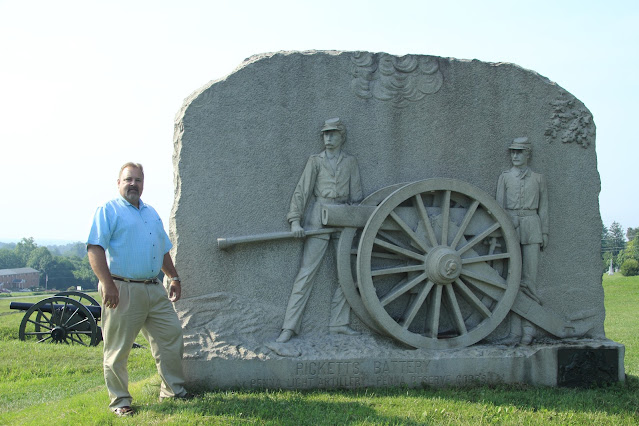
 |
| Author Rick Walton following the footsteps of the 6th North Carolina State Troops in Gettysburg on July 2, 2015. Copyright (C) 2015 Frederick Walton Photography |
By Rick Walton Copyright (C) 2015
continued from previous blog...
In "Walking in their Footsteps: Hoke's Brigade Attack on East Cemetery Hill (Part 1)" I started my Photo journey at the head of East Confederate Avenue, visited the ravine where Hoke's brigade sheltered, paused to read the memorial tablet and concluded at the southern branch of the Winebrenner/Culp run.
Now let's complete the journey...
Stop 3-Crossing Culp's Meadow
Photo 8 is the vicinity where Hoke's NC Brigade would have begun it's right wheel , which would face it toward the Federal battle line entrenched on East Cemetery Hill. Canons on the hillside above them, safely tucked behind earthen lunettes waited for the Confederates to come into range. The 6th North Carolina State troops, on the right of the brigade, would have been near or to the right of East Confederate Avenue, depicted as a fence line on period maps.
At this point, East Cemetery Hill is hidden by trees that would not have been there in 1863. Artillery on both Steven's knoll and East Cemetery Hill would have had a clear view of their wheeling enemy, subjecting them to a punishing cannon fire. Lieutenant Whittier, with Steven's Maine battery, watched, from his position on Culps hill as Hoke's North Carolinians began their wheel, admiring their skill and recalling later that it was
"a movement which none but the steadiest veterans could execute under such circumstances" [1]
a high compliment indeed.
 |
| Photo 8- View from “low bottom” around southern branch of Winebrenner/Culp run looking south. Culp’s Hill is to front and ECH is to the right beyond tree line. Copyright (C) 2015 Frederick Walton Photography. |
Colonel Archibald Campbell Godwin, commanding the 57th NCT on the left, and later becoming the brigade commander wrote:
"We continued to advance, however, under a terrific fire, climbed a rail fence, and still farther beyond descended into a low bottom, and dislodged a heavy line of infantry from a stone wall running parallel with our front." [2]
 |
| Colonel Archibald Campbell Godwin commanding the 57th NCT |
This description corresponds to map 23.2 in Bradley M. Gottfried's highly acclaimed book
"The Maps of Gettysburg". I have drawn in the red arrows to illustrate this better. The fence line where the 41st NY and 33rd Mass. are shown is approximately where East Confederate Avenue is today. Having previously given several tours for my friends and fellow reenactors in the 6th North Carolina State Troops, we share the satisfaction of knowing we have been walking where the 6th NCST walked in 1863 when we traversed this road.
 |
Map 23.1 from Bradley M. Gottfried's "The Maps of Gettysburg".
Used with permission from publisher, click title above for more info. |
While I am certainly in a "low bottom" standing just above the creek, it is probably not the place that Colonel A. Godwin described in the O.R.'s, since at this point he would have been leading the 57th NCT at the far left of the line. Author John Archer depicts this "low bottom" on a map in his book "The Hour was one of Horror" (page 79) as being in the adjoining field to my left, near where it says Menchley's Springs on Gottfried's map 23.1.
Consider the overall length of Hoke's brigade's wheeling line. Three regiments. One thousand soldiers. The 6th NCST, at the pivot, has a much shorter distance to travel than the 57th NCT at the left end. They have to make a wide arc to swing around and face the entrenched Federals behind the stone wall at the base of East Cemetery Hill. The temptation to take cover behind the stone walls they had to cross, or the hollows in the field must have been great, yet they moved on, as veteran soldiers facing unchecked rifle and cannon fire.
Still on the road, I climbed a slight incline rising from the Winebrenner/Culp Run. When I had reached the summit just beyond the tree (picture 8) I found that some of the rails had been removed from the fence, making my entrance into the meadow at this point an easy decision. Keep in mind what Godwin wrote..."we...climbed a rail fence." These are sturdy farm fences meant to keep livestock out of the crops. The top rail was almost shoulder height. Having climbed similar fences during reenactments, I can tell you that it wasn't easy getting my wool covered butt, up and over. The heavy leathers, canteen and haversack hang off your neck like an anchor, your loaded weapon is cumbersome and hazardous and your smooth bottomed, leather brogans are slippery and non flexible, a poor combination for fence climbing. Any reenactor reading this will be smiling and shaking their head in agreement. Been there...done that!
 |
Photo 9- View from place I entered the field looking north toward Winebrenner Run along the tree-line.
(C) 2015 Frederick Walton Photography. |
It was now a little after 6 pm, but overcast and gray. Though the temperature was only in the mid 70's, it was warm, still, and muggy. Even wearing light cotton pants and a short sleeve shirt, I was quite sweaty and hot. As a reenactor, I could easily imagine, from personal experience, the sweat drenched layers of cotton and wool worn by the soldiers in 1863.
Thanks to a 19th century, local Gettysburg man, Rev. Dr. Michael Jacobs, who taught at Pennsylvania (now Gettysburg) College as a Professor of Mathematics and Science, we have a record of the weather in 1863. Jacobs took weather observations three times a day, even as the fighting raged on around him. On July 2nd, 1863, he recorded cumulo-stratus clouds covering 70% of the sky, a light southern breeze and temperatures in the mid to high 70's peaking about 81 degrees about 2 p.m. This was similar to the weather I was experiencing. Perhaps slightly warmer then, but with almost total cloud coverage and no breeze during my tour, it was quite warm and muggy.
 |
Photo 10- View from field near East Confederate Ave looking south west toward Baltimore Road.
Copyright (C) 2015 Frederick Walton Photography. |
I entered a Culp's Meadow, a large field, knee high is grass. Walking through the tall grass took some effort to keep from tripping. Deer trails criss-crossed the field and several flattened areas suggested that they had served as isolated and hidden sleeping areas for them. I didn't see any deer, or any wildlife for that matter, although I was using my folded tripod to clear my path and make enough noise to warn s-n-a-k-e-s of my approach. I didn't see any, and didn't want too! My bigger worry was deer ticks, but I am happy to report that I didn't notice any on me after my adventure.
I paused to take a picture of the meadow (photo 10). Directly in front of me, hidden by the tree-line, is East Cemetery Hill. The trees would not have been there in 1863. My path (red arrows) followed some deer trails, or another intrepid adventurer before me, around the trees. This part of the meadow was fairly flat. Looking at contour maps after the fact, I may have inadvertently been following a slight ridge that crosses the field. In fact, it's visible in photo 10 if you look carefully. To my right the ground fell ever so slightly away toward the boggy edges of the Winebrenner Run. To my left the ground also falls slightly before rising again toward Culp's hill and Steven's Knoll.
 |
Photo 11- View from about 1/3 of the way across the field looking South west
toward Stevens Knoll and Baltimore Pike.
Copyright (C) 2015 Frederick Walton Photography. |
Picking my way across the meadow, I stopped again to record what I was seeing. Directly behind me in Photo 11 is Stevens Knoll on a saddle between Culp's Hill to the left and East Cemetery Hill, still hidden from my view by the trees in the direction I am pointing. I am holding a copy of Licensed Battlefield Guide, John Archer's book, "The Hour was one of Horror, [A tour guide to] East Cemetery Hill at Gettysburg". I found the maps and descriptions very helpful in planning my walk. It was also small and light enough for my haversack, and easy to refer to making sure I stayed on the approximate path of the 6th North Carolina. In the distance you can see the trees lining the Baltimore pike, on the horizon, which passes at the top of East Cemetery Hill and the iconic Cemetery Gatehouse which will be visible when I pass the next group of trees.
 |
| Photo 12- View from about 1/3 of the way across the field looking back from starting point, north east, toward Culp House and East Confederate Avenue. Copyright (C) 2015 Frederick Walton Photography. |
I also took a moment to look behind me (Photo 12) toward the rail fence lining East Confederate Avenue and my path though the tall grass. Just out of site, on the right horizon, would be Benner's Knoll, where General Early's Confederate artillery was deployed. Unfortunately their position was inferior to the Federal's ahead of me on East Cemetery hill. Hoke's Brigade started their march in the ravine to the left, just below the crest of the hill beyond the rail fence and behind the tress which generally follow the line of the stream.
 |
Photo 13- View from about 1/2 of the way across the field looking South west toward Stevens Knoll
and Baltimore Pike. Copyright (C) 2015 Frederick Walton Photography. |
I advanced the rest of the way across the field to the tree line (absent in 1863). My route was funneled by the modern wire fence line to this open gap, close to the trees. I noticed the ground was a little boggy and chopped up. The James McKnight house, present during the battle, may be seen In the distance. It is located on Slocum Ave which connects Wainwright Avenue to The Baltimore Pike. The large tree to the right of the house is probably near Menchey’s Spring along Brickyard lane/ Wainwright avenue. This is where the 41st NY and 33rd Mass took their place on the far right of the Federal line as seen on Map 23.3. This would be the objective of the left of Colonel Avery's line.
 |
Map 23.3 from Bradley M. Gottfried's "The Maps of Gettysburg".
Used with permission from publisher, click title above for more info. |
Coming through the gate and moving back toward my original track, I stopped ( Photo 14) to finally observe my objective, unhidden by trees. Photo 14 is labeled with several things I observed. First of all, this is not a flat field, As I advanced over it, I found myself walking along a slope, quite high in some spots (photo 16). At the top of the hill directly in front of me lies the iconic Cemetery Gate. In front of that, across the Baltimore turnpike and on the crest of East Cemetery Hill are the guns of Rickett's Battery, well protected by earthwork lunettes.
 |
Photo 14- View from about 2/3 of the way across the field looking South west toward Stevens Knoll
and Baltimore Pike. Copyright (C) 2015 Frederick Walton Photography. |
The large tree and the stone wall vertically rising up the hill behind it are depicted on the map near the center of the 153rd PA. I set this as my destination and, as you can see, had an uphill climb. It was nearly 6:30. I was glad I brought a canteen. Even after a large gulp of water, sweat dripped down my brow and my damp clothes were sticking in all the wrong places. My eyeglasses were either sweaty or foggy or both. I'm not complaining, just getting annoyed by the terrible light (a photographers worst enemy) and my reduced ability to see my camera focus with my foggy glasses. I could see the end in sight and started to think cold shower and cold beer, but I had to resist the temptation to rush through the last and most important part of the attack. At least I wasn't fumbling forward in the darkening twilight with cannons roaring and minnies zipping past my head!
Turning around once again I looked back. (Photo 15) It had taken me nearly half an hour to come this far across the field (including camera time). If you enlarge the photo, you should be able to see a blue water tower just above the 3rd arrowhead from the left. This, I have been told, is a good visual reference for the Confederate Artillery at Benner's Knoll.
 |
| Photo 15- View from about 2/3 of the way across the field looking back toward starting point, east, toward East Confederate Avenue. Copyright (C) 2015 Frederick Walton Photography. |
The slope of the hill is not as obvious in Photo 14, but as I continued forward, the ground rose on my left, at one point, enough to block my view of Steven's knoll, and thankfully, if I was attacking with the 6th North Carolina, the artillery's view of me! Although I didn't make the climb up and over this rise, it descends to the "low bottom", mentioned by Godwin. The treetops peeking above the ridge would be where the field rises up out of the bottom toward Culp's Hill and Steven's Knoll.
 |
Photo 16- View from about 3/4 of the way across the field looking South west toward Stevens Knoll
and Baltimore Pike. Notice the rising ground hides Stevens Knoll from our view and vice-versa.
Copyright (C) 2015 Frederick Walton Photograph |
Photo 16B, (taken by me in June 2014) is a Panoramic view from Steven's Knoll of the other side of the rise shown in Photo 16. It gives you a perspective of the undulating ground that had to traversed by the 21st NC and the 57th NC on the left of the line. (Click to enlarge the Panorama and scroll back and forth.)
 |
| Photo 16b- Panoramic view, composed from 2 pictures, from Stevens Knoll looking North. Notice the undulating ground over Which Hoke's Brigade charged. Copyright (C) 2014 Frederick Walton Photograph. Click to enlarge. |
Photo 16C is a familiar period drawing, preserved on a plaque at the top of East Cemetery hill, from a similar vantage point of the Panorama in 16B. Notice the fields are bare of trees at the time of the battle because this was actively being farmed.
 |
Photo 16c- Sign on top of Cemetery Hill near Rickett's Battery.
Copyright (C) 2015 Frederick Walton Photograph |
Stop 4- The Stone Wall at Brick Yard Lane
I veered toward the tree shading the marker for the 153rd Pennsylvania. Briars and other prickly weeds in this section of the field made walking a bit hazardous. I was still walking uphill, and frankly, getting tired! Wainwright Avenue towers several feet above the edge of the field, raised by an old retaining wall and separated by a very overgrown and tumbling down stone wall topped by a haphazard snake rail fence.
This is where the first contact with the enemy was made.
"The enemies batteries kept up a terrific fire, but most of the shells and grape passed over our heads,"
wrote 28 year old Pvt. Thomas Causby of the 6th North Carolina, Company D.
"Our brigade charged in good order it until we were within a short distance of the stone fence, which did not extend all the way across the face of the hill. Here the brigade spread out across the face of the hill, part of the men making for the end of the fence, as I recollect. About 75 of our brigade, led by Col. Tate and Capt. Neill Ray, charged directly on the Stone fence, which we crossed and then bayoneted Yankee gunners and drove them back after a hard fight." [3]
 |
Photo 17- View across Brickyard road at the base of East Cemetery Hill and final charge to
Rickett's battery on top of the hill. Copyright (C) 2015 Frederick Walton Photography. |
I selected a fairly stable looking place to cross over and found myself on a quiet, deserted, paved Wainwright Avenue. Oddly quiet, considering this was the anniversary day of this battle. In 1863 Federal troops would have made crossing this stone wall very difficult!
"In the evening we charged some batteries on the side of a mountain. Our brigade [Hoke's] and the Louisiana brigade we move[d] steadily on them under the most terrific fire I ever saw. We came in contact with a line of infantry behind a stone fence. They stood their ground until our men got to the fence and actually [had to] club them over their heads with the butts of their guns yet we moved on to the heights, But they were so strongly supported, we were repulsed. In all the battles I have ever been in that was the hardest. The batteries were placed one above another on the hill so as to shoot over one another and every one a line of infantry all around the mountain. It was impossible to drive them off. " [4]
 |
| Photo 18- Wainwright Avenue looking North- Copyright (C) 2015 Frederick Walton Photography. |
"As we approached the hill the guns on Battery Hill [Stevens Knoll] , over towards Culp's Hill, had an enfilading fire on us. Still our men rushed forward, crawled over the stone wall near the base of the hill, drove from behind it a strong line of infantry, and went still forward to the top of the hill, and silenced the numerous pieces of artillery that had been so advantageously post
ed. We had full possession of East Cemetery Hill, the key to General Meade's position, and we held it for several minutes." [5]
 |
Part of the mural at the Lincoln Library in SpringField, Illinois.
The fight for East Cemetery Hill. Copyright (C) 2015 Bruce Zigler |
"We turned some of the guns on the enemy and tried to fire them, but most of them had been spiked by the Yankees. By this time it was getting dark, and the enemy we had driven back had been heavily re-enforced, and after remaining beyond the fence some fifteen or twenty minutes we withdrew and rejoined our brigade." [6]
 |
Photo 19. View from Rickett's Battery on top of East Cemetery Hill. 153rd Pa. Marker near tree on right.
Copyright (C) 2015 Frederick Walton Photography |
Almost in front of the place I crossed the stone wall, was a marker for the 11th Corp, 1st Div., First Brigade of Colonel Leopold Von Gilsa who where assigned to defend this sector. The weary Yankee's, who had taken a beating from Hokes Brigade the previous day, now desperately tried to prevent the Confederates from overrunning their position.
 |
Photo 20- XI Corp Marker on Brickyard road at the base of East Cemetery Hill near where the
6th North Carolina State Troops over ran the defenders. Copyright (C) 2015 Frederick Walton Photography. |
"The Confederates... charged from the darkness with a yell and with bayonets fixed. The attack on the two weak New York regiments in the center of the line was of great violence. The New Yorkers had been struck at Chancellorsville and again the day before at Gettysburg and were probably shaky- if so with good reason.The Tarheels shot and killed Sgt Heinrich Michel, color bearer of the 54th [NY], almost immediately and wounded his two successors severely. Soon the surviving members of the 68th [NY] and the 54th [NY] regiments retreated up the hill, probably the first troops on von Gilsa's line to go." [7]
These troops, posted to the left of the 153rd Pennsylvania opened a gap which Major Samuel McDowell Tate, leading members of the 6th North Carolina and Louisianna Tigers to his right, would exploit to climb the hill and attack Rickett's Battery.
Just as I had set my sights on their marker, so did members of the 6th NCST who hit the 153rd Pennsylvania head-on. Lieutenant Miller of the 153rd Pa. recalled:
"The fight was on in all its fierceness, muskets being handled as clubs; rocks torn from the wall in front and thrown, fist and bayonets used, so close was the fighting" [8]
 |
| Photo 21- 153rd PA. Marker on Brickyard road at the base of East Cemetery Hill near where the 6th North Carolina State Troops over ran the defenders. Note Cemetery Gatehouse peaking over crest of hill above. Copyright (C) 2015 Frederick Walton Photography. |
Harry W. Pfanz in "Gettysburg, Culp's Hill and Cemetery Hill" recounts the story of the Confederate flag.
"A rebel color bearer, rifle in one hand and flag in the other, jumped on the wall and shouted, "Surrender you Yankees", and in an instant a Pennsylvanian jammed him with his bayonet and fired his rifle into him at the same time. Lieut. Miller remembered long after how the ball tore shreds from the back of the color-bearers blouse. The man fell backward, holding both of his rifle and the colors. The flagstaff rested briefly across the wall. A Union soldier grabbed for it, and a Confederate grasped its other end. There was a tug-of- war, and the Confederate won."
Could this have been either the battle flag of the 6th NCST, now hanging in the Gettysburg Museum or the Blue Regimental "Fisher flag", reportedly carried at Gettysburg, and now displayed in the Museum of History in Raleigh?
 |
Author with Battle flag of the 6th North Carolina at Gettysburg museum.
Copyright (C) 2014 Frederick Walton Photography |
 |
Reenactors from the 6th North Carolina State Troops holding the reproduction blue regimental "Fisher" Flag
Copyright (C) 2014 Frederick Walton Photography |
 |
| Photo 22- 41st NY Marker on Brickyard road at the base of East Cemetery Hill near where the 6th North Carolina State Troops over ran the defenders. Copyright (C) 2015 Frederick Walton Photography. |
Next in line, The 41st New York had fallen back with the 33rd Massachusetts from skirmish duty in Culp's meadow. The 33rd anchored the far right of the Federal line. The right wing of the 41st NY held firm with the 33rd Massachusetts against the 57th NCT, but the left, unable to withstand the onslaught of Tar heels, was swept away, New Yorkers fleeing up the dark hill behind them.
"The hour was one of horror. Amid the incessant roar of the canon, the roar of musketry, and the glare of bursting shells making the darkness intermittent-adding awfulness to the scene- the hoarse shouts of the friend and foe, piteous cries of the wounded and dying, one could well imagine...that "war is hell". [9]
 |
Photo 23- The 33rd Massachusetts Infantry monument
source: http://historicaldigression.com/2013/05/11/33rd-massachusetts-infantry-at-gettysburg/ |
Too tired to walk all the way down to this monument, I found this great photo on the web. The 33rd Massachusetts Infantry monument is located at the intersection of Slocum and Wainwright Avenues near Steven’s Knoll. It was placed in 1885.The 33rd Mass refused their line to meet the attacking Confederates.
"The enemy came on gallantly, unchecked by our artillery fire, and my regiment opened a severe musketry fire on them, which caused gaps in the line and made it stagger back a little, It soon rallied and bravely came within a few feet of our wall, though my men clung unflinchingly to it and steadily poured in their fire. I ordered them to fix Bayonets to be ready for the enemy, but at this time Stevens [Maine] Battery, then under command of Lieutenant Whittier, to my right, opened on them at point blank range, and this fire and the continued fire of my regiment the enemy's line, said to be Hoke's Brigade of North Carolinians [more specifically, the 57th NCT in this sector] which was almost on to us, their colors nearly within reach, was broken and finally driven back, leaving great heaps of dead and wounded just in front of us." [10]
 |
| Photo 24- Rickett's battery position from base of East Cemetery Hill. Copyright (C) 2015 Frederick Walton Photography. This is the stone wall Major Tate ordered the North Carolinians to take cover behind. |
Lieutenant Colonel Samuel McDowell Tate next described the action from the confederate side in a report to North Carolina Governor Vance. Tate was advanced to lieutenant colonel on 2 July 1863 at Gettysburg where he assumed command of the Sixth North Carolina Regiment after the death of Colonel Isaac E. Avery. He led his troops up East Cemetery Hill and continued to command the Sixth regiment until the close of the war.
"75 North Carolinians of the Sixth Regiment and 12 Louisianians of Hay's brigade scaled the walls, and planted the colors of the Sixth North Carolina and Ninth Louisiana on the guns.
It was now fully dark. The enemy stood with a tenacity never before displayed by them, but with bayonet, clubbed musket, sword, and pistol, and rocks from the wall, we cleared the heights and silenced the guns.
 |
| Samuel McDowell Tate describing the fight at Ricketts Battery |
In vain did I send to the rear for support. It was manifest that I could not hold the place without aid, for the enemy was massed in all the ravines and adjoining heights, and we were then fully a half mile from our lines.
Finding the enemy were moving up a line, I ordered the small band of heroes to fall back down the crest to a stone wall on the side of the hill [photo 24], where we awaited their coming. Soon they came over the hill in pursuit, when we again opened fire on them, and cleared the hill a second time.
Very soon I found they were very numerous in the flats in my rear, and now became the question of surrender or an effort to retreat. There was a calm and determined resolve never to surrender (one of our North Carolina regiments had done so the day before) and, under cover of the darkness, I ordered the men to break and to risk the fire. We did so, and lost not a man in getting out." [11]
 |
| Photo 25- Col. Samuel McDowell Tate Visiting Rickett's Battery in 1894 |
Other members of the 6th North Carolina who fought there told the same story in their own words:
"We charged the Yankees where they were on a hill & in their breastworks[.] we took them but we couldn't hold them and was compelled to fall back [.] I thought I had been where grape and canister and minnies flew, but I never was in a place like this[.] our loss was heavier and it ever was[.]" [12]
and repeated by another, Captain Neill W Ray:
 |
| Captain Neill W Ray describes the action on East Cemetery Hill |
"It was then after daylight had gone down, the smoke was very dense, and, although the moon was rising, we could not see what the enemy was doing, but we could hear him attempting to rally his men, and more than once he rallied close up to us. But our men had formed behind a rock wall [Photo 24], and as he approached we fired a volley into him, which drove him back. This occurred at least twice. No one who has never been in a similar position can understand how anxiously we looked for re-inforcements. None came, however, and before long orders came for us to fall back to our original position." [13]
 |
Photo 26. View of Rickett's Battery on top of East Cemetery Hill on July 3, 2015.
Copyright (C) 2015 Frederick Walton Photography |
Above and behind him shots coming into his rear caused Col. Underwood of the 33rd Mass to send his adjutant to see what was going on:
"He soon reported that the enemy was there, having captured some of our artillery. One part of the line seem to be in a precarious position, But not long after it was ascertained that the enemy were driven out." [14]
This was confirmed by the oft quoted diarist from the Old North State, Barlett Yancy Malone , 6th North Carolina, Co. H., who recorded:
 |
Bartlett Yancey Malone, 6th North Carolina State Troops
|
"We charged and succeeded in driving the infantry from behind two stone fences and got part of the batteries but it was soon so dark and so much smoke that we couldn't see what we was a doing. The enemy got together again and we had no reinforcement and had to fall back to our old position." [15]
How bittersweet their victory. It was a place of strategic importance to the Federal line, and yet it couldn't be held. When placing his battery, Captain Rickett's was informed by his superiors:
"Captain, This is the key to our position on Cemetery Hill, and must be held...[at all hazards]" [16]
 |
Photo 27- Rickett's battery position from base of East Cemetery Hill in the setting sun.
Copyright (C) 2015 Frederick Walton Photography. |
Captain Neill W. Ray, an officer of the 6th NCST recalled this bitterly when writing the history of the 6th NCST many years later.
" By not supporting Hoke's Brigade of North Carolina and Hays' Brigade of Louisiana in the storming and capturing of Cemetery Hill the battle of Gettysburg was lost. I do not know whose fault it was, but I feel assured in saying that it was not the fault of the storming column. It did its whole duty and fell back only when orders came for it to do so.
Much has been written about the battle of Gettysburg, and what was accomplished by the different commands and the troops from the different States. But, at the risk of being charged with immodesty, I venture to claim that the storming and capturing of Cemetery Hill on the evening of the second day was not surpassed by anything that was done during the three days' fight. The facts on which the claim is based will appear to any one who will go to the spot. He will there see the positions of the contending armies and the strength of the hill. The breastworks and embankments protecting the enemy's guns are still plainly visible. Its defenses and the lines of the positions of its defenders are all marked by durable monuments. And on the topmost summit he will find a cluster of monuments, the inscriptions on which recite the desperate assault made by Hoke's and Hays' Brigades on the 2d of July, 1863, and especially mention the hand-to-hand conflict, after the last round of ammunition had been fired and the capture and spiking of the enemy's guns by the Confederates." [17]
As I stood on Wainwright avenue, in the gathering dusk, having completed my tour and taken my last photo, I was hot, tired and thirsty, It occurred to me that it was only 7 pm now, still two hours until the Confederate's would have begun their charge in 1863. What spirits might I have encountered if I had waited?
 |
| Photo 28- In Remembrance- Saluting the troops. Copyright (C) 2015 Frederick Walton Photography. |
This, then is my salute to the brave young men, of both armies, that fought on these slopes. But especially to the men of the 6th North Carolina State troops who I have come to respect and honor after studying their deeds for the last two decades.
Too hot and tired to walk up the slope to "re-capture" Rickett's battery, I headed down the level, paved avenue in front of me, back toward the Winebrenner house. Back to my B&B. Back to a nice cool shower... and a nice cold beer.
Footnotes:
1) Pfanz, Harry, "Gettysburg, Culps Hill and Cemetery Hill", Chapel Hill, UNC Press, 1993, Pg 255
2) The war of the rebellion: a compilation of the official records of the Union and Confederate armies. ; Series 1 - Volume 27 (Part II);No. 473.; Report of Col. Archibald C. Godwin, Fifty-seventh North Carolina Infantry, commanding Hokes brigade.
3) Causby, "Storming the Stone fence at Gettysburg." from the Charlotte Observer, March 11, 1901.Republished in Southern Historical Society Papers, Volume 29.
4) Carrington, Sim, "I heard the Yankee drums beating, PP 186-189
5) Ray, Neill W., "The Sixth Regiment"in "Histories of the Several Regiments and Battalions from North Carolina in the Great War, 1861-1865", edited by Walter Clark and published by the state of N. C. in 1901.
6) Causby, "Storming the Stone fence at Gettysburg. from the Charlotte Observer, March 11, 1901.
7) Pfanz, Harry, "Gettysburg, Culps Hill and Cemetery Hill", Pg 261
8) Gottfried, Bradley M., "The Maps of Gettysburg", El Dorado Hills, Ca., Savas Beatie, 2007, pg 220
9) Archer, John, "The Hour was one of Horror" , Gettysburg, pa,, Thomas, 1997, P. 64
10) Report of Col. A.B. Underwood, 33rd Mass., 12/9/1881, in Authors collection from GNMP files.
11) Report of Samuel McDowell Tate to Governor Vance, N. C. Archives
12) J. J. English, Co. E, July 9, 1863 Letter to his Aunt and Uncle, courtesy of Ernie Dollar.
13) Ray, Neill W., "The Sixth Regiment" in "Histories of the Several Regiments and Battalions from North Carolina in the Great War, 1861-1865", edited by Walter Clark and published by the state of N. C. in 1901.
14) Report of Col. A.B. Underwood, 33rd Mass., 12/9/1881, in Authors collection from GNMP files.
15) Malone, B. Y., " Whipt 'em Every time"
16) Pfanz, Harry, "Gettysburg, Culps Hill and Cemetery Hill", Pg 253
17) Ray, Neill W., "The Sixth Regiment" in "Histories of the Several Regiments and Battalions from North Carolina in the Great War, 1861-1865", edited by Walter Clark and published by the state of N. C. in 1901.


