Showing posts with label Reenacting Stories. Show all posts

Looking Back 20 Years- Living History at Gettysburg- 1997

(c) 1997 by Rick Walton

Lt. Col. Jeff Stepp (1955-2017), commanding the 26th Reg't N.C.T. , invited members of the 6th N.C.S.T. to join them at Gettysburg on Aug 15-17 1997 for the second annual National Park Service invitational Living history, march and musket firing demonstration in conjunction with the 24th Michigan infantry. Wes Jones and myself were the only two members of the 6th NCST to make this memorable Journey. 

Here is my recollection as reported in the 6th North Carolina State Troops newsletter following the event: 

Screen Shot 2017-08-06 at 9.28.53 PM.png.jpg

If your idea of a living history event is sitting around in the shade while occasionally explaining the contents of your knapsack to curious spectators, then be glad you didn't come with us on the weekend of August 15, 16 and 17. The weekend was an opportunity to truly "live" history, but it came at a sweaty, tiring cost. My thanks to the 26th for letting us fall in with them as "Volunteer Park Rangers".

How many re-enactors can claim that they camped on the actual battlefield at Gettysburg?

How many re-enactors can claim that they camped on the actual battlefield at Gettysburg? Or recreate the Pickett-Pettigrew charge across the very terrain that Lee's Confederates traversed on July 3, 1863? With our flags flying and under arms! Private Wes Jones, Rick Walton and the nearly 100 other North Carolinians who made the long trip to Gettysburg for this event can. The weekend was fun, hot, exciting, hot and busy. And hot. Walking in the shadow of our ancestors made it particularly special. I heard it described as an emotional roller coaster. We each have our own reasons for reenacting (which we had to reevaluate often when the 101 degree heat index zapped our energy and parched our throats) but when we stood on the same killing ground that our ancestors fought upon, we realized precisely why we do this. Dealing with emotions is tough business for manly men like us, so imagine how hard it was to keep your pards from seeing that tear in your eye. But dry eye's were often the exception, not the rule this weekend. Each person faced their emotions in their own private way, but everyone who attended will forevermore remember the sacrifices that were made by our forefathers on this faraway battlefield.

We arrived at the camping grounds in Pitzer's woods late Friday afternoon. We dropped off our gear and headed in to Gettysburg to walk the quiet streets, pausing to visit suttlers, bookstores and relic shops. We even squeezed in a little battlefield sightseeing. We bypassed the multitude of tourist shops selling T-shirts and plastic battle flags and began to concentrate on finding an eating establishment that would ease the hunger pains. We were anxious to quench our thirst and knowing that the National Park Service took a dim view of imbibing on park property, we knew that this would have to last us all weekend. We were pleased to find a place with pitchers of our favorite beverage on special. As we studied the menu, or waitress asked us if we were here for the "reenactment", advertised on a poster in their front window. Wes quickly replied "Why, do we stink already?" As we raised the frosty beverage to our parched mouths we thought that we had never experienced such relief. Little did we know the test of endurance that awaited us during the next two days, when an single drop of water would become a priceless commodity.

After dinner we returned to camp to participate in an event called "moving 50 cars to a parking lot 2 miles away and getting everyone back to camp before daybreak". We played follow the leader as a long caravan of North Carolina tags snaked it way thought the moonlit battlefield lanes. We got a lift back in a shuttle, but several of our comrades took a wrong turn and weren't seen for hours.

19971206 6th NCST Christmas Dinner 6.jpeg

When we got back to camp, we strolled over to the artillery section where we were welcomed and offered a treat. A small barrel shaped container held something sloshing around in a liquid. Encouraged to try one, I cautiously withdrew a floating sphere and discovered that it was a Cherry that had been bathing in a solution, somewhat stronger than water, for several days. Wes immediately christened them "Canister", because they look like grapeshot and if you eat enough of them they'll kill you..

Saturday Morning

We awoke to the smells of sizzling bacon. Since there was no commissary, we were forced to rely on the cooking skills we had developed recently at Manassas. After Breakfast, the troops were mustered and the orders of the day were read. Any hope of a relaxing, low impact event were quickly abandoned. We started with drill, then had some drill followed by more drill. But this was the easy part, conducted in the coolness of the morning (barely reaching 90 degrees). It didn't get hard until after lunch, in the heat of the day, when we went on the "death march".

Joining the 26th for this event were representatives from the 6th NCST, 21st NCT, 25th NCT, and 38th NCT as well as the 1st NC Artillery and their horse drawn battery. The morning report showed 105 men present for duty. We were also joined by a rag tag collection of about 15 Marylanders portraying the 1st and 14th Tennessee Volunteers, but the heat "prevented them" from participating in anything but a firing demonstration on Saturday.

Coming down from the Detroit area, were the 24th Michigan, who historically clashed with the 26th in McPherson's woods. This weekend, the 24th encamped near the Pennsylvania Monument to provide a living history from a Yankee perspective.

After lunch the North Carolinians galvanized and began the 2 mile "death march" to the Pennsylvania monument to join the 24th for a joint firing demonstration. We left camp with banners flying , to the beat of the brigade band. Rather than take the "long way" via the park roads, the rangers "allowed" us to go cross country through the fields. At first this made sense , until we got halfway across and ran into a cornfield. We went from column of four to column of two to single file and zig zagged our way through some poor farmers struggling corn crop. (It was rumored, by some of our comrades who also reenact WWII, that this was evasive maneuvers to prevent Nazi U-boats from stalking us).

Codori Barn on Gettysburg Battlefield


Finally reaching the other side, we reformed and marched down the farmers driveway to the highway only to discover that stone walls and fences prevented us from crossing the road. The head of the column executed a "counter march by files right" and before the end of the column knew what was going on, we were passing them on the way back to where we just came from. We tramped across the farmers back yard to a farm lane, following it until a crossing point was found. We entered the welcome shade of another farm yard and took a few minutes rest. By now the canteens were starting to get dry and the Pennsylvania monument was still a shimmering point on the hazy horizon.

Forming up again we proceeded our march down park roads, farm lanes and across still more fields. Women from the 26th NC Soldiers Benevolent Society had driven over from the camp with cold water and ice cubes and were waiting for us under a huge shade tree a couple of hundred yards from the monument. These ladies were indeed angels of mercy. The men fell out to refill canteens and quench powerful thirsts. After a short and welcome rest, we resumed our march and finally joined the 24th Michigan. The large, waiting crowd appreciated the live firing demonstration. Dreading the long march back , we were relieved when air conditionedshuttle vans appeared. When I got to camp I collapsed in a tired, sweaty heat. Who say's living histories aren't as tiring as battle reenactments? I could have stayed there all night but the day was not yet over. We had to change back to gray and get ready for a monument ceremony at 6:00.

19970816 Rick and Wes at Gettysburg.JPG


Still exhausted from the death march, we were thankful to be loaded onto the artillery trailers for the trip up to McPherson's ridge. Hidden just beyond busy Rt. 30, down a quite park lane, are two monuments, one to the 26th North Carolina and opposite that, another to the 24th Michigan. It is on this site that the two regiments met in battle and did their best to obliterate each other.

IMG_5330.jpg

We marched the short distance, under thegreen canopy of shady trees, to the monuments. A small group of spectators trailed at a respectful distance. Upon reaching the monuments, the brigade divided. The 24th Michigan fronted, backs to their monument, while the 26th NC did the same in front of the North Carolina monument. As the last echoes of the fife and drums dissolved into the still evening air, the two regiments stood facing each other, on opposite sides of the road, exactly as their ancestors had done in combat 134 years earlier. But this evening it was a mutual respect that brought the forces together.


24th Michigan Monument at Gettysburg

1st Sgt. Jim Taylor, of the 26th Regt N. C. T., stepped forward with his guitar to begin the program, singing a 19th century version of "Auld Lang Syne". Next Colonel Stepp spoke eloquently about the sacrifices made by the 26th on this spot. He recalled the succession of brave flag bearers, including Colonel Henry K. Burgwyn, who died urging their comrades forward. As the bloody and tattered flag fell for the thirteenth time, Lt. Col. John Randolph Lane grabbed the splintered flag pole exclaiming "No man can take these colors and live! It is my turn to take them forward". Determined to drive the enemy back, he shouted "26th North Carolina, Follow me!" The 24th Michigan momentarily ebbed from the onrushing Confederates, but stubbornly reformed. Lane fell horribly wounded, "the last to discharge his deadly duty that day." Within 20 to 30 minutes, 679 Carolinians fell following the colors in the short and vicious fight. Colonel Stepp reminded us, as Colonel Lane reminded his surviving comrades many years earlier at this same spot, about the importance of the regiment as an extended family. How the loss of a comrade was felt as severely as the loss of any family member. He also talked about remembering and honoring those that came before us. As we stood in the dimming light, our thoughts turned to the sacrifices made on this ground and the human tragedy that awaited the families of the slain back in North Carolina, so far away. The Commander of the 24th Michigan delivered similar remarks, recounting the sacrifices made by the Iron brigade who had an equally high loss. At the conclusion of the remarks, soil from all 100 counties in North Carolina was spread around the base of the N. C. monument consecrating the ground

Portrait of three Cnofederate colonels: Harry K. Burgwyn, John R. Lane, and Zebulon Vance, by William George Randall, 1904. Item H. 1914.290.1. from the collections of the North Carolina Museum of History.  Courtesy of the North Carolina Department of Cultural Resources.
THE THREE COLONELS OF THE 26TH N.C.T.
Col. John R. Lane, Col. Henry K. Burgwyn, Col. Zebulon B. Vance. Painted in 1904 by William George Randall. Painting currently hangs in the North Carolina Museum of History, Raleigh, NC

We marched back to the waiting trailers and piled on. Because of the one way streets, we had to shuttle through Gettysburg on the way back to camp. Can you imagine how many laws we broke? Nearly 100 dirty, sweaty men, dressed in Confederate uniform, no seat belts, Guns pointing every which way. What a site we must have been.

I was exhausted when I got back to camp! I stripped off my hot jacket and poured water over my head. The smells of supper cooking tempted my tired body, but it was no use. The corn, potatoes and canned meat stayed in my knapsack. I was too tired to attempt anything so dramatic and was content to open a cold can of beans for supper. Now I understand how solders could sleep on the march or on a pile of rocks, like we read about in their diaries.


As the shadows lengthened, I noticed groups of people drifting over to the nearby Amphitheater. The National Park service was about to put on a program about battle flags. Fortified by a tin cup of something thankfully stronger than water, Wes and I wandered over with some of our comrades and settled in for the evenings program.
Anticipating the Ranger would bow to the dictates of political correctness, our expectations were understandably low. We were pleasantly surprised when he went into a scholarly presentation which more than adequately explained the meaning and importance of the Confederate flag. References to North Carolina's contributions were frequent. We were very impressed.

Sunday morning

Sunday morning came too quickly, as we rustled our weary bones. A brief shower during the early morning hours, accompanied by a stiff northerly breeze, served to cool things down considerably and I found myself wrapped tightly in my blanket to keep warm. The air was actually pleasant, a big change from the stifling heat of the day before. Shortly after breakfast the company streets reverberated with Sergeants echoing first call. We quickly coutered up and assembled on the parade ground. Roll call, size march, count off 1-2-1-2 and we were ready for another busy day. The regimental band struck up a stirring anthem and we began the mile long march toward the North Carolina Monument . The heel plates clicked on the pavement in loud synchronization with the down beat of the regimental drum causing every breast to swell with pride to be part of this grand spectacle. The cool morning air gave way to the approaching warmth as the stillness began erupting with the sound of peepers singing their peculiar tribute to the swelling heat. Faces glistened in the early morning sun, as streams of sweat began its journey from beneath 100 hat bands. The officers brought us from shoulder arms to right shoulder shift to support arms and back again at just the right moments to give our weary arms a rest. Tourists, taking an early morning drive down Confederate avenue, were surprised to see genuine Confederate soldiers on the march.

Image-08

As we approached a shade covered stretch of road, the music echoed from the trees. Looking into the shady glen, I could almost visualize a phantom army of our forefathers dropping their various camp duties to rush to the roadside and approvingly cheer us on. A loud and spontaneous Rebel yell reverberated through the surrounding forest in response to the band's opening chords of Dixie. The battle flag snapped in the breeze as the men, heads held high, executed a sharp turn at the monument to the applause of the approving crowd gathered there. The pounding of my heart competed with the drum as I stood at attention waiting for the ceremony to begin. Colonel Stepp stood in front of the North Carolina monument facing the brigade. His inspiring remarks caused us to once again reflect on the men we were honoring and the pride we felt as North Carolinians. He called forward representatives to tell what each of their regiments did at Gettysburg.

1997 Gettysburg LH Group.jpg

Colonel Stepp dismissed us to spend a private moment honoring our ancestors. I saw a soldier directly in front of the monument, on bended knee, hat over his heart and head bowed, honoring those who made the ultimate sacrifice by crossing the field behind us. Just then a gentle rain began falling from the overcast skies and lonely bugle call could be heard from a nearby boy scout camp. Someone later recalled that it seemed as if God himself shared our pride and grief while letting his tear drops fall gently to the earth. The brigade posed for a group photo and then formed up to returned to camp, but before departing we were treated to an interesting history lesson about the North Carolina monument. It was Sculpted by Gutzon Borglum, creator of Mount Rushmore, and unveiled in 1929. In 1982, while members of the 26th participated in programs at Gettysburg, it was resolved to restore the sadly deteriorated monument suffering from the ravages of man and time. After struggling with government red tape for three years, this grass roots effort caused our state legislature to delegate $9,800 for cleaning & preservation. Other states soon followed and today all the Statues along Confederate avenue stand proudly shining in the sun.

1997 group.JPG

We returned in time for church services, followed by a regimental meeting. Nearly 100 of us sat in a huge circle and over the course of more than an hour, each person had a chance to speak their minds. Themes about the regiment being like family, the camaraderie, brotherhood and shared devotion to a common cause were repeated by many. The pride of our heritage, association with the 26th and life long memories were also referred to. We discussed the assault on Southern heritage so popular in the politically correct climate of today. Emotions were stretched, racing from moments of tearful sadness and pride, to roaring laughter. Spectators wandering through the camp were drawn to the circle and couldn't tear themselves away from the heartfelt stories. They stood a respectful distance behind us, occaisionaly dabbing their eyes or joining the laughter. They shared a unique look into the culture of American Civil war re-enacters.

After a quick Lunch, we assembled for the final time and marched across the street for a firing demonstration. Curiously, we fumbled through the motions we were so proficient at earlier in the weekend like raw recruits. Was the heat starting to get to us or were our minds on the long awaited event about to commence?

1997 Gburg LH 4.jpeg

We marched out of the field to the applause and appreciation of the spectators and began the march down the now familiar Confederate avenue toward our destination at the Virginia Monument. Waves of heat shimmered of f the surface of the road in the 95 degree heat. Looking down at the pavement, we could see the imprints of our horseshoe shaped heel plates marking our progress on the softening tar giving a new meaning to the term "tar-heel". Our column turned into parking area of the monument and fell out in the cool shade to refill our canteens. We reformed and were positioned in a line of battle overlooking the field we were about to cross. Behind the stone walls, over a mile away, waited the blue coated 24th Michigan.

Jim Taylor stepped forward and sang a poignant song about two comrades about to go into battle. They each promised contact loved ones should either fall in the coming battle. When the smoke cleared, both lie slain on the field of honor with no one to tell their loved ones anything. As we gazed across the hazy field, we wondered how many times this scenario had been repeated on that tragic July day 134 years ago.

Image-06

Our wandering minds were abruptly snapped back to the present as the Colonels orders rang out. The dream of every reenacter was about to be realized as our 100 man brigade entered the field under arms, with flags flying. To our rear, General Lee's calm and approving gaze watched our progress from his post atop the Virginia Monument. Our Sergeants implored us to dress the line as me marched forward in careful synchronization. Someone began calling out the landmarks, reminding us that it was here that artillery would begin disrupting the line and , latter, the point that musketry would find its deadly target. Crossing the Emmitsburg pike, we reformed for the final charge. The muzzles of cannon pointed menacingly toward our line. The huge Federal flag could be seen waving behind the silhouettes of the blue coated defenders as the sun glinted off the polished barrels of dozens of muskets secure behind the rugged stone wall.

Emotions were once again racing as the rebel yell exploded throughout our line. The brigade surged forward and was about to charge over the last few yards in a exuberant rush, but the officers and NCOs quickly restored order and we marched to the base of the bloody angle in a well dressed line. A friendly Michiganer gave me his hand to help me across and greeted me, but the lump in my throat prevented me from responding with anything more than a nod. I am confident that many of my comrades shared my plight. The surrounding crowd burst into cheers having just witnessed a stirring and emotional event. If I hadn't been participating, I would have wanted to be a spectator that afternoon. We reformed on the road behind the angle and marched to the Pennsylvania monument for a final joint firing demonstration. On the open field, under the blazing mid-day sun, the excitement of the crossing began to wear off to be replaced by the effects of the heat. It was time to end a great weekend . Camera Crews shadowed us throughout the event and I understand a film will be available next year, but watching the video can not replace the experience of being part of a weekend like this. If the opportunity presents itself in the future, do yourself a favor and make the trip to Gettysburg to participate. It's an experience you'll never forget.

Walking Home

(C) 2015 Frederick Walton, N. C. Capitol Docent 

Philip Brown portraying a Confederate Soldier Walking home while stopping at the N. C. Capitol to talk to visiting School Children

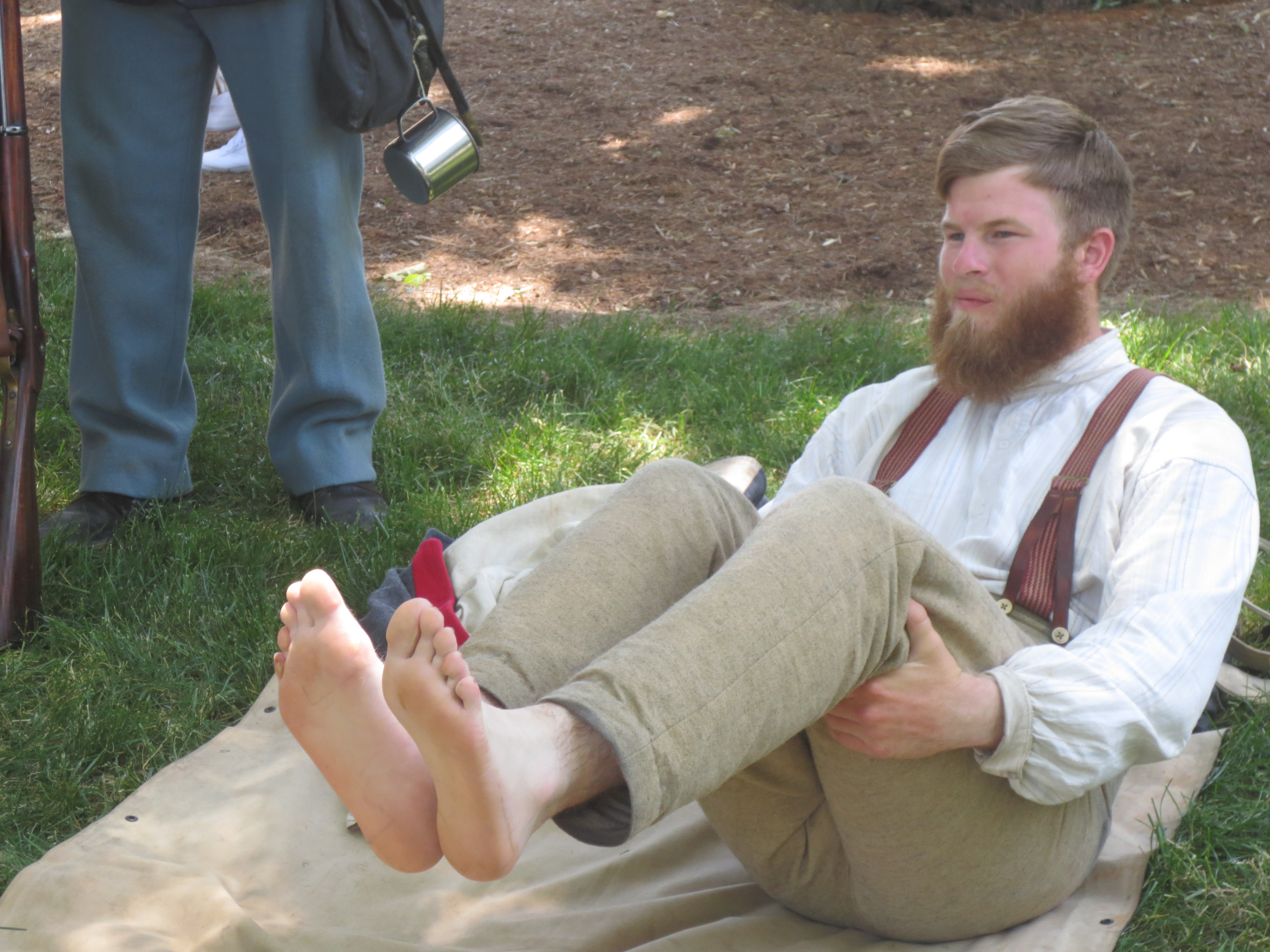
Wednesday, May 20, 2015- "How far have you ever walked?" asked Philip Brown while answering questions from school children visiting the historic 1840 North Carolina State Capitol. Philip had spent the last 9 days walking.  He has walked through rain and steamy heat. He told me that one of the most difficult walks was along a road side trench where he felt like one leg grew longer to compensate for the slope. My back hurts just thinking about it!  He has slept under the stars, in churches and hotels. His meals are from the kindness of strangers. People have read about him in the newspapers and pulled their cars over to chat. He walks all day long taking only a 30-45 minute break for lunch and a rest. He started in New Berne, N. C. and has clocked about 130 miles. He showed me the blisters on his feet that he earned for his trouble.

Blistered feet after nine days of walking

Philip was inspired by Washington Duke, who walked home after the Civil War ended. Brown is not portraying Duke specifically, but is representing all the Confederate soldiers who walked long distances to return to their often war torn homes after fighting in the war. He also hopes this will help people remember all the veterans who didn't alway receive the hero's welcome they deserved when they came home.

Memorial Day is a good time to ignore the SALES at the mall and think about the sacrifices that have given us our freedom. When is the last time you took your kids to a Veterans Memorial Day program?

Headstone marking an unknown Confederate soldier at the historic Oakwood Confederate Cemetery in Raleigh, N. C. 

He told me about Vietnam veterans he had met along his journey, many who had spent more than a year patrolling far-away jungles that were not only hostile because of enemy combatants, but often because of mother nature herself. He downplayed his tiring journey saying that this is a two week commitment, but those guys were in the jungles for over a year, and often came home to be spat upon by protesters.

Sadly, those protesters had ignored the fact that the young men of that generation had simply answered their government's call to service, just like the young men of North Carolina answered their state's call a century before. It's doubtful these boys were anxious to sacrifice their lives, but they had a thing called HONOR that compelled them to serve.

North Carolina State Capitol

Today too many North Carolinians have turned their backs on the men who answered  their states call to serve in 1861. They disrespect them, reasoning that they fought for slavery,  just like the protesters of the 1960's disrespected their peers who fought, calling them baby killers. Both are gross mischaracterizations that dishonor the memory of young men that bravely fought after being called to serve.

I was at the N. C. Capitol with my pal Woody to welcome Philip and talk to school groups about the Civil War and it's impact on Raleigh. We portrayed Federal troops. If Washington Duke passed through Raleigh on his way home to Durham, this is who he would have encountered. Some 80,000 Federal troops camped around Raleigh, while surrender negotiations were taking place up the road at Bennett Place.

Capitol Docents, Woody Reagan, and Rick Walton, standing guard at the N. C. State Capitol

We had the opportunity to talk to several school groups, but they were often more interested in my bayonet than Phillip's blistered feet. "Why didn't you just take the bus?" asked one astonished 4th grader. Philip smiled and explained how walking gave him an opportunity to honor those veterans and draw some attention to them this memorial day.  I'm not sure the youngsters understood the symbolism, because they asked again and again "...but why didn't you just take a bus?"

As the crowds died down, Philip borrowed my knife to sharpen a pencil and added this days events to his journal. "What are you writing?" asked one visitor. "Memories" replied Philip. I'm sure walking 130 miles has generated many. I hope his visit to the Capitol was a pleasant one.

Philips journey will end at the Duke Homestead, having traveled a total distance of about 166 miles,  on Saturday, May 23rd with a day long event that is open to the public.

Philip Brown walked about 166 miles in these soldiers boots giving him a new perspective of what soldiers face trying to return to their home after the war.


My First Reenactment at Gettysburg- a 20 Year Anniversary Memory

 Copyright (C) 2013 by Frederick Walton

Fresh Fish ready for the Battle of Gettysburg

Gettysburg is often called a "Mecca" for reenactors. It's a magical place that has a strong pull for anyone interested in the war between states. I have visited there many times...as a tourist, as a research historian and as a reenactor. I generally stop for a few hours whenever I'm passing through the area. I once spent a week there with my wife seriously contemplating the purchase of a B&B. I have led tours there, acted in the movie "Gettysburg" there, participated in a battlefield monument identification project, taken tours, marched in parades, fought & camped on the ACTUAL battlefield under the auspices of the National park service...Wow! now that I think about it, I've has lots of great memories and experiences there.

Every experience I have ever had in Gettysburg has been memorable, but today I am thinking about my first visit as a reenactor.

When I became a reenactor and joined the 150th New York Volunteer infantry regiment in 1993, most of the members had attended the 125th Gettysburg reenactment in 1988. It was their badge of honor and distinction. The camaraderie they shared, the experience they gained and the bragging rights they earned where all very attractive to a fresh fish newby like me. In time I earned my place as a full fledged member of the regiment, but I would never be...could never be... part of that unique fraternity of brothers who went to the 125th Gettysburg renactment.

When I "enlisted", I didn't realize that 1993 was the 130th anniversary year of 1863, but when the 150th NYSVI put the Gettysburg reenactment on their event schedule, I was anxious to go. Not only would this be my first time reenacting at Gettysburg, it was actually my first "mega"-reenactment anywhere. Sure, I had been to a number of drills, school talks and local living histories, but this was finally the real thing!

I packed my gear. I think I had bought a tent for the occaision, but for just about everything else, I was either wearing it or it fit into my haversack. Today, as a veteran, I choose to travel light, but at that point, my lack of "stuff" gave me little choice.

I wish I could remember exactly how I felt, but I am sure it was overwhelming. That feeling never changes whenever I go to the big national reenactments. Neat orderly rows of white tents cover entire fields, stretching to the horizon. Troops drilling on the margins while individual soldiers of every description walk through the camps under the smoky haze of hundreds of cooking fires. Across the road, a huge car park has taken over the adjacent fields and cars of every color and description stretch to the opposite horizon.

In the middle are large circus size tents and rows and rows of large wall tents, their sides rolled up to display a multitude of exotic wares spilling out into the dusty temporary streets.

Golf carts noiselessly glided around cavelrymen leading straining horses to pasture. Crowds of curious spectators and excited participants flowed eagerly in and out of busy suttlers. The hot air was thick with the smell of woodsmoke, horse manure, popcorn and roasting meat. A stray breeze might ruffle the colorful pennants and flags hanging everywhere, adding to the pageantry, but doing little to stifle the record breaking heat.

Nearby stood row after row of pickup trucks hauling trailers carrying one and sometimes two cannons. I had never seen so many cannons in one place. Colorful license plates were silent witness to the distances these canons have traveled...Texas, Ohio, Vermont, Illinios, North Carolina.

Every where you looked were people in period dress heading somewhere in every direction of the compass. Even little kids, decked out in miniature uniforms or hoop skits ran around underfoot playing soldier.

The site reminded me of the state fair, without the Ferris wheels.

After registering, I joined the throng of sweaty, dusty soldiers loaded down with gear. Some of the smarter guys pushed period wheel barrows. As I wandered up and down the endless rows of tents, looking for our camp site, I realized the aimless wanderings looked a bit like the attack of the zombies, as desperately hot and tired renenactors dragged themselves down one company street after another is a daze.

I don't really recall how I found my friends or, really, anyone who was there, but I have a strong memory of laying on a new wool blanket in a new wool uniform inside a new crisp white dog tent. I gazed at the intense white spot radiating heat, made by the late afternoon sun. Sweat oozed from every pore in my tired, dusty body. The tent was hotter than an oven. But I had a silly grin on my face. I was a soldier and this was my own, personal home for my weekend in Gettysburg! I proud to be a soldier that had finally started earning my own bragging rights.


Meet a 50 Year Veteran

Copyright (C) 2012 by Historian Rick Walton

John Hutton, showing his 1962 Centennial Medal at the 150th Anniversary.

"Hey Rick, I got something to show you."  John Hutton had followed me through the shadowy gloom of our bivouac as the setting sun extinguished the last rays of light. I had just arrived and was setting my gear down. I was anxious to get settled in but it was already too dark to put my tent up and I knew John was a treasure trove of interesting facts and artifacts.

He held a small object clutched in his hand. As I got closer, the last rays of light glinted off  something metal.

"They gave us these when we came up here in '62" said John placing it in my hand. It was a medal, suspended from a blue and gray ribbon.

On the front of the Medal was a picture labeled "Historic Dunker Church". Ironically, this is where the 6th North Carolina and Law's brigade happened to be posted during the battle. Around the outer edge were inscribed the words "Battle of Antietam" and "September 17, 1862"

Front of 50 year old medal John Hutton received at the 100th anniversary of the battle of Sharpsburg in 1962

On the reverse side the words "Re-enactment Participant, September 15-16-17, 1962"were inscribed. Around the outer edge it said "Battle of Antietam" and "Antietam National Battlefield Site"

Rear of 50 year old medal John Hutton received at the 100th anniversary of the battle of Sharpsburg in 1962

I had never seen anything like this before. It is a unique memento and especially memorable to have the actual recipient share it with me half a century after relieving it. Sadly I will not be able to show my momento of the 150th reenactment battle of Sharpsburg to anyone, now or 50 years from now, because we didn't receive anything for our $35 registration fee.

In 1962 a 14 year old John Hutton was a member of the North Carolina sponsored reenactment group, the 6th North Carolina State troops. During the centennial he got to travel to, and fight on, a number of historic Civil war battlefield including the one at Sharpsburg. Today it is unthinkable to fight on the actual battlefield. This weekends reenactment is actually on a farm in nearby Boonesboro. 

After his Centennial experience John served his country on the real battlefields in far off Vietnam. I have a great deal of respect for Viet Nam Vets and appreciate John's Service.When reenacting came back into vogue, John picked up where he left off and has been reenacting with the Sixth NCST since before I joined in 1994.

John is connected to a number of Historic North Carolina families and has Ancestors that were members of the 6th NCST, but what I admire most about John is his devotion to reenacting and the friends he has made over the last half century. I can recall standing next to John on the Battle line when I was a private. As we marched to battlefields across far flung reenactments, commemorating the 130th, 135th, 140th and 145th anniversaries, John would always be calling out to passing troops, whether Confederate or Yankee..."Hey Sammy, give 'em hell", or "hey Al, hows it going?" and they would yell right back ""Hey John, good to see you!"

It is an honor to serve with John and I hope he keeps bringing out those mementos for us to see, even if it only by the flickering light of a campfire.

The 1960's Centennial "Reactivated" Sixth North Carolina State Troops includes a young Cpl John Hutton listed as part of company B.


September 8, 2012- Saturdays Reenactment at 150th Anniversary of Sharpsburg

"You have got to be kidding!"  said a surprised reenactor trying to cook his breakfast over a smoky fire. It was about 6:45 and barely light enough to see. I had just ordered the men to get ready for drill.

Sgt William O'Quinn and Lt. Walton on the reneactment battlefield of Sharpsburg at sunrise on Sept. 8, 2012


The bugles, fifes and drums had blared reveille in the darkness just before 6 AM. I had stretched myself and checked to see what might have seized up after a night sleeping on the hard ground. I found myself surprisingly limber as I sat up and put my wool blanket aside. I had laid down on top of the blanket to have a little cushion between me and the ground, but sometime during the night I must have gotten chilly and pulled my blanket over me. I stumbled through the dark camp as men were getting dressed, starting fires or just trying to grab a few more minutes of shut-eye. I found the First Sergeant and we compared rosters to make sure all the men were accounted for on the morning report he had to get over to headquarters. 

The Captain stopped by to inform me that we would be drilling this lovely morning and to have the men formed on the street by 7:30. There had been speculation that we might be skipping drill, but who were we kidding? In 1862 Confederate Soldiers drilled two, three and four times a day. Drill, drill and more drill they complained in letters home, but their lives depended on it, so they learned to drill with precision and pride. Reenactors typically drill once or twice during each reenactment, not counting using our practiced skills to maneuver on the field while in "battle". Like all good soldiers, we complain about it, but we know it is important so we can look sharp in the eyes of the public and our peers. There are units out there that never drill...and it shows! We DON'T want to be like them!

The 6th North Carolina State Troops on the drill field at Sharpsburg on Sept. 8, 2011

The sun was partially hidden behind gray clouds. We knew rain was in the forecast, but that was for later. Right now, the clouds gave us welcome shade  from the blazing rays and allowed us to drill in the open field without getting too overheated. We ran through the basic facings and knocked the rust off. For most of us it had been several months since we marched together, but, like riding a bicycle, it quickly comes back to you.

Right face! forward MARCH! By the left flank, MARCH! Right wheel, MARCH! Forward, MARCH! By company into line...

We maneuvered up and down, back and forth and were soon effortlessly drifting across the field to the Captain's orders. All around us other companies were doing the same. Today's reenactment battle would require us to act as skirmishers. Once we had demonstrated our comfort with the basics, we moved on to the trickier movements required for the skirmish line. This required the company to spread out at 5 pace intervals across the field, which is easy to do, but always a challenge for those in command to be heard and maintain order. As the sun rose higher in the sky and the morning hours burned away, we practiced skirmishing and began to feel quite confident... again. As with any skill, practice makes perfect.

Brigade officers making sure we didn't miss and drill maneuvers

The brigade officers and NCO's started calling the regiments back together and we completed the mornings program by running through a number of brigade drills before finally marching back to camp.

It would soon be time for lunch. The sky was getting cloudier and our first order of business was to put up our large fly to provide shelter in case it rained. William took charge of the effort and after much discussion, because every passerby had an opinion on the best way to do this, we finally committed ourselves and began the work of stretching the canvas out and securing it. If we only had four evenly spaced trees in a square or four tents poles, our job would have been simple, but we had neither. Nor did we have much rope.

Matt holding last corner, Rick holding pole while William unravels rope

We ended up tying one corner to the predominate tree, under which I had slept the night before. Since this was "my" tree, I tied the rope, but I only had a short rope tail to do this with, left over from our neighbor Craig's tent. I tied a double half hitch and gave it a good solid yank. It seemed secure. Next we stretched the opposite side to a log...which promptly shifted as soon as we tied to it. We shoved it back into place and secured it, then  pondered how to attached the last corner, left hanging in thin air. I finally found a large limb, which the Captain hastened to cut to size with his trusty camp saw. He then helped us tie it to the log and then on to a further tree, stretching our canvas tightly overhead. The resulting macrame project used a lot more rope than my little half hitch and would withstand a hurricane. We finally had a home! we laid out our blankets and I sat down to eat something for lunch before it was time to couter up  and march to the battlefield for Saturday's battle.

First Call! The words jarred me awake. I had stretched out on my blanket after lunch and dozed off. Around me the men were already getting their equipment on. I stood up quickly, hitting my head on the low canvas roof I had forgotten about already. I quickly got dressed and, as is my habit, I rolled  the rest of my gear inside my ground cloth and. placed it under the fly, away from the open edge in case it rained. I looked around and no one seemed to be carrying their ponchos so I dropped mine on top of my gear. To bad I didn't carry it with me!

Marching to the Battlefield

The usual confusion prevailed as men drifted from their camps to the streets and formed companies which were then organized into brigades. Other Brigades marched by us with flags flying and music playing. We waited for our turn and joined the long line of Confederates. There were thousands of troops on the march, the site was awesome. We entered a grassy, overgrown pasture. Tick city was my first thought, but in the end I never saw one or found any once I got home. It may have been the religious spraying of OFF insect repellant provided by our thoughtful comrade Yankee Joe. We stacked arms and were dismissed to rest. I laid down in the long grass next to my friends and watched brigade after brigade march onto the field. This wasn't a mega event by far, but it was pretty impressive seeing all these troops. Overhead the clouds played tag, showing alternating patches of blue sky and sunshine followed by more clouds. The last thought on my mind was rain as we lounged in the grass having idle conversations amongst ourselves.

Members of the 6th North Carolina State Troops resting before the Sept 8, 2012 150th anniversary reenactment of the Battle of Sharpsburg

The calm, relaxed atmosphere suddenly evaporated as officers urgently recalled their men to the battle line. The troops scrambled to their places. We quickly took our arms and marched off down a shady wood road. We were on the way to the battle field. We were ready to fight! No matter how many times I do this, I still get butterflies in my stomach. I'm like a 10 year old kid playing army again except this time and an officer with command responsibilities. Ahead stood two staff officers directing us forward. As I passed them their walki-talki blared to life and announced "severe storms are headed your way in 15 to 20 minutes".  That's it, I thought, the storm would probably force them to cancel the battle. I expected to be turned back to camp at any minute, but we kept going forward. Then, through a break in the woods, I saw why. Hundreds of spectators, colorfully garbed in shiny raincoats and holding umbrellas, lined the edge of the battlefield. Like the gladiators of long ago, WE were the show and the show must go on, regardless of the weather. An image of me leaving behind my poncho suddenly appeared in my brain. Oh Crap, we were gonna get wet, I thought.

Spectators and Yankee's waiting for the battle to begin

The line of marched stopped. We were in our position at the edge of the battlefield. In the distance a cannon roared...or was it thunder? It was thunder. The cannons were directly in front of us and they were quickly being covered to protect them from the pending rain. A flash caught my eye. Someone snapping a picture? No, it was lightning. The men nervously joked about the four foot long musket "lightning rods" they all carried. Overhead the trees started whipping around as a heavy wind blew leaves and hats indiscriminately across the field behind us. With a roar, the sky opened and rain drops as big a Minnie balls pelted us from above. The wind whipped the rain in our faces and we could do nothing but stand there.

6th North Carolina State Troops membesr Craig and William getting soaked during an unexpected downpour

The shady lane offered us little protection and there was no where else to go, so we stood quietly in our ranks and got quicklyand completely drenched.  Water overflowed from hat brims and cascaded in waterfalls. evrything in my haversack was sodden. After the heavy downpour had efficiently done its job in soaking us, It settled into a steady, gentle rain. My garden would have loved this, but I was dripping and ready to go home! Fat raindrops kept falling from the leaves overhead, but outside the treeline the rain had tapered off and a heavy fog rolled in. The artillery men had uncovered their guns and were loading them. In the distance, a line of ghostly looking enemy skirmishers appeared on the ridge, well hidden by the rolling mists.

Federal Skirmishers appearing out of the mist at the 150th anniversary Battle of Sharpsburg on Sept. 8, 2012

BOOM! We all jumped and turned to see a cloud of smoke surrounding a nearby Cannon that had fired and caught us off guard. BOOM!, BOOM! roared two more cannons. The battle was on and wet or not, we would soon be called on to push back the enemy.

Booming Canons begin the fight

The brigade officers demanded our attention and formed us back into our battle line. We surged forward through the underbrush and  advanced through the cheering cannon crews across the wet field. The cannon smoke hung in the damp air mixing with the floating mist. The acrid black powder smoke stuck our eyes and throats. Whatever was beyond the rise was obscured from our view. Our battle line marched on until we came to the far edge of the field. We deployed as skirmishers and cautiously entered a a copse of trees still dripping from the rain. The ground rose in front of us as and huge slabs of wet gray rock punctured the surface at odd angles, giving the skirmishers good cover. We continued our advance. Suddenly the mist cleared and we could see long lines of blue troops packed along the distant edge of the field. Their skirmishers appeared in front of us and opened fire. The crackle of muskets interrupted the worried shouts of officers trying to move us into position. We held the high ground and had a good selection of trees and rocks to hide behind as we started to return fire. As we moved through the woods we stumbled across spectators in lawn chairs. Up until that moment, the urgency of battle made it all seem very real, but it vanished in a flash after seeing spectators in brightly colored casual wear. From my position as a file closer I spotted the Federals starting to turn our flank and shouted a warning the other field officers. The Brigade started to withdraw and we found ourselves in front of the cannons again, but, this time,  blocking their shot. We quickly got out of the way and ended the battle with a final ear splitting BOOM!

Members of the 6th North Carolina state troops deployed as Skirmishers at the 150th anniversary Battle of Sharpsburg on Sept. 8, 2012

Fresh troops rushed past us into the fray as we  realigned ourselves and marched to the rear. We stood back at the first staging area as hundreds of fresh troops poured in waiting their turn to fight. The battle field was so small that they had to rotate us out to give others a chance, and the battle was over for us.

Members of the Carolina Legion returning at the 150th anniversary Battle of Sharpsburg on Sept. 8, 2012

The only casualty was my soul...the sole of my shoe that is. I'm not sure what caused it to give way, because they aren't that old. The long wet grass had managed to slide between the soul and upper and nearly tripped me as I was marching, pulling the soul away. I was forced to flap my way back to camp.

Between the exhilarating fight and the march back to camp we had begun to dry out from the rain. We would have enjoyed fighting longer but with our camp in sight we were happy to be back home...until we got to our tents. It seemed the wind and storm has passed through our camp with a vengeance. Tents we leaning or toppled. Blankets and knapsacks were soaked and my corner of the tent had ripped loose, exposing me and my messmates to the elements. My fate could have been worse but I had wrapped my blankets in the ground cloth so only the edges got wet, Matt's blankets got wet on one end, but William's entire kit was under a large puddle of water that had funneled into his once cozy quarters. To say this was disheartening would be an understatement.

William refastened the corner. I think my knot tying skills will be forever questionable, even though I personally think the rope was defective! The only thing to do was to stoke the fire and  dry the blankets. The sky still looked questionable as we stood surrounding the fire holding blankets and jackets close the the licking yellow flames, hoping they would not errupt in an inferno. I started thinking about the Confederate soldiers who fought here in 1862. It had rained prior to the battle. I realized how easy we have it compared to them. They  surely spent many wet nights wrapped in wet blankets, too tired to care, after fighting or marching all day. At least we had a fire and if absolutely necessary, we had any number of dry tents we could double up in. My overheated hands brought me back to the present. The fire was hot and my blanket had dried to at least damp. I felt and smelled like a smoked ham

I wasn't happy about my shoe either. It was aggravating to flap around. I don't remember when or where I got these brogans, but it didn't seem that long ago. I was hoping I could get them repaired and worried that they would be permanently damaged if I kept walking on them .(They were wrecked after this weekend!) Being wet, tired, embarrassed about my knot skills and frustrated with my bad shoe... I was dreading the planned evening battle.

Yankee Joe talked me into walking (limping actually) up to the sutlers where he introduced me to several friends who he thought could help. While walking around I was pleased to see the friendly faces of two of my old comrades from the 150th NYSVI. We stopped and exchanged pleasantries, but I was on a mission to get my shoe repaired. In the end the shoe was too wet and muddy to make a temporary fix.  I wasn't in the mood the spend $100 or more on a new pair or to continue shopping. My stomach started grumbling from the smells of food cooking on sutler row. I was still damp and suddenly very tired. I flapped my way back to camp ready to cook supper and figure out what to do with my bad brogan.

More rain was forecast, canceling the evening battle.  I was relieved to hear this news. The bodies around the fire had thinned out and the other half of the men had headed up to the sutlers. I had brought some smoked turkey sausage, a pepper from my garden and an onion. I chopped up the pepper and onion and put them in the frying pan with a little oil. I raked a pile of glowing coals to the edge of the fire and spread them out until I had set my "stove" to medium. I rested the frying pan on the coals and started to gently cook the onions and peppers. The smell drew a few of my comrades. Unfortunately I had brought only a small amount and didn't have any extra to share. I sliced the single sausage and dropped it in the hot pan. the coals had cooled a little so I raked some fresh coals under the pan to renew the heat. I covered the pan with my tin plate to keep the moisture in and the ashes out.  It didn't take long to heat the sausage. I settled myself near the fire to eat supper, finishing my masterpiece with a few squirts to Texas Pete. Bon Appétit! At least one thing went as planned that afternoon!

"Private Hinnant" made an appearance around the campfire
(strictly for medicinal purposes since we had gotten soaking wet and wanted to avoid a chill)

I was finishing the final morsels of my supper as my neighbors and tent mates  started returning from the sutlers. The camp was dark and damp, but the fire cast a cheery glow. The quiet satisfaction of a full days activities counterbalanced the disappointment of the rain, broken footware and collapsed tents. Private Hinnant made an appearance and tin cups appeared from every corner of camp, bringing us together, even if only for a few moments. Jeff introduced us to an African nectar, which was quickly shared amongst the empty cups. We chatted around the campfire briefly, but people started drifting off to their tents or other fires. I stretched out on my blanket and my eyelids were getting heavy as I listened to a nearby conversation. I was wavering in and out, adding a comment here and there before finally drifting off to dreamland ending my first day on the reenactment battlefield to commemorate the 150th anniversary of the Battle of Sharpsburg.

link to Photos:

Next: A 50 year veteran


Commemorating the 150th anniversary of the Battle of Sharpsburg

The 6th North Carolina State Troops on the reenactment battlefield of Sharpsburg at sunrise on Sept. 8, 2012

Is it the Battle of Antietam or The Battle of Sharpsburg? Both names refer to the same terrible battle fought on September 17, 1862 and often referred to as the the bloodiest single-day battle in American history. How you refer to this battle may indicate your loyalties. Southerners refer to it as Sharpsburg, after the town near where it was fought. Northerners  refer to it as the battle of Antietam after the creek that separated the armies at the center of the battlefield. Since the Yankee's won the war, lots of history books refer to it that way too. (To the victor goes the spoils). But with about 23,000 casualties between the two armies, there was no victor on this battlefield. Historians generally consider the battle a draw, although many arguments exist that McClellan lost his opportunity to wipe out the Confederate army and end the war. On the other hand, General Lee, with a smaller force, used gutsy tactics and aggressive action to save his army from annihilation. No matter what you call it, I'm glad that we are commemorating the 150th anniversary of this seminal battle and mourn the flower of youth that perished from both sides of the conflict.

Reenactor members of the 6th North Carolina State Troops traveled to the reenactment battlefield near Boonesoro, Maryland from across eastern North Carolina and Virginia. The 350 mile journey took us a little more than 7 hours to drive. Crawling the last 50 miles or so through rush hour Washington traffic on the interstate reminded me of the resistance provided by Confederates troops blocking the mountain passes prior to the main battle. This must be how the Federal army felt...knowing they had someplace to be, but obstacles in your path are slowing you down.

Finally clear of traffic, we hurried along the narrow, winding mountain roads for the final 20 miles or so. We watched the late summer sun sink behind the horizon, as our spirits also sank, knowing we had missed dinner with our comrades and would be forced to set up camp in the dark on an empty stomach, never a fun experience.

Dining out before the reenactment...the dinner we never made!

We drove into camp to unload our minimal gear with our headlights supplementing the fading twilight and were directed to General Stepps HQ camp. Parking the truck close by we got out and stretched our cramped legs before plunging into the dark shadows under the forested glens to look for our camp. The first fire we approached was no one we recognized and they didn't know where the 6th NCST was either. "Try over there" replied three or four lounging Confederates, their arms pointing in every direction of the compass.

Pushing through the underbrush we stumbled into a small clearing full of glistening white A-frames set up in orderly rows filling the space in every direction. So much for "campaign style" camping! There were more A-frames in any one of the rows than exist amongst the entire Carolina legion, so we knew this was not the right place. Walking along the rough logging road we could soon saw our truck in the distance, having circumnavigated the woods but still not seeing anyone we knew. We had just about given up hope when we spied Colonel Roberts in the deepening shadows and he was kind enough to direct us to our nearby camp. We had nearly parked in front of it and had passed it by without noticing the naturally camouflaged entrance.

Members of the 6th North Carolina State Troops in a well camouflaged camp in the woods near Sharpsburg, Md.

The camp was well hidden, close to the water buffaloes and latrines, nicely groomed by the labor of our earlier arriving  comrades and fully populated with their dog tents and shebangs. Most of our company had gone to eat supper. A few souls had stayed behind and gave us a cheerful greeting and hearty welcome. There were not many spots available so we choose a large empty area in the center of camp. It was too late to do more than throw down our knapsacks. We would hang our fly tomorrow in the light. The weather forecast was  favorable and the still air inside the sheltering woods was a little warm and humid, but a breath of air occasionally waved the leaves, promising a cooler respite during the night.

Putting up our fly on Saturday morning

There was no Campfire lit in our camp so we ate an unplanned for cold supper by flickering lantern light. I had eaten a late lunch and made a supper out of the crackers I had brought for snacks. Just as I was laying out my wool blanket on top of my poncho, the rest of the company started filtering in and the next 30 minutes were spent greeting old comrades. Without a central campfire to draw us together, everyone drifted off either to an early sleep or to sit in the shadows in little knots visiting amongst themselves. The long ride to Maryland and the long walk back to camp from the parking lot was enough to wear me out and I soon found myself half listening to the comrades who were gathered around our lantern before dozing off to a sound sleep.

Coming Next- Saturdays Battle.


Carrying the Colors at Sharpsburg

Author with the Sixth North Carolina State Troops Third Bunting issue cotton/wool flag issued in 1862 and most likely carried at the battle of Sharpsburg. Flag is on display at Gettysburg.

Members of the 6th North Carolina State Troops, Co. I will be traveling from throughout North Carolina and Virginia to Sharpsburg , Md. this weekend (Sept 8-10, 2012). We will be participating in the 150th anniversary reenactment of the battle of Sharpsburg. For many members this is a return trip, having visited 5 years ago for the 145th anniversary. Some have even attended as far back as the 130, 135th and 140th anniversaries.

We have been informed that we will be the color company for the Carolina Legion, which prompted me the wonder about the flag. What colors did the 6th North Carolina wave above them on that warm September day as they traveled back and forth across Millers bloody cornfield in Sharpsburg?

I have been researching the 6th North Carolina State Ttoops for nearly 20 years and  have only focused on their flags during the last decade, documenting my findings whenever I stumble across something, which isn't as often as one might like. The problem with Civil war era flags is that they don't seem to be mentioned too much, unless they are captured or have some special place of honor. Otherwise they are ordinary “tools” which are needed to get the job done as much as rifles or swords.

Imagine a researcher from the next century trying to document the model cell phone or laptop we carried.  Sure, everyone knows we carried them, but in those few important documents that survive, who would have bothered to identify what phone they had or where they got it or exactly when they carried which specific model? That is the dilemma I face trying to document the colors of the 6th NCST. Flags are too ordinary.

Regarding the flag they used at Sharpsburg… I’m not coming up with many specifics, but I have a theory.

Captain Neill W Ray

You may be familiar with Captain Neill W. Ray's sketch of the Sixth Regiment contained in Clark's North Carolina troops.

If you haven't read it lately, take a minute to read Captain Ray’s description of the 6th NCST at Sharpsburg, it's very interesting and informative reading. In addition to some very specific details about where the 6th NCST was and when and what they did in the fight, Ray says (directly to you and me!)

"If the future historian will study the battle of Sharpsburg...he will be forced to conclude that it should be considered one of the most noted battles of the war..."

In this regard he was correct, since this battle has come to be known as the bloodiest single day.

At the end of his overall sketch of the 6th NCST he talks about the regimental flag (What we call the “Fisher Flag”).


The Fisher" flag at the North Carolina Museum of History

"...a beautiful silken banner ...it was highly prized; It waved over the regiment at ...First Manassas...and at Gettysburg. It was not always used in battle, especially after battle flags had been distributed to the army."


 Since Ray wrote such detail and felt so strongly about the importance of the battle of Sharpsburg and then went on to describe the Fisher flag in detail, I believe that if this flag had flown in this battle he would have specifically mentioned it. Therefore I conclude that they most likely carried a battle flag rather than the Fisher Flag. But which battle flag? That's the million dollar question.

If we assume the 6th NCST was issued a first issue flag in 1861, when it was available, it may have been lost when some of their stored baggage fell behind enemy lines and was captured in the spring of ’62. To my knowledge this flag was never claimed as being captured and I have never really found evidence that they actually either had it or lost it. It's possible it was never issued since the 6th was already mustered and in the field before the design was even approved!

So did they have a first issue flag or not?

If it was issued and they carried  it during the marches and battles of the peninsula Campaign in the spring of '62, It may  have become so worn (they were made of fragile silk) after being in the field that It had to be replaced.  In the spring of 1862 the Richmond Clothing Depot  slightly changed the colors it had been issuing. The blue cross was now made only 5 inches wide. The stars were also reduced in size, to 3 3/4 inches in diameter. The so called Third Bunting Pattern flag appeared later in  1862, when the orange borders were replaced with white 2-inch-wide bunting.

An important clue is the July 25, 1862 general order 88 issued by the General Whiting which directs:

“The regiments of the five brigades of this division now present will have inscribed on their battle flag the names, “Seven Pines, Gaines farm & Malvern Hill.” In addition to the above the regts of the Texas Brigade, The Hampton Legion & the 6th N. C. will have the word Eltham’s landing out on their colors & all the regiments of the 3d. Brigade including the Legion the word Manassas.”

I have never really found evidence that they actually were issued a second issue flag, but it would seem improbable that the regiment would disregard a general order and one that would bring honor and fame to their regiment. Since we know of two late war 6th NCST, non-honor marked battle flags at the NC museum of history, It seems logical that there is at least one “Missing” Flag…with battle honors. (Current  evidence suggests that one of these has been mis-attributed to the 6th North Carolina State Troops .)

I have recently learned that the Gettysburg museum is displaying a Third Bunting issue 6th NCST flag with battle honors that was carried into battle at Gettysburg. It was probably also the one they carried at Sharpsburg!

To bad I got a late start on my research because most reenacts historians I polled guessed  that they probably carried a second issue (orange border) battle flag at Sharpsburg based on timing, but there is little evidence to prove or disprove it.  That is the flag we will be carrying this weekend


Oh and if you're reading this from 2112..my phone was a Samsung M220, ancient even in 2012 but good enough for me.


Tell my Father…

The story of two soldiers united in death on the Gettysburg battlefield By Frederick E. Walton, Historian of the Sixth North Carolina State ...