150th Anniversary of the Battle of Second Manassas

Copyright 2012,2022 Frederick Walton, Historian of the 6th North Carolina State Troops


The Battle of Second Manassas was fought August 28–30, 1862, in Prince William County, Virginia near the site of the 1st battle, fought a year earlier on July 21, 1861.

The Sixth North Carolina State Troops, fought in Whiting's Brigade under the command of  Colonel Evander M. Law and were brigaded with:

4th Alabama: Ltc Owen K. McLemore

2nd Mississippi: Col John M. Stone

11th Mississippi: Col Philip F. Liddell

6th North Carolina: Maj Robert F. Webb

They were under the right wing of General Lee's Army commanded by Maj General James Longstreet in the Division of Brig. Gen John B. Hood.

In memory of those members of the 6th North Carolina State Troops who answered their states call and made the ultimate sacrifice 150 years ago on this anniversary of the 2nd Battle of Manassas.

Source: October 1, 1862 North Carolina Standard Weekly Newspaper, available on Microfilm from the N. C. Archives and at Olivia Raney Library. (18621001 WklyStd- Casualties 6th North Carolina State Troops Sharpsburg.jpg)


Click on photo to enlarge

Where have all the Captains gone?

A look at the leadership present at the Sixth North Carolina State Troop's battle at 2nd Manassas


Copyright (C) 2013, 2023 By Frederick Walton, Historian of the 6th North Carolina State Troops

The 6th North Carolina State troops played an important role in the battle of Second Manassas (August 28–30, 1862). Since we did not participate in the reenactment at Cedar Creek commemorating this event, I decided to commemorate the 150th anniversary by researching period newspapers to find first hand accounts of the battle and it's casualty lists.

On October 1, 1862, the North Carolina Standard weekly published "A list of casualties in the 6th N. C. Reg't, Aug 27-30, Major Robt. F. Webb, commanding."

This listing included a breakdown of casualties by Company and Listed the company commanders:

Company A- Lieut J Calder Turner Commanding.
Company B- Lieut A K Umstead commanding.
Company C- Capt. H B Lowrie commanding.
Company D- Lieut Carson commanding.
Company E- Lieut J H Burns, commanding.
Company F- Captain White, commanding and severely wounded,
Aug 30th- Lieut H. C. Dixon, commanding.
Company G- Lieut J T Roseboro, commanding.
Company H- Captain J.A. Lea, commanding.
Company I- Lieut W B Allen, commanding.
Company K- Lieut S J Crawford, commanding.

Seventy percent of the company commanders are Lieutenants! Where have all the Captain's gone? Lets look at each Company led by a Lieutenant to unravel the mystery of the missing captains.

Company A

The original Captain was Robert M. McKinney. He was Commissioned as a Captain, by Governor Ellis, on May 24, 1861. He left the Sixth North Carolina State Troops in June of 1861 when elected Colonel of the 15th N.C.T. and was killed in action on April 16, 1862.

His replacement was 1st Lt. Samuel S. Kirkland who was promoted to Captain on June 24, 1861 but resigned on July 29, 1862.

1st Lt. James Caulder Turner was appointed as Kirkland's replacement and promoted to Captain July 29, 1862. Technically Turner was a Captain for nearly a month at the time of this battle even though he is still listed as a 1st Lt. But what a month it was...Between the battle of Gaines Mill (June 27, 1862), Malvern Hill (July 1, 1862) and many unnamed skirmishes, marches and maneuvers, its no wonder this information may not have been announced until some time after this battle.

Company B

The original Captain was Robert F. Webb who was promoted to Major on 11 July 1861 and was commanding the 6th North Carolina State Troops regiment during this battle.

Major Robert F. Webb

1st Lt. William K. Parrish was promoted to Captain on 11 July 1861 to take over for Webb and commanded the company until 27 June 1862 when he was wounded at Gaines Mill and command devolved temporarily on 1st Lt. Alvis K. Umstead until Captain Parrish returned.

Company C

William Johnson Freeman was commissioned Captain by Governor Ellis to rank from May 16, 1861. He was wounded and captured at Seven Pines, Va. on May 31, 1862 eventually dying of his wounds on June 21, 1862. 


1st Lt. and Regimental Adjutant Houston B. Lowrie transferred from field and Staff to replace the wounded Freeman. He was promoted to Captain in June 1862. Spoiler alert, Captain Lowrie is killed less than a month after surviving this battle, falling at Sharpsburg on the morning of September 17, 1862, during Colonel Evander Law's charge through Miller's Cornfield

Company D

Samuel McDowell Tate was the original Captain of Company D, appointed by Governor Ellis on 16 May 1861. He was promoted to Major on June 11, 1862 and was acting as Lieut. Colonel during this battle. It is interesting to note how the October 1, 1862 Weekly Standard article describes him:

"Capt Tate acted as Lt Colonel, and Capt York as Major."

This reenforces the assumption that the current round of promotions had yet to catch up with the deserving recipients.


Major Samuel McDowell Tate

Twenty-two year old 1st Lt. Duncan C. Pearson was promoted to Captain on June 11, 1862 to replace Captain Tate.  It is unclear why he was not in command at this battle. The muster roll for August is missing but a card in his compiled service record for May-Oct mentions his promotion, but nothing about his absence. He resigned due to Poor health on January 21, 1863.

1st Lt. Neill Ray

Sr. 2nd Lt. John Carson is listed as the commander. He was promoted June 11, 1862, on the same day that Neill W. Ray is promoted to 1st Lieutenant, which means that, technically, Ray should command the unit if the Captain is unable. Neill describes the battle, from the perspective of the regiment's historian, in his post war article chronicling the history of the unit. He does not indicate his personal position during this battle, but does not appear to have been sick or wounded. He may have been assigned other duties, which would have caused the 2nd Lt. to rise to command of the company. Ray was promoted to Captain of Company D on January 21, 1863.

Company E

Isaac E. Avery was the original Captain. He had been promoted to Lt. Colonel, commanding the regiment, on June 1, 1862. This created somewhat of a political firestorm and was debated in the newspapers by supporters of Major Webb. They felt Webb had more seniority and military experience than Avery, however it was Avery that was hand picked by departing Colonel William Dorsey Pender. Avery was severly wounded at the Battle of Malvern Hill (July 1, 1862) and Webb ended up in command of the 6th North Carolina State Troops during this battle.

Colonel Isaac Erwin Avery

Colonel Avery's brother, 1st Lt. Alphonso C. Avery, succeeded him as Captain on June 1, 1862. The records are unclear as to why 1st Lt. James A Burns is commanding during this battle. (Although I have no evidence to support this conclusion, Avery may have been accompanying his brother home to recuperate from his wound. Additional research will be required to validate this. Reviewing his Compiled Service record, June/July 1862 is marked under Present/Absent- "Not stated". There is no roll for August, although a separate card indicates present from April to October 1862, further confusing the issue.)

Captain Alphonso C. Avery


Newly promoted to 1st Lt. on June 1, 1862, James H. Burns was listed as commander of Company I during this battle and eventually promoted to Captain on 24 Dec 1862.

Company F

Company F was commanded by Captain Benjamin Franklin White,  who was severely wounded during the battle on August 29th. He was succeeded by his newly promoted 1st Lt., 20 year old  Henry C. Dixon .

Captain B. F. White


While Company F was actually commanded by its Captain, at least until he was wounded, Captain White was actually the third to command the company. His predecessor was Robert N. Carter, mortally wounded at Malvern Hill.  The first Commander was James W. Wilson, who raised the company and appointed Captain by Governor Ellis on May 16, 1861. He was unable to take the field at First Manassas due to illness, leaving Carter, his senior Lt. to command the company into action. Wilson resigned on Nov. 27, 1861 but was appointed Captain of, Assistant Quartermaster of the 49th N. C. Regiment on April 12, 1862.

Company G

James A. Craige, a 20 year old native of Salisbury and cadet at the North Carolina Military institute in Charlotte,  was appointed original Captain of company G on 16 May 1861. On 17 July 1862 he was elected Major of the 57th Regiment (which would later be brigaded with the 6th N. C. under Hoke). There is no clear record of where he served during this battle, but it is probable he was in transition to his new regiment, still in North Carolina during this battle.

Major James A. Craige, 57th NCT


1st Lt. Benjamin Rush Smith was promoted to Captain July 17, 1861. He was previously serving as Adjutant of the regiment as a member of the Field and Staff and may have been carried forward in this role during the battle to take advantage of his experience, since he is not listed as sick or wounded.

Captain B. R. Smith


1st Lt. James T. Rosborough was appointed Sr. 2nd Lt. by Governor Ellis as of 16 May 1861, making him a battlefield veteran by August 1862. He was promoted to 1st Lt. on July 17, 1862. Given his experience it is not surprising to find him commanding the company if his Captain was needed for duties elsewhere.

Company H

Like the other companys, Company H had several captains prior to this battle. Alfred A Mitchell, a druggist,  was appointed Captain by Governor Ellis on May 16, 1861, but resigned on August 18, 1861, presumably due to the need of his occupational qualifications back home. He was replaced by 1st Lieutenant William Durham of Company C who was promoted to captain of Company H on September 27, 1861. He resigned on February 3, 1862. 

Lieutenant Jeremiah A. Lea

Captain Thomas Ruffin Jr, of the 13th Regiment of North Carolina Troops was assigned temporarily to Company H, 6th North Carolina State Troops on January 14, 1862 until replaced by Sr. 2nd Lieutenant Jeremiah A. Lea, who was promoted to Captain of Company H on February 3, 1862.


Company I


Richard Wyatt York was the original Captain, appointed by Governor Ellis on 16 May 1861. He was wounded during the Battle of Gaines Mill on 27 June 1862, but is listed as acting as Major during this battle.

His 1st Lt. was Malcus W. Page who was appointed Captain, Assistant Quartermaster to rank from Sept. 16, 1862. His role in this battle is not clear, but he is not listed as sick or wounded during this time frame. He may have been assigned to other duties, during this battle, leading to his promotion.

Sr. 2nd  Lt. Wyatt B. Allen stepped into the leadership role and commanded Co. I during the Battle of 2nd Manassas. He was promoted to 1st Lt. on September 16, 1862. After Captain York was promoted to Major on July 3, 1862, Allen rose to company command until his capture at Rappahannock Station on Nov 7, 1863, still a 1st Lieutenant. He remained a prisoner through the end of the war, becoming one of the "Immortal 600" - Confederate officers used as "human shields "by Federal forces at Morris Island, S. C. in Sep/Oct 1864. 

1st Lt. Wyatt B Allen, Commanding Co. I

Company K


33 year old James W. Lea, was appointed the first Captain of Company K by Governor Ellis to date from 16 May 1861. Captain Lea was wounded at seven Pines on May 31, 1862 and resigned due to his injury on August 23, 1862.

1st Lt. Joseph S. Vincent was promoted to Captain on August 23, 1862 and presumably stepped in to command after Captain Lea was wounded. It is not clear why he is not listed as commander during this battle.

32 year old Sr. 2nd Lt. Samuel J. Crawford was promoted to 1st Lt. on the same date that his predecessor was promoted to Captain, just prior to this battle.

Battle of 2nd Manassas

The Battle of Second Manassas occurs after a bloody summer of fighting that will be capped less than a month later by the "Bloodiest single day" at the Sept. 17 battle of Sharpsburg. This prolonged period of fighting took its toll on field officers as well as the soldiers on the battle line.  This analysis of the 6th North Carolina regiment's Company commanders show a regiment in transition. Lieutenants are seamlessly stepping into command roles to replace Captains that have been wounded or promoted. This succession of officers is working as it should and many of these Lieutenants will be promoted to Captain themselves by the conclusion of this hard fighting year.

Sources:

October 1, 1862; the North Carolina Standard weekly; "A list of casualties in the 6th N. C. Reg't, Aug 27-30, Major Robt. F. Webb, commanding."

Iobst, Richard W., The Bloody Sixth, The Sixth North Carolina Regiment History.1965; North Carolina Confederate Centennial Commission, N. C. Division of Archives and History.

Manerin, Louis H., "The Sixth North Carolina Regiment Roster", published as anappendix to "the Bloody Sixth" by Richard W. Iobst, 1965, North Carolina Confederate centenial commision, North Carolina division of Archives and History.

 Ray, Neill W., "The Sixth Regiment" in  "Histories of the Several Regiments and Battalions from North Carolina in the Great War, 1861-1865", edited by Walter Clark and published by the state of N. C.  in 1901.
Civil War Service Records (CMSR) - Confederate - North Carolina, 
NARA M270 Record Group 109;Compiled service records of Confederate soldiers from North Carolina units, labeled with each soldier's name, rank, and unit, with links to revealing documents about each soldier. Viewed on Fold3.com


Faces of the Sixth-Private Solomon Moore- Company K


The following photographs and information are original members of the "Bloody Sixth". I am honored to include their stories and images here. If you would like to share a story or photo about your 6th NCST ancestor, please leave a comment and I will be in touch.


Private Solomon Moore

Company K

6th North Carolina State Troops


Prior Occupation: Farmer 

Enlisted: June 21, 1861 For the War 

Where: Alamance County 

Age at enlistment: 26 

Wounded: Mortally Wounded at Sharpsburg, Maryland, September 17,1862 

Died: Prior to September 22, 1862

His 20 year old brother Harrison Moore enlisted at the same time. Harrison was killed at the Battle of Fredericksburg, Virginia in December 1862.


His 17 year old brother named Eli enlisted on March 1, 1862. Eli died in a hospital of Bronchitis in January 1863.


Note the 6th N. C. S. T. Buckle. This is the only known picture showing this unique buckle.


Closeup of Moore's Buckle with letters outlined for clarity


Source Notes:

1) Jordon, "North Carolina Troops, 1861-1865"

 2) Compiled Service records at North Carolinas State Archives, Sixth Infantry, Be-Ca F.6.21.4P (NA-MC270-159), 7/24/2004, Co. I, 6 NC Inf

Additional information or photos would be welcomed to complete the record of this honorable soldier.


Private Thomas Lafayette Morrison- Company A


The following photographs and information are original members of the "Bloody Sixth". I am honored to include their stories and images here. If you would like to share a story or photo about your 6th NCST ancestor, please leave a comment and I will be in touch

Private Thomas Lafayette Morrison

Company A


No known photograph

Prior Occupation: Farmer

Enlisted: September 22, 1862 For the War 

Where: Burke County 

Age at enlistment: Rappahannock Station, Va.  on 7 Nov. 1863 

confined at Point Lookout Maryland

Thomas Lafayette Morrison was born on December 31, 1837 in Burke County, NC. His parents were John Duckworth Morrison of Burke County, NC and Fannie Epley of McDowell County, NC. Thomas was married to Temperance Louse Hall on December 20, 1860 in Burke County, NC. In less than two years after his marriage, Thomas enlisted in the Confederate States Army in Burke County, NC as a Private on September 22, 1862. He was in Company A, North Carolina 6th Infantry Regiment. While his young wife was at home, he shouldered the musket and marched against the enemy. He wrote a running account of his experiences as a soldier in a series of letter to his wife.

At his request, she kept all the letters he wrote and when he came home after the war he copied them all with his own hand in a book he acquired for the purpose. In the introduction Morrison wrote as follows:

This is copied from the letters that I sent home while I was in the war. I left home in the 22nd of September, 1862. While in service, I was in Virginia all the time until I was taken prisoner on November 7, 1863, on the Potomac River, was taken to Washington City and stayed two nights and one day and then was taken to Point Lookout, Maryland. There I stayed one year and six months and then was paroled and sent to Richmond and stayed ten days and want then from their home till exchange and at home twenty-three days and peace was made. I went through the war and got back without the mark of a bullet.” 

Thomas returned to Silver Creek Township, Burke County, NC to live out the remainder of his life as a farmer of corn and wheat. He died at the age of 76 on August 7, 1914 from a strangulated hernia. He was buried in the Snow Hill Methodist Cemetery in Burke County, North Carolina. 

These letters were first published in the May 27, 1927 issue of The News Herald newspaper, Morganton, NC and the others appeared subsequently until the entire group on thirty-eight letters selected had been completed.

Click below to read the letters

Visiting Camp Fisher

Friday, June 22, 2011- Manassas, Va.- We were getting close to Manassas. We had just exited interstate 95 at Dumfries, when it occurred to me that we were near the place the 6th North Carolina State troops camped during the winter of 1861-1862.

“Have either of you ever visited Camp Fisher, near Dumfries?”, I asked my mess mates William and Matt.

They hadn’t, so I suggested a detour since we were nearby. They agreed. Now all I had to do was recall exactly where it was. I hadn’t visited here myself for 4 or 5 years and I hoped I could recall the exact neighborhood the marker was in. I vaguely recalled a historic marker on the roadside right before the entrance which would give us a clue.

“Is that it?” someone yelled.

Camp Fisher Roadside Marker near Dumfries, Virginia 

“Yes” I cried  at the last minute and we turned in. I was hoping I remembered this right! We cruised along the divided roadway through a densely populated suburban neighborhood. I started getting a little nervous. It seemed like we had driven a long way.

“I remember it being on the right hand side, halfway down a hill” I said as we rounded a bend and started down an incline. And there it was, just as I remembered.

Camp Fisher Marker

The marker had been placed during a ceremony in 2005 by a fellow named Robert Alton who lived in the Montclair subdivision where Camp Fisher once stood. He had contacted me back then looking for information on the 6th NCST which I provided. As a civil war buff, he drove a project to mark this important landmark which had all but disappeared beneath his neighborhood.

The marker reads:

 “Camp Fisher” Civil War Campsite
The 6th North Carolina Infantry Reg’t (C.S.A.) camped along the hills 100 yard south of here from Sept. 1861 to Mar. 1862 and named the site in honor of their fallen commander Col. Charles F. Fisher. The camp contained more than 100 winter huts housing nearly 750 soldiers and was often referred to as a “City in the Wilderness” by other soldiers camped along Powell’s Creek—forming Gen. Johnston’s Dept. of Northern Virginia (Ref. 1861-62 Blockade of the Potomac River).

  After the 1st battle of Manassas (July 21, 1861), the Sixth North Carolina State Troops marched to Camp Jones at Bristoe Station, 8 miles away. There, In August 1861, They spent their time drilling, while waiting for a new commander to lead them. W. H. C. Whiting, the new brigade commander declared their camp “The best camp in the Brigade”, but was unable to stop the sickness that was spreading through the men. By mid September Whiting decided to move the third brigade, consisting of the 4th Alabama, the 1st Tennessee, the 2nd Mississippi, and the 6th North Carolina, along with Imboden’s battery to the vicinity of Dumfries on the Potomac near where defensive batteries where being constructed to control traffic on the river. The camp was named in honor of their fallen commander, Colonel Charles Frederick Fisher. Their mission was to patrol the river banks and support the batteries .

Woods in Montclair near Camp Fisher

In his book “Relic Hunter”, Howard R. Crouch describes his luck in rediscovering the camp in the 1970’s. It was well known by locals, but hidden deep in the woods and rarely seen by anyone but game hunters passing through. He recalled rows of chimneys marking the long gone company streets. His metal detector unearthed a number of 6th NCST Belt buckles, NC buttons and other dropped and discarded objects associated with the military settlement. I wish I could have been with him.

Today the camp has disappeared beneath a suburban development. What was once an officer’s cabin may be the site of some child’s playhouse or swing set. Were boy soldiers once stood in drill formation may now be someone’s vegetable garden sprouting orderly rows of tomatoes with military precision.
Colonel Charles F. Fisher, Comander of the 6th North Carolina State Troops


The landscape that was so well known to the soldiers in 1861 would be unrecognizable now.

We pulled into a maintenance shed next to the monument. Leaving the air conditioned truck, we stepped into the steamy afternoon heat and pulled on our wool uniform coats to have a picture made with the marker. I told Matt and William what I knew about the Camp, but they had already heard of it. Although there was not much to see, we speculated what the camp must have looked like. I felt a little excited to be in a place where the 6th NCST once walked. I was glad I got to share it with Matt, Beth  and William. I was glad Robert Alton shared it with me.

William, Rick and Matt at Camp Fisher 22 July 2011

We stood behind the monument, out of time and place in our 6th North Carolina uniforms. nearby, cars whizzed by, hurrying home to start the weekend in suburbia. I don’t think any of them gave us a second glance. I wonder how many of them know they live on hallowed ground.

links:


Copyright (C) Rick Walton 2011

Learning how to drill as a new recruit

6th North Carolina State Troops at Bentonville March 11, 2011


Last Saturday (19 March 2011) I participated, with other members of the 6th North Carolina State Troops, in a living history program at the Bentonville Battlefield State Historic Site as part of their Civil War Sesquicentennial commemoration. The program was called "TO ARMS! TO ARMS" and featured us reenactors portraying civilians answering the call to duty, to be recruited into the Confederate Army. My previous post describes my experience being recruited. This post will describe what it was like to learn drill for the first time. For this program, the reenactors were instructed to "forget everything" we knew about drilling and pretend we didn't know a thing...not too hard for most of us after a long, idle winter off the drill field.
 After taking the oath of allegiance to the Confederate government and then being sworn into Confederate Service, uniformed officers pushed and prodded us into a line facing a mean faced drill sergeant.

 "OK. you ignorant sod-busters, shut up and pay attention!" 

 I was getting the feeling the honeymoon was over... 

 "How many of you dumb farm boys know your right from your left?" 

 A scattering of hands were sheepishly raised. 

 "This is your right" said the Sergeant, like he was talking to a group of dimwitted school children. 

Facing the men, he pointing to the right with his right hand. This was instantly mimicked by a several of the recruits who pointed in the same direction, the mirror image of the sergeant, which of course was their left hand. 

 "No you idiots! that is your left hand " roared the Sergeant to the delight of the spectators. 

Looking confused, recruits started turning around in circles, pointing every which way and babbling to each other about which is right and which is left. The Sergeant was clearly losing control. 

 "Quiet in the ranks! Get back in line! Now pay attention." 

 He walked up to a recruit in the center and, roughly grabbing him by the shoulder,  spun him to the right. 

"This is right face!" 

 Now he spun him 180 degrees to the left, "This is left Face!" 

 Glaring at the recruits he shouted "Got it? GOOD! Now you try it!" 

 "Right FACE"

Most of the recruits turned right, but a few turned left.

"Your other right!" screamed the Sergeant spinning a lefty to the right position. 

"Now, come back where you started when I say front." 

"FRONT!" 

 Most of the recruits turned back to face him, but a few of us had the same idea to mess things up, so we faced backwards. 

 "Front...FRONT....FRONTTTTT!" screamed the exasperated sergeant trying to get our attention. 

 We ran through our "facings" several more times, demonstrating to the crowd how challenging it was for the sergeant to get all the men to follow the same command. Being quick learners, we soon had these simple commands committed to memory.

It was said that farm boys joining the army often didn't know their right foot from their left foot.  Maybe this knowledge wasn't important in farming, but it is critical in the army. The drill sergeants quickly realized that the farm boys knew the difference between hay and straw, so by sticking some hay into the laces of one boot (called brogans) and straw in the other, the sergeant could call the cadence of "Hay foot , Straw foot" instead of "Left, Right, Left."

We didn't suffer the indignity of shoving straw in our shoes, but the event narrator told this story to the spectators. Is it true? Who knows, but it is an entertaining story.  

Now that we had learned our left from our right, it was time to engage in musket drill and the sergeant attemped to lead us across the street to the drill field. Spectators trailed along as if following the pied piper. We were marching in single file, but like so many kindergartners on a lovely spring day we soon bunched up and started chatting amongst ourselves as we lolly-gagged in the general direction the sergeant was headed. 

 The poor sergeant was nearly apoplectic when he turned and saw what a disorderly mess his single file line had become. 

 "What are you men doing? Get back into Line! Single file there! Quiet in the ranks!" 

 He soon marshaled us into a line again and we arrived at our destination. As the Spectators gathered to watch, He ordered us to re-line up by height. Playing the dumb recruits, we wandered around in confusion in disorder before the NCO's and officers got us lined up properly. The Sergeant explained the difference between a rank (all the men in either the front or rear line) and a file (each pair of men, one in the front rank and one in the rear rank). Next he gave the order: "In each rank Count TWO's"

 Trained recruits would replay "One, Two, One, Two, One, Two" and so on, down the line. But we we're trained recruits.... 

"One, Two, Three..." 

"Hold on!" said the Sergeant "There is only ONE and TWO! There is no three! 

"Yes there IS!" someone yelled out, "it comes after two, they taught us that in school" 

"QUIET IN THE RANKS" Screamed an onlooking officer 

"You don't have to shout..." Said another voice from the ranks 

 "ONE!, TWO!, ONE!, TWO!, ONE!, TWO!" shouted the sergeant as he walked down the line poking an index finger into the chest of each front rank man in turn. 

"Now you try it!" The recruits has some more fun pretending to be confused and messing up this simple count, drawing chuckles from the onlooking spectators. By this time even the dullest of the spectators understood this better than if we had tried to explain it to them.  

Once we were finally counted off, we learned how to form a column of four, again with much pretended difficulty and confusion, to the consternation of the officers. The recruits complained about the heat. They complained because their feet hurt. They complained because the musket was heavy. Sometimes when an order was given, a voice would mutter "who voted him to be the boss anyway!

 At one point an officer disgustedly shouted, "You men are hopeless! this line looks terrible! You should come here and see how bad you look!" 

 Half the men in the front rank took his invitation at face value and rushed toward where he was standing to have a look. 

 As the crowd roared in laughter, the officer sputtered "What are you men doing? Get back in line!" 

 The men slunk back to their places and several of them were heard to mutter "well he said to come take a look!". 

 All the reenactors played their parts well. The officers and NCOs were properly stern and demanding. The raw recruits were...well...raw and clueless. But, now it was time to show the crowd what we really knew. We told the crowd to fast forward six months into the future after we had  been properly trained and, with the reenactors on their best behavior, we ran though the facings and manual of arms without flaw. We marched around the field in fine formation, fired a number of nearly perfect volleys and for the finale, we fixed bayonets and charged the crowd. Their applause told us they were impressed. 

 This program gave spectators a better understanding of what it took to drill raw recruits. Now it was their turn. Officers asked for volunteers. Young and old alike came forward to try mastering the skills that eluded us all morning.  NCO's handed out wooden muskets. The new batch of "recruits" were lined up and counted off. They were about to discover the joys and pains of reenacting. The rest of us broke ranks and headed to camp for lunch with a fresh appreciation for the skills we had mastered over the years.

To Arms! To Arms!


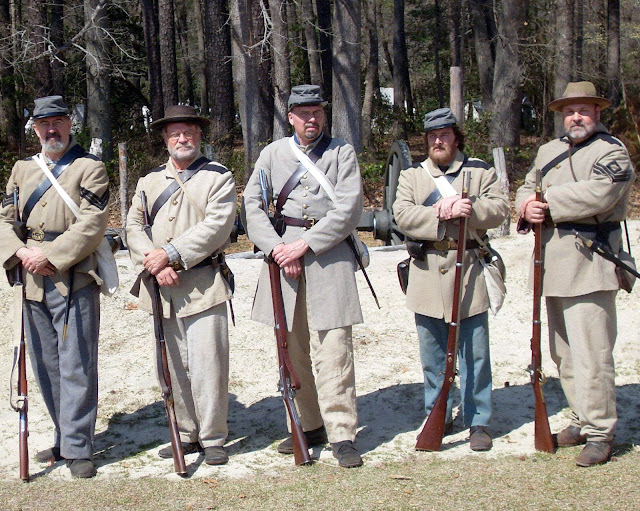
Members of the 6th North Carolina State Troops at the Bentonville Living History on March 19, 2011


Harper House, Bentonville Battlefield, NC- Throngs of people gathered in small clusters on the lawn of John Harper's farmhouse in Bentonville, NC on the morning of Saturday March 19, 2011. It is the sesquicentennial commemoration of the War Between the States. Even at 9 am the brightly shining sun was warm enough to drive people into the dappled shade of the ancient trees in front of the house. Red, white and Blue bunting hung limply from the second story balcony in the stillness of the morning. The air buzzed with excited conversation as dozens of small groups of men and woman talked amongst themselves. Small children played soldier with wooden rifles and chased each other through the crowd. Others clung to the thick spreading lower branches in trees that invited children to climb them. 
Rick Starting the day in "civilian" togs


I wandered onto the park-like lawn and joined the festive atmosphere with my reenacting friends from the 6th North Carolina State Troops. Like most of the others present this morning, we were wearing the garb of 19th century civilians and portraying local citizens who had gathered to join the Confederate Army. This was an event sponsored by the North Carolina department of Cultural resources and the Staff of the Bentonville Battlefield. The public had been invited to witness a living history program portraying camp of instruction  for newly enlisted, "green" troops. The frustrated officers trying to whip us into shape called us "pasty faced shopkeepers and oafish, sod busting farm boys", but that was later in the day after the speech making and merriment ended and we were being turned into cannon fodder.

My friend, Tom Justus, and I stood at the edge of the crowd in the shade of a tree. He unbuckled the straps that formed a carrying sling around his black instrument case and withdrew his ever present fiddle. The thin, high pitched drone of an irish jig punctuated the still air as Tom scratched out a tune. Normally this would have drawn a crowd, but with all the activity in the yard, we were barely noticed. 

Suddenly a hush fell over the crowd and we looked up at the balcony. A gray haired man, nicely dressed in a black sack coat and black short brimmed hat, waited politely while the crowd quieted down and gave him their attention. He was John Harper, owner of the farmhouse whose lawn we were gathered on. He welcomed us and lamented the occasion that brought us together...the coming war. He referred to the telegram received by our governor, John Ellis, asking for 75,000 troops to quell the rebellion. He reminded us of the reply, "you can get no troops from North Carolina" which was met with rousing cheers from the gathered crowd. Mr. Harper encouraged us to enlist in the Johnston volunteers and regretted he was to old to lead us himself, but assured us the war would be over in a matter of weeks since we all know that a good southern boy can whip any 12 Yankees!

At the conclusion of the speech, uniformed army officers funneled the eager volunteers into lines for examination by a medical officer before being enlisted and sworn in. By this time some spectators had gathered behind us to watch. Looking at my gray haired friend Tom, and thinking about the gray streaking my own beard, it occurred to me that we could no longer portray eager farm boys anxiously running off to a great adventure. Men of our senior years needed no excuse to stay out of the army, so why would we have been present?

Perhaps we could portray veterans of our own boyhood adventure in the Mexican war. Older men who wanted to prove to themselves and fellow villagers that we were "able bodied men" willing to fight in this patriotic cause. That would be a more likely impression for us to portray at this stage of our reenacting career.

As Tom packed away his fiddle, we remained where we were, surveying the youngsters in a rush to enlist.  I remarked to Tom, and some spectators within earshot,

"Remember when we were boys and they told us the war with Mexico would be over in a week? That sure  didn't work out so well, if you recall those dusty marches across the dessert. Are you SURE we still want to enlist"

 To which Tom played his part perfectly by reminding the skeptical character I was playing of "duty and honor" while the spectators behind us chuckled.

We soon found ourselves in a long line. In the distance, officers laboriously filled out paperwork. A reenactor behind us joked that it didn't take him this long to enlist in the real army. Tom and I started chatting about our first person impressions. A first person impression is the 19th century person you are portraying. They can be a real person or a fictional person. The important thing is that you stay in character and be true to that persons core knowledge and beliefs. This can be as simple or complex as you care to make it. Some reenactors invent elaborate characters or portray ancestors or once living soldiers through detailed research into every aspect of their life. I asked Tom if he was going to be a blacksmith which ties into his passion and profession as a medieval armorer. He had thought about this and decided he would portray a foundry-man or maybe a railroad metal worker as a tribute to some of the skilled "mechanics" that comprised the 6th NCST and in tribute to the company shops near his home. I hadn't given my character much thought, but as the lined moved closer, I decided I would portray my Great-Great Grandfather, John Walton.

John Walton was born on Applyby-Magna, England in 1830. In the 1861 English census he lists his occupation as a coachman in Cheddleton, England. John Walton never traveled to America. At the time of the war between the states he was 31 years old and had a large family. 

Had he lived in America, he would have been a prime age to have fought, either as a volunteer or later as a conscript. What he thought of this war in far off America was never recorded. I am the descendant of John's son George, who arrived on these shores two decades after the war.

I stepped up to the doctors table.

"Name?"

"John Walton" I replied

The doctor did a double take. "Are you related to the Waltons?"

"I am "the Waltons", sir" I replied

He gave me a foolish grin, undoubtedly thinking about the 1970's T.V. show, "The Waltons" which caused me to suffer through high school with the nickname "John-boy" .

He continued checking off items on his examination form, without actually examining anything. Another Doctor told me to touch my toes. Playing up the "old-man" angle, I placed my right hand on the table, to steady myself, I bent my knee and lifted my foot to touch my toe. The Doctor gave me an exasperated look and exclaimed "not that way!"

I calmly turned around placing my left hand on the table and raised my other leg in the same manner, to the amusement of onlooking spectators. The doctor gave up, shoved my papers toward me and told me to  report to the enlisting officer before turning to the recruit behind me and shouting, "Next!"

I joined another line. Welcome to the army...hurry up and wait!

Tom and I were looking over the forms in our hand. Even though Tom is a head shorter than me, both our forms said: height 5' 10".  The forms said we have brown hair, and brown eyes. I looked at Toms white hair and beard. It turns out we both have hazel eyes, which may be a greenish hue, but not brown. I wondered how they got that so wrong.I guess in their hurry to enlist us they glossed over some of the details.

I started thinking about how excited I have been in the past, when researching, to find a soldier enlistment papers or other "official documents" in a  soldiers compiled service record. Their height, hair and eye color brought them to life a little bit. But now I have to question how accurate those "facts" really are. I never thought about it before, but if this information was not recorded by the person themselves, it may be questionable. Just because it is on a form, doesn't make it accurate.

When I got to the recruiter he glanced over the form, looked me over, filled in a few more items and sent me to a group of recruits waiting to be sworn in.  I sat in the shade and had just gotten comfortable when a officer got us into line and we we sworn in.

I was now officially a soldier of the Confederate states of America!

Next: Learning how to Drill

Regimental Commanders of the "Bloody Sixth"

  1st: Colonel Charles F. Fisher May 16, 1861-July 21, 1861 Killed in action at the Battle of First Manassas 2nd: Colonel William Dorsey Pen...