Confederate battle flag of 'Bloody 6th' regiment conserved for future generations


Members of the Sixth North Carolina State Troops proudly display the authentic Battle flag they worked so hard to raise over $6,000 to conserve in honor of the men of North Carolina who fought under this banner

Published: April 7, 2013 in the Raleigh News and Observer (section B, page 1)

"Bloody 6th" Battle Flag at Home

N. C. Regiment lost it in Virginia; Museum brings it home to Raleigh

By Renee Elder — relder@newsobserver.com

RALEIGH — A Confederate battle flag lost in the final months of the Civil War was handed over again Saturday – this time back into the collection of the N.C. Museum of History following a $6,500 restoration.

The flag was carried by the 6th Regiment of North Carolina [State Troops] at the Battle of Sailor’s Creek in Virginia when it was captured by a Union soldier on April 6, 1865. Forty years later, the federal government returned the flag to North Carolina, but it remained hidden in storage because the torn and dirty fabric was not suitable for display, said Jackson Marshall, assistant director of programming at the history museum.

“It’s been 100 years since the public has seen this flag,” Marshall said. “Now it’s cleaned and conserved in a way that will protect it for another 40 or 50 years.”

The museum is short on funds for restoring historic artifacts and must depend on private groups such as the Cedar Fork Rifles Preservation Society[1], which raised money to restore the 6th [North Carolina State Troops] Regiment flag, he added. The museum has about 125 battle flags but only about 30 have been cleaned and preserved so they can be made available for display.

More than 100 people from across the state came to the dedication Saturday to see the flag and share stories about the N.C. 6th Regiment, which formed in Charlotte [Company Shops, N. C., present day Burlington, N. C. ] in May 1861 and fought its first major battle two months later in Manassas, Va., also known as the First Battle of Bull Run.

“It was the only North Carolina battalion [to fight] at that first great battle of the war,” said Rick Walton, a Civil War historian and member the Cedar Fork Rifles Preservation Society. [2]

Known as “the bloody 6th,” the regiment fought constantly during the war and at many famous battle sites in throughout Virginia, Pennsylvania and North Carolina: Yorktown, Sharpsburg, Fredericksburg, Chancellorsville, Gettysburg, New Bern, Plymouth, Petersburg and others. Starting out with 1,000 members, the ranks were diminished by injuries and deaths after years of fighting. Replacements were brought in whenever possible, Marshall said.

Sailor’s Creek, about 60 miles southwest of Richmond, was the last battle fought by the 6th Regiment, which carried a practically new flag that had been issued to replace others lost or captured in battle.

“We don’t know who the 6th’s flag-bearer was that day; in fact we know more about who captured it,” Walton said.

Joseph Kimball, of Littleton, N.H., got credit for taking the 6th Regiment battle flag; he was awarded one of the 57 medals handed out by the Union Army for military service on that day.

The Confederate battle flag has 13 five-pointed stars set on an “X” pattern, known as St. Andrew’s Cross but also sometimes called a Southern Cross. It is distinct from the Stars and Bars design of the Confederate States of America flag.

Sailors Creek Battle Flag before Conservation

This 6th Regiment’s battle flag is missing a star, which was cut rather than ripped from the fabric, indicating it was likely taken as a souvenir from the battlefield or after the war, Marshall said. Conservators who prepared the flag for exhibit cleaned and protected the delicate fabric but did not change the flag’s overall appearance.

The Confederate Army lost more than 7,700 men at Sailor’s Creek. Just 72 hours later, General Robert E. Lee surrendered at Appomattox Court House.

More than just a symbol of a long-ago military conflict, the flag represents family history for many of those who came to see the flag rejoin the museum’s collection, Walton added.

“What this represents to us is heritage,” he said. “It’s a visual reminder of our ancestors.”

Marshall said North Carolina troops suffered massive losses in the Civil War -- as many as 35,000 men were killed and thousands more severely wounded.

“In Gettysburg, almost 25 percent of the total losses were North Carolinians killed or wounded,” Marshall said.

He said North Carolina’s Civil War heritage remains strong largely because of the losses so many families endured.

“I’m astounded at how many people give money to these efforts because they know they have a family connection,” he said. “People still remember the suffering and loss and want to keep family memories alive.”

NOTES

1.  The Cedar Fork Rifles Preservation Society is the formal name of the living history organization that incorporates the Sixth North Carolina State Troops reenacting group.

2 Two other North Carolina units were present at Manassas but not actually engaged. The 11th Volunteers/21st NCT were  stationed one mile northwest of Mitchell’s Ford on Bull Run, but were not engaged in the battle. The 5th North Carolina State Troops were stationed  at Blackburn’s Ford on Bull Run. The regiment was not engaged but was under artillery fire.

Lt. Walton’s Keynote address for the dedication of the conserved 6th NCST Battle flag

 Copyright (C) 2013 By Frederick Walton, Historian of the 6th North Carolina State Troops

On Saturday April 6, 2013, the anniversary of the battle of Sailors creek, I presented the following program at the North Carolina Museum of History as the keynote speaker to dedicate a newly conserved battle flag that was captured at Sailor’s creek 148 years ago,
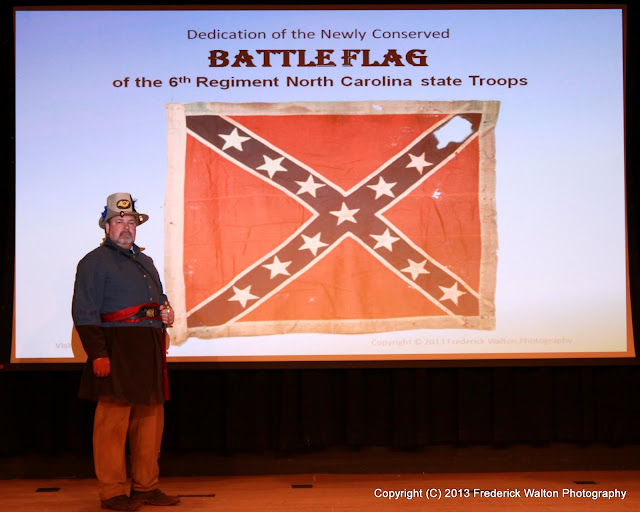
Author presenting the keynote address at the North Carolin Museum of History on April 6, 2013

An Address for the Dedication of a Newly Conserved Battle Flag 

The Confederate Battle Flag…   

That familiar flag…. 

With a bright red field….,

Crossed by the blue bars of the saint Andrews Cross….

Five pointed white stars represent the states of the Confederacy...

We all recognize this flag. It is the thing that brought us together today.

It is a flag that proudly symbolized the unity of Southern communities in the 1860’s, who were sending husbands and brothers and son’s off to fight for their vision of a new government… one that more closely represented their Anglo-Saxon and Scots-Irish agrarian, political and religious beliefs.

Sadly, it is a flag that divided many of these same communities a century later and still causes much confusion about cultural and racial identity today. 

I’m not talking about the “Stars and Bars” or the “Bonnie Blue”. These are distinctive flags with their own story and pride of place, but people sometimes mistakenly apply their name to this flag. 

I know YOU wouldn’t make that mistake….you KNOW that this is the Confederate battle flag.  Sometimes it is called the Southern cross.

It is the soldier’s flag.  A flag that was carried into battle by each and every Confederate regiment.  

It marked their place on the battle field. It led them into battle and acted as a rallying point in the swirling noise and confusion of many a desperate and deadly fight.

We’re here today to pay honor and tribute….not to a battle flag that has simply endured for a century and a half…but for what it represents …to US!… Heritage!     Honor!       Devotion! 

We gather here today to honor the memory of those men of the 6th regiment North Carolina State Troops … our ancestors… that carried this flag…. That fought under this flag…That died for this flag. 

We are here because of the hard work of our members and the financial support of our friends and descendants who contributed to this project.   Thank you for your support. And Thank you for supporting future projects.    We take great pride in our sacrifices of time and money that have made this project so successful. But let us never forget the men we do it for … our ancestors, .. Some who made the ultimate sacrifice. 

And Thank you to the North Carolina Museum of History for Partnering with us on this project and sponsoring today’s event. We look forward to a long relationship with the great folks here who have taken pride in our heritage. 

Together, we have ALL preserved this flag as a visual reminder of our ancestors so that future generations may be reminded of them and learn of their sacrifices. 

When the state of North Carolina called upon them to come forward … They willingly volunteered. Many never came home. Today this chapter of North Carolina history is considered by many to be politically incorrect. They would rather we forget it.   But luckily, I’m a historian…not a politician!  So let me tell you a little bit about the 6th North Carolina and  the history of the flag we’re about to unveil. 


The 6th North Carolina State Troops earned the nickname “Bloody Sixth” through hard fighting on many battlefields throughout the war.  I could easily spend the next several hours sharing with you their remarkable history.  But for the sake of brevity let me read to you from the colorful and descriptive summary written by their unit historian, Captain Neill W. Ray at the turn of the century.    

 I Quote …

“Theirs was not garrison or post duty …it was their lot to fight the enemy in the field …to meet him in his advances….to check him when possible and to follow him back and fight him in his own country and in his own strongholds …to contest

inch by inch…

day after day …

week after week

month after month

the enemy’s investment and gradual closing in on the lines around Petersburg and Richmond and when numbers prevailed over the thinned and thinning lines of the Army of Northern Virginia to fall back and back with them until finally hemmed in and compelled to surrender”

Captain Neill Ray

Captain Ray was justifiably proud of the Regiment he served in. They mustered into service on May 16, 1861. This was six months before the confederate battle flag was first issued in November of 1861. He wrote, and I quote:

 “At the first call her men volunteered for the War and hastened to the Northern border of Virginia to meet the enemy at the forefront 

From July 1861 to the closing scene at Appomattox they shared the fortunes of the Army of Northern Virginia

Their blood … wet the soil of Manassas Plains on July 21st 1861”  

Regimental flag of the 6th North Carolina State Troops

They were the ONLY North Carolinian’s to fight in this first great battle, But BEFORE the  6th North Carolina even left for  Virginia, Colonel  Fishers sister presented them with a regimental flag made using her own blue silk Shawl. It survived the war and is on display HERE in the museum.  

Written on the flag is the regiment’s motto…”DEEDS NOT WORDS”.  Throughout the war they embodied this motto by their gallant deeds.

Deeds Not Words-Regimental flag of the 6th North Carolina State Troops


Captain Ray’s history details all the places they fought which I will summarize for you:

In 1862 they held back invading Federals during the Peninsular Campaign Fighting at

  • Yorktown
  • Eltham’s Landing,
  • Seven Pines and Fair Oaks  
Next came the seven days battles

  • Gaines Mill ,
  • Savage Station ,
  • White Oak Swamp
  • Malvern Hill ,
  • Harrison’s Landing

 Then they were drawn back to northern Virginia to fight at 2nd Manassas and Sharpsburg, a battle that became infamous as the bloodiest single day of the war. They ended the year defending Fredericksburg in December 1862. 

Colonel Isaac Erwin Avery

In 1863 they fought again in Fredericksburg as part of the  Chancellorsville campaign.   Then on to Gettysburg  Where Colonel Isaac Erwin Avery, commanding the Brigade, fell in the attack on East cemetery Hill…  writing his last words

“Tell my Father I died with my face to the enemy”

Colonel Avery's Note. Held in the Vault at the N. C. State Archives
 

  In November, Hoke’s brigade was overrun at Rappahannock Station and many members of the 6th were killed, wounded or captured.   Returning to North Carolina in the spring of 1864 they fought at:

  •  Bachelor’s Creek near New Bern, 
  • Plymouth
  • and little Washington,

before being rushed back to the Virginia theater of war for a busy summer of campaigning.

  • Petersburg
  • Cold Harbor

and then to the Valley under Jubal Early:

  • Lynchburg,
  • Martinsburg,
  • Monocacy,

all the way to the gates of  Washington D. C. where their very presence caused quite a stir!   But the long hard march prevented them from entering the heavily fortified Capitol so they returned to the Valley fighting at:

  • Winchester
  • Fisher’s Hill
  • and Cedar Creek

January 1865 found the hardened veterans in the frozen trenches of Petersburg. On March 25th 1865 they stormed Fort Steadman in a desperate gamble which Ray called a “forlorn hope”. 


He concludes by saying, Quote:

“Three times they went into the enemy’s territory in Maryland and Pennsylvania, fording the Potomac six times “  


Interestingly enough, the one place he forgets to mention is Sailors creek! The final battle for the 6th NC and the battle where their flag was lost. So let me tell you a little bit about the flag and how it was captured.

After the 1864 Valley Campaign, the Richmond Depot produced a 6th issue bunting battle flag to be distributed to regiments who lost flags in the Valley or needed replacements. The flag we are unveiling today was issued to the 6th North Carolina State troops after their long and tiresome campaign in the Valley.

The flag is approximately 4 feet square.  Notice, I said square. Not a rectangle.  Battle flags flown by the Army of Northern Virginia were square.   Our flag measures 45 1/8 inches at the”hoist” (or width) by 48 inches in length, which is called the “fly”.  

"Sailors Creek" flag at N. C. Museum of History, before conservation

The blue bars that forms the St. Andrews cross are 5 ¼ inches wide and are edged with a ½ inch white fimbriation.  There are thirteen, white, 4 ½ inch, five pointed stars are evenly spaced every 8 inches.   The flag is edged with 2 ¼ inch white bunting on three sides, while the hoist edge is strengthened with 2 ½ inch wide white canvas that contains three hand stitched eyelets to tie the flag to a pole.   

"Sailors Creek" flag at N. C. Museum of History, before conservation

This flag contains no battle honors and no unit identification, however on the reverse is the number “357” stenciled there by the U. S. War Department when it was cataloged after being captured. This unique serial number  can be used to trace the provenance of an individual flag, especially an unmarked flag like this one.

At the Battle of Sailor’s Creek, The 6th North Carolina was a member of Lewis’s brigade along with the 21st, the 54th and the 57th North Carolina Troops. As part of Major General John B. Gordon’ second army corps, they were struggling along as the Army’s rear guard  on April 6, 1865. 

In his “Reminiscences of the Civil War “ General Gordon paints a picture of the hardship they faced:   Quote

“Fighting all day, marching all night, with exhaustion and hunger claiming their victims at every mile of the march, with charges of infantry in rear and of cavalry on the flanks, it seemed the war god had turned loose all his furies to revel in the havoc. 

  On and on, hour after hour, from hilltop to hilltop, the lines were alternately fighting and retreating, making one almost continuous shifting battle “

Around 11 AM Sheridan’s cavalry swooped down on the Gordon’s men , driving them back.   Nearby at the upper fords, both General Anderson and General Ewell were trapped and forced to surrender.    But at the lower ford, near Lockett Farm, the  North Carolinian’s of Lewis’s brigade bitterly resisted, pushing their attackers back. The action seesawed back and forth on the muddy, narrow road. With their backs to the swiftly flowing Sailors creek, the embattled Confederates fought for their very lives.

No narrative exists to describe the action that happened next…at the moment the 6th North Carolina’s flag was captured.   Ironically we know more about who captured this flag, than we know about who in the 6th North Carolina State Troops carried it.

We don’t know who the flag bearer was or what fate befell him,   But It was a  29 year old Yankee cavalryman named Private Joseph Kimble who galloped away from the battle line with a prized confederate Battle flag that day, earning him a medal of honor.

Kimbell, was born in Littleton, New Hampshire. He enlisted in Ironton, Ohio and was a member of, Company B, 2d West Virginia cavalry.

Sixty Medals of Honor were awarded for actions at Sailor’s Creek, Virginia, during the period March 29 to April 6, 1865.   Fifty-seven awards were presented for actions on April 6 alone…all but ten  of them for the capture of Confederate battle flags.  

As  Grant’s Federal troops scattered the Confederate army across the battlefield, General Lee looked down on the scene from a nearby hilltop and remarked 

“My god, has the Army dissolved?” 

 The catastrophic loss of nearly 8,000 men, 8 generals, Cannons, supplies and …battle flags, spelled the end for the Army of Northern Virginia. 3 days later, on April 9th, 1865 …it was over.

The men of the 6th North Carolina returned to their homes and rebuilt their shattered lives after the war, many rising to prominence in State and local government or successful business or farming careers.    Many of you descended from these brave men and probably have your own interesting war stories to tell about your ancestor. I would love to hear them some time.

And so we gather today to dedicate a battle flag carried by the men of the 6th North Carolina State troops, captured from them as they fought honorably in a furious battle, returned to North Carolina by the united states government in 1905 and Preserved…by Us in 2012.   It will once again be a witness to the Story of the 6th North Carolina state troops.

At this time I would like to invite forward two descendants. I am proud to call them my friends and my partners in this project. As, Reenactors We have stood shoulder to Shoulder on many of the battlefields their ancestors fought on.   To unveil the flag, please welcome Corporal Matt Holder, Great-Great  grandnephew of Private Lemuel Holder, from Co. I, who was captured after the Battle of Gettysburg and perished in Point lookout Prison.

Descendants Matt Holder and William O'Quinn unveil the conserved flag

And Corporal William O’Quinnm, the great-Great grandson of Corporal Thomas C. Barbee who was wounded at the battle of Gaines mill and served honorably in Co. I through the war until paroled at Appomattox.

Both Ancestors served in Co. I, which is the company our reenactment unit proudly  portrays.   

(wait for William and Matt to come on stage)

Will the Audience please stand.

(to members of the 6th North Carolina State Troops) 

Attention Company….. Present Arms…..

We proudly dedicate this conserved flag to the descendants of the veterans of the 6th North Carolina state troops and to the people of the old North State   

(Flag is unveiled)  

 Three Cheers for the Old North State….   

(Musicians come on Stage)   

THANK YOU   

(Return Podium to MC)

Author standing next to the Conserved Flag on the stage at the North Carolina Museum of History


Selected Bibliography

Clark, Walter, editor. Histories of the Several Regiments and Battalions from North Carolina in the Great War, 1861-65. 5 vols. Raleigh and Goldsboro: E. M. Uzell, 1901.

Iobst, Richard W. The Bloody Sixth: The Sixth North Carolina Regiment, Confederate States of America.Raleigh, NC: NC Confed Centennial Comm, 1965. 493 p. E573.5.6th.I6.

Dedmondt, Glenn. The Flags of Civil War North Carolina. Gretna, La.; Pelican Publishing Co. , Inc, 2003. 206 p.

Rollins, Richard M.  The returned battle flags. Redondo Beach, Calif. : Rank and File Publications, 1995.

Cannon, Jr., Devereaux D. The Flags of the Confederacy: An Illustrated History: St Lukes Press and Broadfoot Publishing,1988.

Calkins, Chris, The Appomattox campaign : March 29-April 9, 1865 Conshohocken, PA : Combined Books, 1997.  


The Bloodiest Day- September 17, 1862

 September 17, 1862- The Battle of Sharpsburg- known as The single bloodiest day in the Civil War. The Sixth North Carolina State Troop fought there! I walked in their Footsteps 150 Year later...

The 6th North Carolina State Troops on the reenactment battlefield of Sharpsburg at sunrise on Sept. 8, 2012

A Brief History of the Sixth North Carolina State Troops at Sharpsburg (Anteitam)

The 6th North Carolina State Troops arrived in Sharpsburg on September 15, 1863 tired and hungry, after spending the previous day fighting to block the Federal army from passing through Boonesborough Gap, and then acting as a rear guard as the Confederates consolidated at Sharpsburg.  Law's brigade was posted on the Hagarstown Pike with their right posted at the Dunker Church and the line extended along the turnpike. The other regiments in Law's 1474 man brigade were the 4th Alabama, the 2nd Mississippi and the 11th Mississippi.1 Regimental strengths for the Sixth NC at this battle are not easily found, but in discussing this with my colleague and fellow researcher, Randall Garrison, we guesstimate their strength to be around 400.

Author Rick Walton in front of the Dunker Church in 2007

They crossed the high wooden post and rail fences bordering the Hagarstown pike and entered a field adjacent to Miller's cornfield. This is where they fought....and died. By mid morning it was over. They were recalled to the woods around the Dunker church and waited in readiness under a heavy bombardment of cannon fire for a call to action that never came.

Various casualty records can be found, all with slightly different numbers but they are all in the same ballpark:

  •  Iobst, in "The Bloody Sixth", referred to a casualty report in the October 8, 1862 "Hillsborough Reporter" of  8 Killed and 105 Wounded for a total of 113 Casualties. 
  • Contrast this with John Micheal Priest's figures from the Official Records of 6 Killed and 94 wounded.  
  • Col. Laws report2 in the O.R.'s states 8 killed and 117 wounded. 

I found a casualty list for the 6th North Carolina in the Wednesday, Oct. 1, 1862 "North Carolina Standard" that I used as the basis for my research, which agrees with Iobst's figures of 8 Killed and 105 Wounded, but after going through the rosters I found that even these figures don't  match. My research has identified 12 killed.

Confederate dead in the field, the west side of the Hagerstown Road, after the Battle of Antietam 
Digital ID: (digital file from original, front) ds 05176 http://hdl.loc.gov/loc.pnp/ds.05176


Of the nearly 4,000 deaths resulting from that horrific battle, at least 12 men from the 6th North Carolina State troops ("The Bloody Sixth") made the ultimate Sacrifice that day 150 years ago.

As reenactors of the Sixth North Carolina State Troops, we visited the field they fought on to honor their memory 150 years later. 


They have not been forgotten:


6th NCST Roster of  Killed from the battle of Sharpsburg, Maryland as reported in the 7-31-1861 North Carolina standard and verified against North Carolina Troops Roster (Jordon), Bloody Sixth Roster (Manarin), The O.R's and Compiled Service Records and transcribed by Historian Rick Walton, I am including the 12 members of the 6th Killed in action below. (use scroll at bottom to see entire table)
Co Rank Name in Newspaper Name on roster County enlisted Age enlisted Date enlisted Occupation Resided
C Captain Capt Lowrie Lowrie, Houston B. unknown 22 5/16/1861 unknown unknown
C Sergeant Serg’t. M Markham Markham, Matthew Orange 25 5/1/1861 unknown Orange
D Corporal Corp’l A L Poteet Poteet, Alburto L. Mecklenburg 41 5/28/1861 unknown Burke
D Private G Stanford Stanford, John J. Alamance 33 6/27/1861 Farmer Burke
D Private Henry Roseman Roseman, Henry Alamance 25 6/15/1861 unknown unknown
D Private L L Hank Houk, Lawson L. Mecklenburg 19 5/281861 unknown unknown
D Private <not listed> Branch, Martin J. Alamance 22 6/27/1861 unknown Burke
E Sergeant Serg’t P A Erwin Erwin, Isaac Mecklenburg 30 5/28/1861 Farmer Yancey
G Private Thos Cress Cress, Thomas Mecklenburg 25 5/29/1861 Farmer Rowan
H Corporal Corp’l J B Walker Walker, James B. Caswell 21 6/6/1861 Farmer Caswell
H Private J T Wren Wren, John T. Caswell 24 6/10/1861 unknown unknown
K Private David Hatchell Hatchell, David Wake ? 9/1/1861 Unknown Unknown

List of Killed and Wounded [and Missing] in the 6th N.C, Reg.,

Sept. 17th, 1862.


Source: “The Weekly Standard”, Raleigh, N. C. October 1, 1862

FIELD AND STAFF.— 

Major Webb commanding Reg't., severely wounded in arm ; 

Capt. Tate acting Lieut Col., in the neck ; 

Serg’t Major C. Mebane, slightly in the face

Company A.—

Corp’l J W Williams slightly wounded 

private R. Croker slightly wounded ; 

R. L Elliott, James Griffin, Geo Lentz, Serg't J R Swafford missing.

Company B.—

Lieut Umstead, slightly wounded ; 

Alex Laws, severely in face; 

Clem Crabtree severely in face 

Robt Ashley, in foot; 

Guilford Laws, slightly, Sept. 14th [note: engaged at Turners Gap, South Mountain]

Company C.—

Capt Lowrie, killed ; 

Lieut Wm. G. Guess, severeIy wounded in the arm ; [Note: Promoted to Captain, September 17]

Serg’t. M Markham, killed ; 

M V Blalock severely wounded ; 

John L Killgore, mortally

D. C.  Warren, severely; 

W D Blalock, severely ;

Silas Hutchins, severely ; 

Jas Hutchins, Slightly ; 

James May slightly ; 

John Proctor slightly ; 

Jas M Shepard slightly 

Jas S Lee, slightly; 

Thos Haley, slightly ; 

John Turner slightly ; 

Thaddeus Redmond, slightly ; 

John W Poe, slightly ; 

Serg’t Turner slightly; 

Levi Markham slightly 

Company D.—

Killed Corp’l A L Poteet ; 

privates G Stanford, Henry Roseman and L L Hank. 

Wounded : Lt. Carson, Serg’t. A W Honck, Corp’l Cook, 

Privates W J.Carson, J D Berry, Chas Branch, Jason McNeely and H Speigle [Speagle]

Company E.- 

Wounded: Lieut Burns, Serg’ts Howell, P A Erwin, and M B Pendley

Corp’l McKinney, privates R Boon, J H Kipp, John Huntinger, A F Johnson, John McNeil, L Ollis, J H Rathbone, D R Silvers, E C Wiseman, William Watts and William Matthews.


Company F.—

Lieut H C Dixon, commanding company, in the head; 

Lieut B Y Mebane slightly in neck; 

Serg’t A Tate, severely in breast; 

Serg’t J M Durham in leg 

privates, J. T. Bradshaw slightly in arm ; 

Robt Evans, in head; T R Faucette, slightly in arm ;Joseph G Freeland, slightly in leg; Wm. Kirkpatrick, slightly in leg and hip; W C Lashley severely in leg; S M Lashley slightly in breast; Daniel Sharp, severally in breast ; Moses Stanford, severely in neck and shoulder; Wm Jones, slightly in ear; John Dodge ,slightly in leg.

Company G.—

Lt. Roseborough commanding Company, in head ; 

Lieut Rothrock disabled by concussion; 

private Thos Cress, killed; 

Serg't W Cooper, private C J Lipe, J B McNeely, J 0 Barnhardt, J A Barnhardt, H C Johnson, J P Thomason, J W Russell, H Rischie, E Upright, W S Shulibaringer, D A Sloop, J S Overcash, Adam Trexler, and J M Walker, wounded.


Company H.— 

Lieut Oliver, severely in leg; 

Corp’l J B Walker, severely 

privates, Thos It Garrison, W B Miles and H Malone, severely, P Simpson, slightly; J T Wren, severely.


Company I.—

Lt Allen slightly wounded; 

Serg’t Gunter, severely; 

Corp'l Clemens severely; 

privates Burgess, S. W. Chappel, Holder, Roberts, and Corporal T M Jenkins, slightly.


Company K.— 

Private David Hatchell, killed; 

Solomon Moore, wounded severely; 

Sam’l Hatchell slightly; 

Anderson Roberts, John Daily, sightly, and Robert Walker, severely.


Killed, 8; wounded, 105—total 113.


Notes:

1. Priest, John Michael, Antietam: The Soldiers Battle, White Maine Publishing Company, Shippensburg, PA, Pg 323.

2 O. R., Series 1, Volume XIX/1, Pg. 811


Meet a 50 Year Veteran

Copyright (C) 2012 by Historian Rick Walton

John Hutton, showing his 1962 Centennial Medal at the 150th Anniversary.

"Hey Rick, I got something to show you."  John Hutton had followed me through the shadowy gloom of our bivouac as the setting sun extinguished the last rays of light. I had just arrived and was setting my gear down. I was anxious to get settled in but it was already too dark to put my tent up and I knew John was a treasure trove of interesting facts and artifacts.

He held a small object clutched in his hand. As I got closer, the last rays of light glinted off  something metal.

"They gave us these when we came up here in '62" said John placing it in my hand. It was a medal, suspended from a blue and gray ribbon.

On the front of the Medal was a picture labeled "Historic Dunker Church". Ironically, this is where the 6th North Carolina and Law's brigade happened to be posted during the battle. Around the outer edge were inscribed the words "Battle of Antietam" and "September 17, 1862"

Front of 50 year old medal John Hutton received at the 100th anniversary of the battle of Sharpsburg in 1962

On the reverse side the words "Re-enactment Participant, September 15-16-17, 1962"were inscribed. Around the outer edge it said "Battle of Antietam" and "Antietam National Battlefield Site"

Rear of 50 year old medal John Hutton received at the 100th anniversary of the battle of Sharpsburg in 1962

I had never seen anything like this before. It is a unique memento and especially memorable to have the actual recipient share it with me half a century after relieving it. Sadly I will not be able to show my momento of the 150th reenactment battle of Sharpsburg to anyone, now or 50 years from now, because we didn't receive anything for our $35 registration fee.

In 1962 a 14 year old John Hutton was a member of the North Carolina sponsored reenactment group, the 6th North Carolina State troops. During the centennial he got to travel to, and fight on, a number of historic Civil war battlefield including the one at Sharpsburg. Today it is unthinkable to fight on the actual battlefield. This weekends reenactment is actually on a farm in nearby Boonesboro. 

After his Centennial experience John served his country on the real battlefields in far off Vietnam. I have a great deal of respect for Viet Nam Vets and appreciate John's Service.When reenacting came back into vogue, John picked up where he left off and has been reenacting with the Sixth NCST since before I joined in 1994.

John is connected to a number of Historic North Carolina families and has Ancestors that were members of the 6th NCST, but what I admire most about John is his devotion to reenacting and the friends he has made over the last half century. I can recall standing next to John on the Battle line when I was a private. As we marched to battlefields across far flung reenactments, commemorating the 130th, 135th, 140th and 145th anniversaries, John would always be calling out to passing troops, whether Confederate or Yankee..."Hey Sammy, give 'em hell", or "hey Al, hows it going?" and they would yell right back ""Hey John, good to see you!"

It is an honor to serve with John and I hope he keeps bringing out those mementos for us to see, even if it only by the flickering light of a campfire.

The 1960's Centennial "Reactivated" Sixth North Carolina State Troops includes a young Cpl John Hutton listed as part of company B.


September 8, 2012- Saturdays Reenactment at 150th Anniversary of Sharpsburg

"You have got to be kidding!"  said a surprised reenactor trying to cook his breakfast over a smoky fire. It was about 6:45 and barely light enough to see. I had just ordered the men to get ready for drill.

Sgt William O'Quinn and Lt. Walton on the reneactment battlefield of Sharpsburg at sunrise on Sept. 8, 2012


The bugles, fifes and drums had blared reveille in the darkness just before 6 AM. I had stretched myself and checked to see what might have seized up after a night sleeping on the hard ground. I found myself surprisingly limber as I sat up and put my wool blanket aside. I had laid down on top of the blanket to have a little cushion between me and the ground, but sometime during the night I must have gotten chilly and pulled my blanket over me. I stumbled through the dark camp as men were getting dressed, starting fires or just trying to grab a few more minutes of shut-eye. I found the First Sergeant and we compared rosters to make sure all the men were accounted for on the morning report he had to get over to headquarters. 

The Captain stopped by to inform me that we would be drilling this lovely morning and to have the men formed on the street by 7:30. There had been speculation that we might be skipping drill, but who were we kidding? In 1862 Confederate Soldiers drilled two, three and four times a day. Drill, drill and more drill they complained in letters home, but their lives depended on it, so they learned to drill with precision and pride. Reenactors typically drill once or twice during each reenactment, not counting using our practiced skills to maneuver on the field while in "battle". Like all good soldiers, we complain about it, but we know it is important so we can look sharp in the eyes of the public and our peers. There are units out there that never drill...and it shows! We DON'T want to be like them!

The 6th North Carolina State Troops on the drill field at Sharpsburg on Sept. 8, 2011

The sun was partially hidden behind gray clouds. We knew rain was in the forecast, but that was for later. Right now, the clouds gave us welcome shade  from the blazing rays and allowed us to drill in the open field without getting too overheated. We ran through the basic facings and knocked the rust off. For most of us it had been several months since we marched together, but, like riding a bicycle, it quickly comes back to you.

Right face! forward MARCH! By the left flank, MARCH! Right wheel, MARCH! Forward, MARCH! By company into line...

We maneuvered up and down, back and forth and were soon effortlessly drifting across the field to the Captain's orders. All around us other companies were doing the same. Today's reenactment battle would require us to act as skirmishers. Once we had demonstrated our comfort with the basics, we moved on to the trickier movements required for the skirmish line. This required the company to spread out at 5 pace intervals across the field, which is easy to do, but always a challenge for those in command to be heard and maintain order. As the sun rose higher in the sky and the morning hours burned away, we practiced skirmishing and began to feel quite confident... again. As with any skill, practice makes perfect.

Brigade officers making sure we didn't miss and drill maneuvers

The brigade officers and NCO's started calling the regiments back together and we completed the mornings program by running through a number of brigade drills before finally marching back to camp.

It would soon be time for lunch. The sky was getting cloudier and our first order of business was to put up our large fly to provide shelter in case it rained. William took charge of the effort and after much discussion, because every passerby had an opinion on the best way to do this, we finally committed ourselves and began the work of stretching the canvas out and securing it. If we only had four evenly spaced trees in a square or four tents poles, our job would have been simple, but we had neither. Nor did we have much rope.

Matt holding last corner, Rick holding pole while William unravels rope

We ended up tying one corner to the predominate tree, under which I had slept the night before. Since this was "my" tree, I tied the rope, but I only had a short rope tail to do this with, left over from our neighbor Craig's tent. I tied a double half hitch and gave it a good solid yank. It seemed secure. Next we stretched the opposite side to a log...which promptly shifted as soon as we tied to it. We shoved it back into place and secured it, then  pondered how to attached the last corner, left hanging in thin air. I finally found a large limb, which the Captain hastened to cut to size with his trusty camp saw. He then helped us tie it to the log and then on to a further tree, stretching our canvas tightly overhead. The resulting macrame project used a lot more rope than my little half hitch and would withstand a hurricane. We finally had a home! we laid out our blankets and I sat down to eat something for lunch before it was time to couter up  and march to the battlefield for Saturday's battle.

First Call! The words jarred me awake. I had stretched out on my blanket after lunch and dozed off. Around me the men were already getting their equipment on. I stood up quickly, hitting my head on the low canvas roof I had forgotten about already. I quickly got dressed and, as is my habit, I rolled  the rest of my gear inside my ground cloth and. placed it under the fly, away from the open edge in case it rained. I looked around and no one seemed to be carrying their ponchos so I dropped mine on top of my gear. To bad I didn't carry it with me!

Marching to the Battlefield

The usual confusion prevailed as men drifted from their camps to the streets and formed companies which were then organized into brigades. Other Brigades marched by us with flags flying and music playing. We waited for our turn and joined the long line of Confederates. There were thousands of troops on the march, the site was awesome. We entered a grassy, overgrown pasture. Tick city was my first thought, but in the end I never saw one or found any once I got home. It may have been the religious spraying of OFF insect repellant provided by our thoughtful comrade Yankee Joe. We stacked arms and were dismissed to rest. I laid down in the long grass next to my friends and watched brigade after brigade march onto the field. This wasn't a mega event by far, but it was pretty impressive seeing all these troops. Overhead the clouds played tag, showing alternating patches of blue sky and sunshine followed by more clouds. The last thought on my mind was rain as we lounged in the grass having idle conversations amongst ourselves.

Members of the 6th North Carolina State Troops resting before the Sept 8, 2012 150th anniversary reenactment of the Battle of Sharpsburg

The calm, relaxed atmosphere suddenly evaporated as officers urgently recalled their men to the battle line. The troops scrambled to their places. We quickly took our arms and marched off down a shady wood road. We were on the way to the battle field. We were ready to fight! No matter how many times I do this, I still get butterflies in my stomach. I'm like a 10 year old kid playing army again except this time and an officer with command responsibilities. Ahead stood two staff officers directing us forward. As I passed them their walki-talki blared to life and announced "severe storms are headed your way in 15 to 20 minutes".  That's it, I thought, the storm would probably force them to cancel the battle. I expected to be turned back to camp at any minute, but we kept going forward. Then, through a break in the woods, I saw why. Hundreds of spectators, colorfully garbed in shiny raincoats and holding umbrellas, lined the edge of the battlefield. Like the gladiators of long ago, WE were the show and the show must go on, regardless of the weather. An image of me leaving behind my poncho suddenly appeared in my brain. Oh Crap, we were gonna get wet, I thought.

Spectators and Yankee's waiting for the battle to begin

The line of marched stopped. We were in our position at the edge of the battlefield. In the distance a cannon roared...or was it thunder? It was thunder. The cannons were directly in front of us and they were quickly being covered to protect them from the pending rain. A flash caught my eye. Someone snapping a picture? No, it was lightning. The men nervously joked about the four foot long musket "lightning rods" they all carried. Overhead the trees started whipping around as a heavy wind blew leaves and hats indiscriminately across the field behind us. With a roar, the sky opened and rain drops as big a Minnie balls pelted us from above. The wind whipped the rain in our faces and we could do nothing but stand there.

6th North Carolina State Troops membesr Craig and William getting soaked during an unexpected downpour

The shady lane offered us little protection and there was no where else to go, so we stood quietly in our ranks and got quicklyand completely drenched.  Water overflowed from hat brims and cascaded in waterfalls. evrything in my haversack was sodden. After the heavy downpour had efficiently done its job in soaking us, It settled into a steady, gentle rain. My garden would have loved this, but I was dripping and ready to go home! Fat raindrops kept falling from the leaves overhead, but outside the treeline the rain had tapered off and a heavy fog rolled in. The artillery men had uncovered their guns and were loading them. In the distance, a line of ghostly looking enemy skirmishers appeared on the ridge, well hidden by the rolling mists.

Federal Skirmishers appearing out of the mist at the 150th anniversary Battle of Sharpsburg on Sept. 8, 2012

BOOM! We all jumped and turned to see a cloud of smoke surrounding a nearby Cannon that had fired and caught us off guard. BOOM!, BOOM! roared two more cannons. The battle was on and wet or not, we would soon be called on to push back the enemy.

Booming Canons begin the fight

The brigade officers demanded our attention and formed us back into our battle line. We surged forward through the underbrush and  advanced through the cheering cannon crews across the wet field. The cannon smoke hung in the damp air mixing with the floating mist. The acrid black powder smoke stuck our eyes and throats. Whatever was beyond the rise was obscured from our view. Our battle line marched on until we came to the far edge of the field. We deployed as skirmishers and cautiously entered a a copse of trees still dripping from the rain. The ground rose in front of us as and huge slabs of wet gray rock punctured the surface at odd angles, giving the skirmishers good cover. We continued our advance. Suddenly the mist cleared and we could see long lines of blue troops packed along the distant edge of the field. Their skirmishers appeared in front of us and opened fire. The crackle of muskets interrupted the worried shouts of officers trying to move us into position. We held the high ground and had a good selection of trees and rocks to hide behind as we started to return fire. As we moved through the woods we stumbled across spectators in lawn chairs. Up until that moment, the urgency of battle made it all seem very real, but it vanished in a flash after seeing spectators in brightly colored casual wear. From my position as a file closer I spotted the Federals starting to turn our flank and shouted a warning the other field officers. The Brigade started to withdraw and we found ourselves in front of the cannons again, but, this time,  blocking their shot. We quickly got out of the way and ended the battle with a final ear splitting BOOM!

Members of the 6th North Carolina state troops deployed as Skirmishers at the 150th anniversary Battle of Sharpsburg on Sept. 8, 2012

Fresh troops rushed past us into the fray as we  realigned ourselves and marched to the rear. We stood back at the first staging area as hundreds of fresh troops poured in waiting their turn to fight. The battle field was so small that they had to rotate us out to give others a chance, and the battle was over for us.

Members of the Carolina Legion returning at the 150th anniversary Battle of Sharpsburg on Sept. 8, 2012

The only casualty was my soul...the sole of my shoe that is. I'm not sure what caused it to give way, because they aren't that old. The long wet grass had managed to slide between the soul and upper and nearly tripped me as I was marching, pulling the soul away. I was forced to flap my way back to camp.

Between the exhilarating fight and the march back to camp we had begun to dry out from the rain. We would have enjoyed fighting longer but with our camp in sight we were happy to be back home...until we got to our tents. It seemed the wind and storm has passed through our camp with a vengeance. Tents we leaning or toppled. Blankets and knapsacks were soaked and my corner of the tent had ripped loose, exposing me and my messmates to the elements. My fate could have been worse but I had wrapped my blankets in the ground cloth so only the edges got wet, Matt's blankets got wet on one end, but William's entire kit was under a large puddle of water that had funneled into his once cozy quarters. To say this was disheartening would be an understatement.

William refastened the corner. I think my knot tying skills will be forever questionable, even though I personally think the rope was defective! The only thing to do was to stoke the fire and  dry the blankets. The sky still looked questionable as we stood surrounding the fire holding blankets and jackets close the the licking yellow flames, hoping they would not errupt in an inferno. I started thinking about the Confederate soldiers who fought here in 1862. It had rained prior to the battle. I realized how easy we have it compared to them. They  surely spent many wet nights wrapped in wet blankets, too tired to care, after fighting or marching all day. At least we had a fire and if absolutely necessary, we had any number of dry tents we could double up in. My overheated hands brought me back to the present. The fire was hot and my blanket had dried to at least damp. I felt and smelled like a smoked ham

I wasn't happy about my shoe either. It was aggravating to flap around. I don't remember when or where I got these brogans, but it didn't seem that long ago. I was hoping I could get them repaired and worried that they would be permanently damaged if I kept walking on them .(They were wrecked after this weekend!) Being wet, tired, embarrassed about my knot skills and frustrated with my bad shoe... I was dreading the planned evening battle.

Yankee Joe talked me into walking (limping actually) up to the sutlers where he introduced me to several friends who he thought could help. While walking around I was pleased to see the friendly faces of two of my old comrades from the 150th NYSVI. We stopped and exchanged pleasantries, but I was on a mission to get my shoe repaired. In the end the shoe was too wet and muddy to make a temporary fix.  I wasn't in the mood the spend $100 or more on a new pair or to continue shopping. My stomach started grumbling from the smells of food cooking on sutler row. I was still damp and suddenly very tired. I flapped my way back to camp ready to cook supper and figure out what to do with my bad brogan.

More rain was forecast, canceling the evening battle.  I was relieved to hear this news. The bodies around the fire had thinned out and the other half of the men had headed up to the sutlers. I had brought some smoked turkey sausage, a pepper from my garden and an onion. I chopped up the pepper and onion and put them in the frying pan with a little oil. I raked a pile of glowing coals to the edge of the fire and spread them out until I had set my "stove" to medium. I rested the frying pan on the coals and started to gently cook the onions and peppers. The smell drew a few of my comrades. Unfortunately I had brought only a small amount and didn't have any extra to share. I sliced the single sausage and dropped it in the hot pan. the coals had cooled a little so I raked some fresh coals under the pan to renew the heat. I covered the pan with my tin plate to keep the moisture in and the ashes out.  It didn't take long to heat the sausage. I settled myself near the fire to eat supper, finishing my masterpiece with a few squirts to Texas Pete. Bon Appétit! At least one thing went as planned that afternoon!

"Private Hinnant" made an appearance around the campfire
(strictly for medicinal purposes since we had gotten soaking wet and wanted to avoid a chill)

I was finishing the final morsels of my supper as my neighbors and tent mates  started returning from the sutlers. The camp was dark and damp, but the fire cast a cheery glow. The quiet satisfaction of a full days activities counterbalanced the disappointment of the rain, broken footware and collapsed tents. Private Hinnant made an appearance and tin cups appeared from every corner of camp, bringing us together, even if only for a few moments. Jeff introduced us to an African nectar, which was quickly shared amongst the empty cups. We chatted around the campfire briefly, but people started drifting off to their tents or other fires. I stretched out on my blanket and my eyelids were getting heavy as I listened to a nearby conversation. I was wavering in and out, adding a comment here and there before finally drifting off to dreamland ending my first day on the reenactment battlefield to commemorate the 150th anniversary of the Battle of Sharpsburg.

link to Photos:

Next: A 50 year veteran


Tell my Father…

The story of two soldiers united in death on the Gettysburg battlefield By Frederick E. Walton, Historian of the Sixth North Carolina State ...