By Rick Walton, Historian of the 6th North Carolina State Troops Copyright (C) 2015
The 6th North Carolina State Troops Civil War experience through the eyes of Historian & Reenactor, Rick Walton
Walking Home
(C) 2015 Frederick Walton, N. C. Capitol Docent
| Philip Brown portraying a Confederate Soldier Walking home while stopping at the N. C. Capitol to talk to visiting School Children |
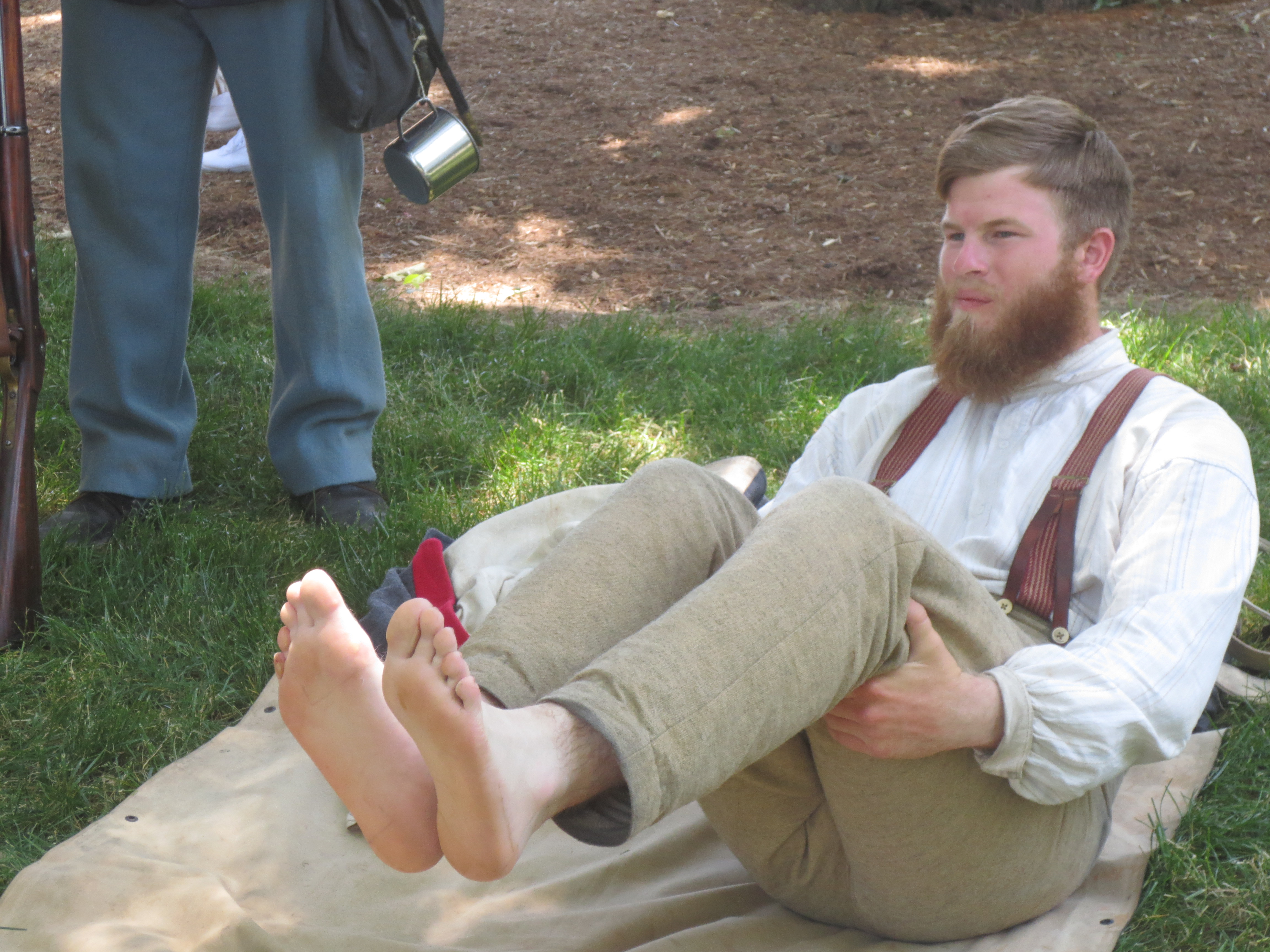
Wednesday, May 20, 2015- "How far have you ever walked?" asked Philip Brown while answering questions from school children visiting the historic 1840 North Carolina State Capitol. Philip had spent the last 9 days walking. He has walked through rain and steamy heat. He told me that one of the most difficult walks was along a road side trench where he felt like one leg grew longer to compensate for the slope. My back hurts just thinking about it! He has slept under the stars, in churches and hotels. His meals are from the kindness of strangers. People have read about him in the newspapers and pulled their cars over to chat. He walks all day long taking only a 30-45 minute break for lunch and a rest. He started in New Berne, N. C. and has clocked about 130 miles. He showed me the blisters on his feet that he earned for his trouble.
| Blistered feet after nine days of walking |
Philip was inspired by Washington Duke, who walked home after the Civil War ended. Brown is not portraying Duke specifically, but is representing all the Confederate soldiers who walked long distances to return to their often war torn homes after fighting in the war. He also hopes this will help people remember all the veterans who didn't alway receive the hero's welcome they deserved when they came home.
Memorial Day is a good time to ignore the SALES at the mall and think about the sacrifices that have given us our freedom. When is the last time you took your kids to a Veterans Memorial Day program?
![]() |
| Headstone marking an unknown Confederate soldier at the historic Oakwood Confederate Cemetery in Raleigh, N. C. |
He told me about Vietnam veterans he had met along his journey, many who had spent more than a year patrolling far-away jungles that were not only hostile because of enemy combatants, but often because of mother nature herself. He downplayed his tiring journey saying that this is a two week commitment, but those guys were in the jungles for over a year, and often came home to be spat upon by protesters.
Sadly, those protesters had ignored the fact that the young men of that generation had simply answered their government's call to service, just like the young men of North Carolina answered their state's call a century before. It's doubtful these boys were anxious to sacrifice their lives, but they had a thing called HONOR that compelled them to serve.
| North Carolina State Capitol |
Today too many North Carolinians have turned their backs on the men who answered their states call to serve in 1861. They disrespect them, reasoning that they fought for slavery, just like the protesters of the 1960's disrespected their peers who fought, calling them baby killers. Both are gross mischaracterizations that dishonor the memory of young men that bravely fought after being called to serve.
I was at the N. C. Capitol with my pal Woody to welcome Philip and talk to school groups about the Civil War and it's impact on Raleigh. We portrayed Federal troops. If Washington Duke passed through Raleigh on his way home to Durham, this is who he would have encountered. Some 80,000 Federal troops camped around Raleigh, while surrender negotiations were taking place up the road at Bennett Place.
| Capitol Docents, Woody Reagan, and Rick Walton, standing guard at the N. C. State Capitol |
We had the opportunity to talk to several school groups, but they were often more interested in my bayonet than Phillip's blistered feet. "Why didn't you just take the bus?" asked one astonished 4th grader. Philip smiled and explained how walking gave him an opportunity to honor those veterans and draw some attention to them this memorial day. I'm not sure the youngsters understood the symbolism, because they asked again and again "...but why didn't you just take a bus?"
As the crowds died down, Philip borrowed my knife to sharpen a pencil and added this days events to his journal. "What are you writing?" asked one visitor. "Memories" replied Philip. I'm sure walking 130 miles has generated many. I hope his visit to the Capitol was a pleasant one.
Philips journey will end at the Duke Homestead, having traveled a total distance of about 166 miles, on Saturday, May 23rd with a day long event that is open to the public.
| Philip Brown walked about 166 miles in these soldiers boots giving him a new perspective of what soldiers face trying to return to their home after the war. |
The 150th Anniversary of the Confederate Surrender at Appomattox
(C) 2015 Rick Walton, Historian of the 6th North Carolina State Troops
I am sitting in my office today, in Wendell, N. C., reflecting on why I'm not with my comrades at Appomattox and lamenting a bad back that kept me out of the field on this sesquicentennial anniversary. Outside my window, dark clouds drift overhead making the day as somber as this occasion calls for.
Of the more than 2,000 boys and men that served with the 6th North Carolina State Troops over the course of the war, Only 181 received paroles at Appomattox on this day. Only 72 still carried arms!
Two questions arise: Why so few men and why so few arms?
As part of Lewis' Brigade, The 6th North Carolina participated in a desperate attack on Fort Steadman in Petersburg on March 25, 1865. Although successfully getting into the Fort as the Yankee defenders fled, a counter attack made their position untenable and their retreat deadly.
William J. Walker, of company K, 6th NCST, wrote,
"... it looked almost impossible for any of us to escape when we were ordered to retreat[.] the grape and shell were comeing so thick that some laid down and was taken prisoners but when I thought of Point Look[out] you better know I come out."
His was the voice of experience. William had already spent a year of his young life in this horrible prison and he wasn't anxious to return. He was barely 20 years of age.
Many others on the 6th Regiment did not fare so well:
Along with Privates Levi Allen and Harvey Workman, Colonel Tate was severely wounded. Bedford Merthes, William Miles, John Alerson, Jacob Walker and many others were captured. Private James Turner of Company I had been "killed dead" with a bullet through the head. He was not alone. In total the 6th NCST lost 5 killed, 25 wounded, and 39 missing. The total loss for the Confederates was about 3,000.
Resettling back into cold, miserable, muddy trenches, the Confederates ducked Federal snipers and waited to be called into action again. This occurred on March 29, when the line was broken at Five Forks and the Confederates had no choice but to retreat. The exhausted soldiers of the 6th NCST, part of Gordon's Corps, were once again called on to be the rear guard. General Gorden recalled those days by saying:
"On and on, hour after hour, from hilltop to hilltop, the lines were alternately fighting, and retreating, making one almost continuous shifting battle."
Then another disaster struck, on April 6, 1865, when they were suddenly attacked by Sheridan's Cavalry at Sayler's creek. The weary Confederates fought valiantly, but were soon overwhelmed. "My God! Has the army been dissolved?" exclaimed General Lee, watching the disaster from his vantage point on a hillside. Almost 8,000 men, 8 generals, numerous artillery, miles of wagons and dozens of battle flags, including the battle flag of the 6th NCST were lost in one broad stroke. Exact casualties for the 6th NCST are elusive.
![]() |
| 6th North Carolina State Troops Battleflag captured at Sailors Creek. |
Those that escaped had not given up and began to regroup. The battle hardened veterans marched toward Farmville in an orderly brigade formation and after crossing the Appomattox, bivouacked north of Farmville, finally receiving much needed rations. Continuing northwestward, exhausted men started falling out and whispers of surrender were being passed amongst the officers, but most of the foot soldiers marched onward, hoping to put more distance between themselves and the enemy, looking forward to additional rations and a rest in the safety of the distant mountains.
The Federals were on the move too, eventually flanking the escaping Confederates. On April 9th the Federal infantry and cavalry had formed an impassable barricade across the Confederate route of retreat and... well you know what happens next.
What happened to the men of the 6th North Carolina State Troops?
Did they all surrender? Were there really only 181 left? Beside suffering great losses at Rappahannock Station in 1863 and the arduous Valley campaign of 1864, the 6th NCST continued losing men right up to the surrender. I'm not sure such statistics exist, but it would be interesting to account for each soldier, whether killed, wounded captured...or just drifted away.
I wonder how many fell into the that last category. I am certainly not suggesting they deserted, but when the surrender was announced there was a great fear of retribution. Men feared being hung or sentenced to death by firing squad or, worse yet, being thrown into a far away Yankee prison. This was especially true for the officers, who might be accused of treason for leading soldiers against the Federal government. As young William Walker said above, he would take the chance of getting killed rather than face capture and imprisonment. With many returned paroles in the ranks, the infamous experience in northern prisons was well known to the men in the ranks. It would not surprise me to learn that when the fighting was over and surrender announced, many men simply slipped away and returned home.
Another factor was the suffering their wives and mothers were suffering at home. Food shortages, rampaging thieves, general lawlessness and the helplessness these woman felt. Their letters begged the men to come home. With the war over and their duty done, taking care of family had to have become a priority.
What happened to all the officers? After Fort Steadman, Colonel Lewis lamented: "Our loss was considerable. I lost all the field officers of my Brigade wounded." Lewis himself was wounded and captured in the fighting after Saylers Creek.
This might explain the low number of men and lack of officers.
Why only 72 weapons?
I recently saw the following quote:
"At Appomattox when word got out [of the surrender], a lot of my boys smashed their guns against the trees and burst out crying. They were just wild with grief. But when General Lee came riding by, they drew up to him, clung to his boots and stirrups, and tried to kiss his hand. They knew he had done his best for them."
Colonel Henry Rutledge - 25th North Carolina
Was this a common reaction? Could the men of the 6th NCST done likewise?
Another explanation is that they "lost" them on the march. As a reenactor of long experience, I have been on some extremely tiring marches and my aching arm would have loved to have "lost" my rifle, but the cost to replace it prevented me from taking such a foolish action. If I were a real soldier, I may not have cared about the cost, but I would certainly care about a weapon that might keep me and my comrades alive. As far back as 1862 A Maryland boy was quoted: "They were the dirtiest men I ever saw, a most ragged, lean and hungry set of wolves." But he could not help adding "They were dirty, but their rifles were clean and their cartridge boxes full." Surrounded by the enemy and still ready to fight, I cannot imagine this would not be equally true in 1865. If a gun was "lost" it may have been knocked loose while running through dense woods pursued by the enemy or accidently dropped while scrambling up the slippery bank of Sailors creek, but I can not imagine a soldier purposely discarding such an important tool of survival.
Another, more logical, explanation my be that some of the guns were hidden away to be recovered after the surrender and taken home with the men for protection.
If anyone has ever read a veterans explanation for this mystery, I wish you would share it.
It is now late afternoon on April 9, 2015. One hundred and fifty years ago Captain Joseph H. Dickey, Captain of Co. I of the 57th NC had been given temporary command of the 6th NCST since the remaining officers were too junior. When Captain Dickey surrendered the regiment there were only 6 officers, 175 men and 72 weapons. The war was finally over... except for the long walk home.
As I write this I imagine my comrades in the 6th NCST lining up with our friends in the Carolina Legion to stack arms and walk away. I will miss sharing their comradeship, I will miss sharing their tears, but I will not miss the pride we have for those men who came before us and surrendered here on this day.
Click to see Appomatox Roster 6NCST
Blueberry Muffins
Yesterday morning my friend, Woody Ragan, and I were at the The City of Raleigh Museum, in our Federal uniforms, where we had been invited to present a program for children who had just read "Emma and the Civil Warrior". In attendance were about half a dozen enthusiastic children and their supportive parents.
Our role was to try to give them a little background on the causes of the Civil War, perform a "show and tell" of our uniforms, weapons and equipment and then take a walk down the street to the North Carolina State Capitol, where we both volunteer as docents, and point out some of the places mentioned in the story.
Why did we have a Civil War? I have been studying this period of history for over a quarter of a century and have only concluded that there is NO simple answer. Having experience leading tours and speaking in public on this topic, I am well aware of the "simple" answer that comes to most peoples minds...Slavery. I do not deny that this was a factor but it is not THE sole cause any more than hamburgers are THE cause of America's burgeoning crisis with obesity.
I struggled to find a simple analogy that I could relate to school children that would help them understand that the American Civil War, like all wars, sprung forth from a complex mix of many issues, many of them, ultimately, with economic roots. I did not want to get into the complicated and emotional issue of slavery, but I also did not want to leave the impression that I was trying to avoid the issue. I am happy to delve into an intellectual discussion on this topic, but it does not really fit into a 10 minute overview of the Civil War for 8 and 10 years olds on a sunny Saturday morning.
I finally hammered out an analogy in my head that I thought would be simple to understand and get my point across. Let's say we all chipped in a dollar and we used that money to buy a couple of pizzas and everyone got an equal share. Would that be a fair way to split up our pooled resources? I pictured youngsters shaking their heads in agreement while imagining a steaming slice of pizza. Now...I would continue, lets say we gave the money to one of the group to go buy the pizza and he decided to buy his favorite...Pizza with anchovies, which no one else really likes...would that be fair? I imagined the look of disgust coming across the young faces as they heard mention of anchovies, hoping they knew what anchovies were! No! they would say, we don't like anchovies!
I would continue by proposing we used our pooled resources to buy... Here I struggled not to be sexist, but when I was a kid I could have said something like baseball gloves for the boys and dolls for the girls. To continue the analogy I would suggest that if everyone got their fair share they would be satisfied, but what if we pooled our money and one group got more than the other, to illustrate in simple terms how unfair it is to one side if they contribute to the pool of money, but don't get an equal share of what it is spent on. Anyway, I knew it wasn't perfect but I thought it might be workable and I trusted to luck that I would make sense of it during my presentation.
On Saturday morning we were introduced by the City of Raleigh Museum's Assistant Director Kimberly Puryear. I launched into a discussion of the Civil War as it related to the book they were reading, events that occurred right here in Raleigh and North Carolina, and then began my discussion of Civil War 101.
"What do you think were some of the major causes of the Civil War?" I quizzed my alert students.
Hands shot up and I called on a young lady.
"Slavery" she predictably said, to which the other heads, including the proud parents nodded in unison.
I smiled knowingly and said "well...not exactly..." and made the point that there were many factors including economics, states rights, and the election of Lincoln.
"How would you feel if you voted for the next president, and the man that won, was not even on the ballot in your state?" Because that is what North Carolinians faced after the 1860 election.
I launched into my brilliantly thought out analogy of the Pizza. "Let's say we all chipped in a dollar and we used that money to buy a couple of pizzas and everyone got an equal share. Would that be a fair way to split up our pooled resources?"
Some of the childrens shook their heads in agreement, but my young antagonist folded her arms firmly across her chest and politely said, "NO! I can't eat Pizza."
I glance over to Woody who smiled as my analogy fell apart. "well, forget Pizza" he exclaimed "make it Ice cream cones".
Big smiles appeared on the other children's faces as heads rapidly shook in agreement.
"I don't eat Ice cream." declared the young lady. The adults in the back smiled in amusement. This was not exactly what I had in mind.
"What DO you like then?" I blurted out.
"Muffins!"
"OK, Let's say we all chipped in a dollar and we used that money to buy MUFFINS and everyone got an equal share. Would that be a fair way to split up our pooled resources?"
"Sure" they all agreed
"Now, lets say we gave the money to one of the group to go buy the muffins and they decided to buy their favorite...blueberry muffins, which no one else really likes..."
"But I like Blueberry" exclaimed my young friend " they're my favorite"
"OK, so then it was YOU that we sent to get the muffins" I wearily exclaimed, "and YOU bought YOUR favorite but what about everyone else?"
The parents chuckled as I struggled to regain control and get my point across.
In the end we discussed many themes including economics. I tried to weave some of these themes into the book's story line. We agreed that Emma was a Confederate, but I asked them to consider why? Did they think Emma understood all the issues that led to the Civil War (N0) or was she influenced by her father being a Confederate soldier and her friends and neighbors?
In the story Emma smuggles medicine in her doll for the wounded soldiers. Is smuggling good or bad, I asked? Bad they agreed. But in this case wasn't it really good? I could see the wheels tuning in their young minds.
I asked them to think about reading an account of a battle or an article about President Lincoln in a Raleigh newspaper. Would the story would be the same or different if we read it New York newspaper? I could see the spark of recognition ignite on their attentive faces. They understood that newspapers may have a slant, both in 1861 and still today.
I explained as historians, we need to look at the issues from all sides to understand what really happened and not be misled by only one point of view.
![]() |
| Lt. George C. Round at the North Carolina State Capitol |
The kids where great listeners and eager to learn. We concluded by walking a couple of blocks down to the capitol. We stopped across the street and I pointed to the green metal dome describing how signal officer Lt. George C. Round climbed to the top. I had them look up and down Fayetteville Street, the very street where thousands of Yankee soldiers entered Raleigh 148 years ago. We walked through the Capitol grounds and looked at Christ church, Where Emma's mother worked as a nurse in the Confederate hospital there. Across the street, where the North Carolina Museum of History now stands, was once the residential neighborhood where Emma's fictional house once stood. They could see how close it was to the Capitol and how natural it would have been for her to use it as her playground.
We returned to the museum to conclude the program with a talk by the book's author, Candy Dahl. She talked a little bit more about her fictional characters, and Lt. Round, whose impressive actions inspired her to write the book.
Walking back to my car, I recapped what we talked about and was satisfied that I got my learning point across. The Civil War was the result of many causes that built up in the decades preceding the war. I felt confident that these junior historians where sufficiently intrigued to continue reading and learning. They are fortunate enough to live in an area that offers so many nearby Civil wars sites, like the Bentonville battlefield and Bennet place.
My stomach growled as I got into the car. It was lunch time.and I was hungry.
I was going to need something more substantial than a blueberry muffin.
Who was William G. Ray?
Copyright (C) 2013 by Frederick Walton, Historian of the 6th North Carolina State Troops
| Confederate Graves to Raleigh's Oakwood Confederate Cemetery |
As we begin the Labor day weekend, the Sesequntinial anniversary of the battle of Gettysburg has already been relegated to the far recesses of our minds. Only two short months ago the climax of years of planning and anticipation exploded in, not one, but two reenactments that received national attention for two weeks around the July 1-3 anniversary. But that is ancient history now. And yet, 150 years ago, the battle was far from over in late August and early September. It wasn’t until July 22, 1863 that the first casualty reports for the 6th North Carolina were published in the “Raleigh State Journal”(1). Can you imagine being a worried parent, spouse or sibling, waiting to hear if your loved one was killed or wounded, or worse yet, captured, during the horrible battles that took place in far off Pennsylvania?
Among the 178 names listed (k-20, W-128, M-30) for the 6th North Carolina regiment we find the following: “Company B. Killed--Sergt W G Ray”. Perhaps this was how his mother first received this sad news. Perhaps a friend or relative read it and conveyed it to her while offering sympathy. Perhaps a comrade of her son sent a letter home. However she heard about it, it must have been heartbreaking news.
Of the 20 names listed as killed, you may wonder why I singled out Serg’t Ray? Simple, I found his obituary in the August 26, 1863 edition of the “Hillsboro Recorder”. Having searched through hundreds of newspapers and seeing thousands of North Carolina casualties listed on page after page, it is very unusual to find an obituary for a specific soldier. Sometimes tributes are written for famous officers, but rarely is one written for an “ordinary soldier”. Here is what his said:
Obituary.
Was killed in battle at Gettysburg, July 1, 1863,
Sergeant WILLIAM G. RAY, of Company B, 6th N. C. Troops. Aged about 23 years. Thus has a noble youth fallen in defense of his country. At the commencement of hostilities he volunteered his service and soon earned distinction as a brave and generous hearted soldier. At the first Manassas battle, commanded by and at the fall of the lamented fighter, he was slightly wounded (2). This wound detained him from service but a short time. At the battles before Richmond he was again wounded on a [xx xxx] from a charge from the enemy’s breastworks (3) . from the effects of this wound he lingered at home some months, but inspired by patriotism and a love for his comrades in arms, he returned to his command before he was entirely recovered. He was in all the battles up to the time of his fall, fought by the memorable Sixth N. C. Regiment. He fought with firmness, bravery and determination, never faltering from duty, in camp, on a march or the battle field ever ready to bear his portion of the burdens of warfare. He was a gentleman, a good soldier, and a devoted Christian. Always modest and unassuming, he seldom passed for his true worth only with those with whom he was intimately acquainted. He was a consistent member of the Presbyterian church at Little River. The church has lost a devoted member, the army a good soldier, and his mother a humble and submissive son.He leaves an aged and afflicted mother (4), five brothers (three of whom are in Illinois and two in Confederate service) and five sisters (two of whom are in Illinois and three in North Carolina) (5) too mourn their irreplaceable loss but they mourn not as those that have no hope, for their loss is his eternal game.
J. W. M.
My curiosity aroused, I searched out William G. Rays record in the roster of both the “Bloody Sixth”, the regimental history, and “North Carolina Troops 1861-1865 a Roster”. In both cases the soldiers record were somewhat less detailed than I would normally expect to see:
RAY, WILLIAM G., Sergeant
Resided in Orange County where he enlisted at age 19, May 25, 1861, for the war. Mustered in as Private and promoted to Corporal on September 28, 1861. Promoted to Sergeant on January 1, 1863. Killed at Gettysburg, Pennsylvania, July 1, 1863. (6)
This led me to research his slim compiled service record, which contained a few muster roll records, his roll of honor commemoration and his mother’s name, Emily, on a register of claims made after he was deceased.
So, who was William G. Ray? Turning back to the obituary raised more questions than it answered. It mentioned he was twice wounded, yet neither wound is mentioned in his Compiled service record or his roster entry. Searching a little further I found his name mentioned in newspaper casualty records and was able to confirm those wounds. This tells me that you can’t always trust compiled service records to be complete records.
Going further back, I looked him up in the 1850 Census. He was a member of a large family. His parents were farmers, yet he lists his occupation in the 1860 census as laborer. His father was deceased by 1860 but his mother is still listed as farmer. Could this mean he is working elsewhere, perhaps for Charles Frederick Fisher’s North Carolina Railroad? If so, this may explain how he came to be a member of the 6th North Carolina.
I wondered who was the author of the obituary? It wasn’t his mother Emily or any of his siblings because their names do not match the initials. It’s probably not a comrade either, since there is no J.W.M. in Company B or in officer roles in the 6th NCST. The author would appear to be someone close to him, with intimate knowledge of his siblings and church membership. Perhaps a cousin or member of his church, although no obvious name popped out during my brief investigation 150 years after it was written.
Whoever J. W. M. was, he thought enough of Sergeant Ray to have a nicely written obituary written and placed in a widely read public newspaper. If we know nothing else about Ray, we have been assured by J. W. M. that he was a brave and committed soldier (his record confirms that) and that he was a devoted Christian and loving son. I don’t doubt the later, but have no way to confirm it. Wouldn’t J. W. M. be amazed to know his tribute has now been immortalized on the world wide web!
My last bit of research was to identify William G, Ray’s grave. I have a list of places he is Not buried, but in the end I was unable to locate where his remains lie. If he was buried on the battlefield he may never be found. In 1871 the Wake County Ladies Memorial Association arranged for the remains of North Carolina’s Gettysburg dead to be returned and buried in Oakwood Cemetery in Raleigh. 137 remains were returned (7). Sergeant Ray was not listed among them, although 14 are unknown. He may rest close by, but wherever he is buried, may he rest in Peace.
Notes:
1 C. Mebane, Adj’t 6th N. C. Regiment, “Sixth Regiment”, Raleigh State Journal, Raleigh, N. C., July 22, 1863, RaSTJw-1 microfilm at the North Carolina State Archives researched on June 14, 2008 by Rick Walton.
2 “Lamented Fighter” refers to Colonel Frederick Charles Fisher who fell leading the 6th NC troops in their first battle, Ray is listed in the August 1, 1861 “Richmond Daily Dispatch” list of casualties in “Col. Fisher’s regiment” (6th NCST) as “slightly wounded”. Not mentioned in his Compiled Service records.
3 Listed in June 18, 1862 North Carolina Standard as “Slight” wound under 6th NCT casualties from the May 31st battle of Seven Pines. Not mentioned in his Compiled Service records.
4 The name “Emily Ray, Mo” [mother] appears in his compiled service record on a register of claims of deceased soldiers from NC which were filed for settlement in the office of the Confederate states auditor for the war department.
5 1850 census (11/22/1850) for first district in the county of Orange, NC list the following: William D Ray, 53, farmer, Emily 48, Eliza 23, Peter 21, Isaac 19, George 16, Hugh 14, Margaret 11, William 9, Henry 7, Emily 4. All born in NC. William SR., Peter, Isaac and George list their occupation as Farmer. Isaac and everyone younger except emily is listed as having attended school in the last year.
The 1860 (8/26/1860) census lists the following: Emily Ray 57 farmer with personal estate worth $1300, Eliza 25 (should be 33), Margaret 21, William 18 laborer, Emily 13. They live in the Veasey Household
6 Jordon Jr., Weymouth T., “North Carolina Troops 1861-1865 A Roster”, Office of Archives and History, Raleigh, NC, 1973, Pg 290, second column.
7 Purser, Charles E., “A Story Behind Every Stone”, Scuppernog Press, Wake Forest, NC 27588, 2005, Pg 19-21.
1861 North Carolina State Troops Uniform Regulations
| REGULATIONS FOR THE UNIFORM DRESS AND EQUIPMENTS, OF THE Volunteers & State Troops OF NORTH CAROLINA 1861 N. C. Adjutant General Raleigh Printed at the N.C. Inst. for the Deaf & Dumb & The Blind 1861 |
| General Orders, NO. 1 STATE OF NORTH CAROLINA. Adjutant General's Office Raleigh, May 27th, 1861 The following regulations for UNIFORM DRESS AND EQUIPMENTS of the volunteers and State Troops of North Carolina, are published for the information and guidance of the same: Proceedings of a Board of Officers, which assembled in the City of Raleigh, N.C., May 23, 1861, by virtue of the following order, viz: Top |
STATE TROOPS OF N. C. ADJUTANT GENERAL'S OFFICE, Raleigh, May 23,1861. SPECIAL ORDER, No. 1 A Board of officers to consist of Col. J. A. J. Bradford, Corps of Ord'nce and Engineers. Col. Geo. B. Anderson, 4th Infantry. Lieut. Col. R. H. Riddick, Ass't Adjutant General. Captain A. M. Scales, 3rd Reg't. of N. C. Volunteers. Captain John W. Cameron, Ass't Quarter Master, will assemble at the Quarter Master General's office, this afternoon, at half past four o'clock, or as soon thereafter as practicable, to determine the Uniform dress and equipments of the Volunteer and State Troops of North Carolina.
R. H. RIDDICK, Ass't Adj't. General. |
The board having no other business before it adjourned sine die. JAS. A. J. BRADFORD, Col. Ordnance & Engineers & Artil. Pres. JNO. W. CAMERON, Cap. Ass't Quarter Master, Recorder of Board. STATE OF NORTH CAROLINA. DEPARTMENT OF MILITARY AFFAIRS, Raleigh, May 25th, 1861. The proceedings of the Board of officers, to determine the uniform dress and equipments of the volunteers and State troops of North Carolina, having been submitted to the Military Board and unanimously recommended by it, the Governor approves the same, and directs that the Regulations contained therein, be carried into effect. WARREN WINSLOW, Military Secretary. By order of the Commander in Chief,Ass't Ad'jt. General. |
My First Reenactment at Gettysburg- a 20 Year Anniversary Memory
Copyright (C) 2013 by Frederick Walton
![]() |
| Fresh Fish ready for the Battle of Gettysburg |
Gettysburg is often called a "Mecca" for reenactors. It's a magical place that has a strong pull for anyone interested in the war between states. I have visited there many times...as a tourist, as a research historian and as a reenactor. I generally stop for a few hours whenever I'm passing through the area. I once spent a week there with my wife seriously contemplating the purchase of a B&B. I have led tours there, acted in the movie "Gettysburg" there, participated in a battlefield monument identification project, taken tours, marched in parades, fought & camped on the ACTUAL battlefield under the auspices of the National park service...Wow! now that I think about it, I've has lots of great memories and experiences there.
Every experience I have ever had in Gettysburg has been memorable, but today I am thinking about my first visit as a reenactor.
When I became a reenactor and joined the 150th New York Volunteer infantry regiment in 1993, most of the members had attended the 125th Gettysburg reenactment in 1988. It was their badge of honor and distinction. The camaraderie they shared, the experience they gained and the bragging rights they earned where all very attractive to a fresh fish newby like me. In time I earned my place as a full fledged member of the regiment, but I would never be...could never be... part of that unique fraternity of brothers who went to the 125th Gettysburg renactment.
When I "enlisted", I didn't realize that 1993 was the 130th anniversary year of 1863, but when the 150th NYSVI put the Gettysburg reenactment on their event schedule, I was anxious to go. Not only would this be my first time reenacting at Gettysburg, it was actually my first "mega"-reenactment anywhere. Sure, I had been to a number of drills, school talks and local living histories, but this was finally the real thing!
I packed my gear. I think I had bought a tent for the occaision, but for just about everything else, I was either wearing it or it fit into my haversack. Today, as a veteran, I choose to travel light, but at that point, my lack of "stuff" gave me little choice.
I wish I could remember exactly how I felt, but I am sure it was overwhelming. That feeling never changes whenever I go to the big national reenactments. Neat orderly rows of white tents cover entire fields, stretching to the horizon. Troops drilling on the margins while individual soldiers of every description walk through the camps under the smoky haze of hundreds of cooking fires. Across the road, a huge car park has taken over the adjacent fields and cars of every color and description stretch to the opposite horizon.
In the middle are large circus size tents and rows and rows of large wall tents, their sides rolled up to display a multitude of exotic wares spilling out into the dusty temporary streets.
Golf carts noiselessly glided around cavelrymen leading straining horses to pasture. Crowds of curious spectators and excited participants flowed eagerly in and out of busy suttlers. The hot air was thick with the smell of woodsmoke, horse manure, popcorn and roasting meat. A stray breeze might ruffle the colorful pennants and flags hanging everywhere, adding to the pageantry, but doing little to stifle the record breaking heat.
Nearby stood row after row of pickup trucks hauling trailers carrying one and sometimes two cannons. I had never seen so many cannons in one place. Colorful license plates were silent witness to the distances these canons have traveled...Texas, Ohio, Vermont, Illinios, North Carolina.
Every where you looked were people in period dress heading somewhere in every direction of the compass. Even little kids, decked out in miniature uniforms or hoop skits ran around underfoot playing soldier.
The site reminded me of the state fair, without the Ferris wheels.
After registering, I joined the throng of sweaty, dusty soldiers loaded down with gear. Some of the smarter guys pushed period wheel barrows. As I wandered up and down the endless rows of tents, looking for our camp site, I realized the aimless wanderings looked a bit like the attack of the zombies, as desperately hot and tired renenactors dragged themselves down one company street after another is a daze.
I don't really recall how I found my friends or, really, anyone who was there, but I have a strong memory of laying on a new wool blanket in a new wool uniform inside a new crisp white dog tent. I gazed at the intense white spot radiating heat, made by the late afternoon sun. Sweat oozed from every pore in my tired, dusty body. The tent was hotter than an oven. But I had a silly grin on my face. I was a soldier and this was my own, personal home for my weekend in Gettysburg! I proud to be a soldier that had finally started earning my own bragging rights.
Tell my Father…
The story of two soldiers united in death on the Gettysburg battlefield By Frederick E. Walton, Historian of the Sixth North Carolina State ...
-
The story of the Sixth North Carolina State Troops and the Battle of Gettysburg should be well known by the readers of this blog and there i...
-
By Rick Walton, Historian of the 6th North Carolina State Troops Copyright (C) 2015 Author Rick Walton following the footsteps of the 6t...
-
Sergeant Willie Meadows ?? Company B- "Flat River Guards" Discussion of photograph- Is this REALLY Willie Meadows? I Don't ...